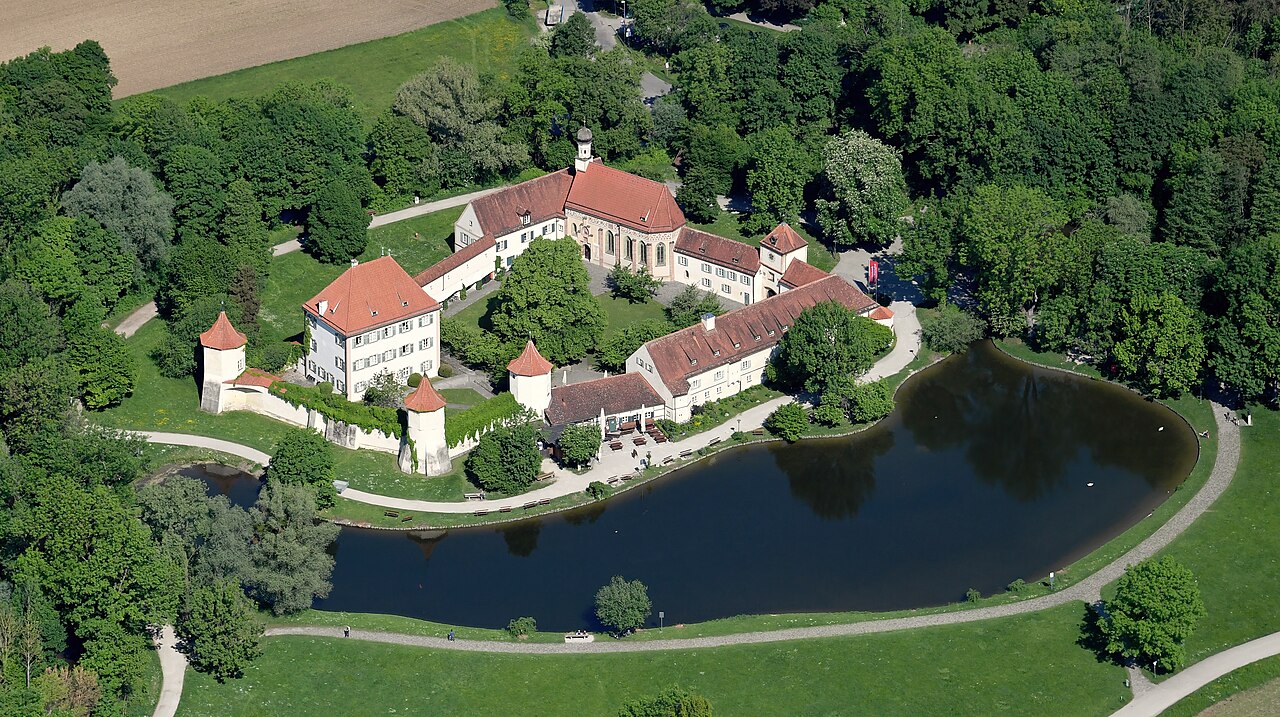
Schloss Ottenburg
Schloss Ottenburg stands as a remarkable example of a medieval hill castle that has evolved through centuries into a late-classical residence, reflecting the rich history of Bavaria. Located in the municipality of Eching, Germany, this castle’s origins trace back to at least the mid-8th century, making it a site of considerable historical and architectural significance. Its enduring presence atop a prominent hill spur underscores its original strategic importance in the region.
Early history and medieval significance
The earliest known mention of the site dates to the year 750, when it was recorded as "Outinpurg." Initially, it served as the ancestral seat of the Counts of Ottenburg-Grögling, a noble Germanic family. This early establishment highlights the castle’s role as a center of local power and governance during the early medieval period.
From at least 1070, Schloss Ottenburg was held as a bishopric fief under the Bishopric of Freising, indicating a significant ecclesiastical influence in its administration. This relationship between secular nobility and church authority was typical for the period and crucial for the castle’s development.
Between approximately 1150 and 1158, the castle underwent substantial expansion under the direction of Bishop Otto of Freising. This phase of construction reinforced its role as both a military stronghold and an administrative center. By 1212, the estate had grown into a closed manorial jurisdiction (Hofmark), encompassing nearby settlements such as Eching, a farm in Günzenhausen, and Deutenhausen. Within this jurisdiction, Schloss Ottenburg served as the residence of the Freising bailiff, the bishopric’s local representative, highlighting its importance in regional governance and judicial matters.
Architectural features and defensive structures
Originally designed as a hill castle, Schloss Ottenburg occupied a commanding position on a projecting spur, providing natural defensive advantages. A key feature of its fortifications was the neck ditch guarding the southern approach. This narrow trench, cut across the ridge, was a common medieval defensive measure intended to hinder attackers and protect the castle’s vulnerable access point.
While much of the original medieval fortification has not survived intact, archaeological evidence and remaining structural elements reveal a complex layout typical of high medieval castles. The castle’s role as a military stronghold was complemented by its administrative functions within the bishopric’s territorial organization.
Destruction, transformation, and later history
Schloss Ottenburg suffered severe damage during the Thirty Years’ War in 1632 when Swedish troops inflicted extensive destruction. This conflict marked a turning point in the castle’s history, leading to its gradual decline as a purely defensive fortress.
By the late 17th century, reflecting broader shifts in political and military realities, the castle was remodeled from a fortress into a pleasure palace for the prince-bishops. This transformation signified a change in function from military defense to residential and representational purposes, aligning with the baroque and early modern trends in castle architecture.
The secularization movement in Bavaria in 1803 resulted in the transfer of church properties to state control. Schloss Ottenburg became property of the Electorate of Bavaria and was sold in 1804 to Adam von Aretin, an official overseeing secularization. Subsequent ownership changes occurred through the early 19th century, including possession by the Hierl family and later by Joseph Zeiller, a royal court and city court clerk from Munich.
During Zeiller’s ownership, parts of the original castle were dismantled, and the remaining structures were remodeled into a late-classical villa characterized by a hipped roof. This architectural adaptation reflects the 19th-century aesthetic and functional preferences, transforming the medieval fortress into a stately residence.
The castle chapel was rebuilt in its current location in 1845, maintaining the site’s religious heritage despite the secular changes in ownership and function.
Current condition and heritage status
Today, Schloss Ottenburg remains private property, yet it is formally recognized and protected as a historic architectural monument and an archaeological site under Bavarian heritage laws. Classified as a Burgstall, the site preserves the footprint and remaining structures of the original medieval castle, even though much of the fortification has disappeared.
The castle’s layered history is visible in its preserved features: the hilltop location, the defensive neck ditch, the late-classical villa with its distinctive hipped roof, and the restored chapel. These elements together illustrate the transformation from a medieval stronghold to a noble residence, reflecting broader historical trends in castle architecture and regional governance.
The castle’s role in regional history and governance
Schloss Ottenburg was more than a military fortress; it served as the administrative heart of a Hofmark—a manorial jurisdiction that included the surrounding settlements of Eching, Günzenhausen, and Deutenhausen. The presence of the Freising bailiff within the castle underscores its function as a center of local authority, judicial power, and ecclesiastical administration.
This dual role of defense and governance was typical of many medieval castles in Bavaria, where noble families and church authorities often shared power and responsibilities. Schloss Ottenburg’s history encapsulates these intertwined aspects, providing valuable insights into the region’s feudal and ecclesiastical structures.
Architectural legacy and archaeological significance
Despite alterations and partial dismantling, Schloss Ottenburg retains significant architectural and archaeological value. The site offers a tangible connection to the high and late medieval periods, with surviving elements that reveal construction techniques, defensive strategies, and residential adaptations over time.
Its classification as both an architectural monument and an archaeological site ensures ongoing preservation and study, contributing to our understanding of medieval hill castles in Bavaria and their evolution into modern residences.
Visitors and scholars alike can appreciate the castle’s strategic location, historical layers, and architectural transformations, making Schloss Ottenburg a noteworthy example of Bavarian heritage.
Frequently asked questions (FAQ)
- How do I visit Schloss Ottenburg?
- Schloss Ottenburg is private property and not generally open to the public. Visitors can view the castle from public roads and nearby viewpoints in Eching.
- What is the historical significance of Schloss Ottenburg?
- Schloss Ottenburg served as a medieval hill castle and administrative center for the Bishopric of Freising, reflecting its dual military and ecclesiastical roles.
- When was Schloss Ottenburg built?
- The site dates back to at least 750, with significant construction phases in the mid-12th century under Bishop Otto of Freising.
- Can I tour the castle chapel?
- The castle chapel was rebuilt in 1845 and is part of the private estate, so public access is typically restricted.
- Why was the castle transformed into a pleasure palace?
- After damage in the Thirty Years’ War, the castle was remodeled in the late 17th century to serve as a pleasure palace for prince-bishops, reflecting changing uses from defense to residence.
Information
Sources & official resources
Verify the information above using these authoritative references.
Loading map...
Visitor reviews
No reviews yet. Been here? Write the first review and help other travelers!
Write the first reviewVisited this castle? Share your experience
Your review helps other travelers and adds first-hand knowledge to our encyclopedia.