Schloss Merkenstein — Austria castle

Schloss Merkenstein

Schloss Merkenstein: historic hill castle in Austria
Bad Vöslau, Austria
High Medieval (11th–13th c.)
Partially Preserved

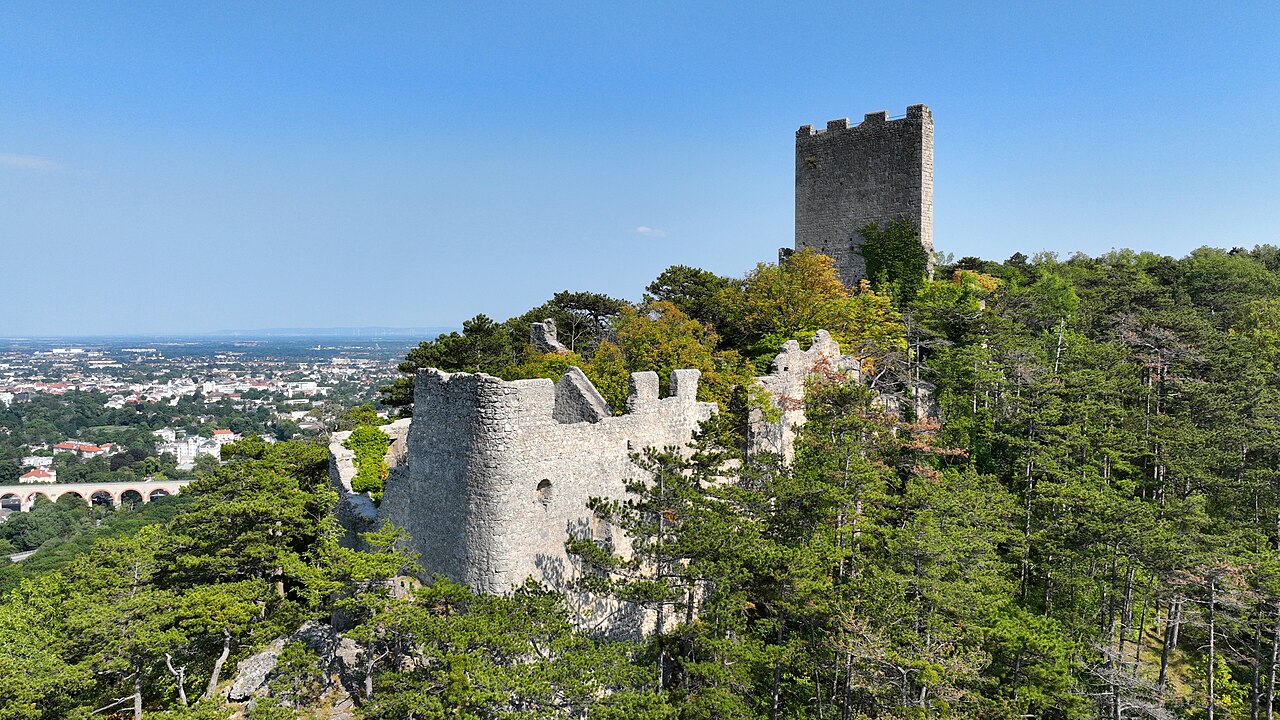
Schloss Merkenstein is a prominent hill castle located in Lower Austria, near the town of Bad Vöslau. Its strategic position atop a rocky outcrop overlooking the surrounding landscape provided a natural defense advantage, typical of medieval fortifications. The castle's origins trace back to the High Medieval period, with the earliest documented references appearing in the 12th century. Over the centuries, Schloss Merkenstein has undergone various phases of construction and modification, reflecting the evolving architectural styles and military needs of its occupants.

Historical background and significance

The castle was initially built as a defensive stronghold to protect important trade routes and local settlements in the region. Its location in Lower Austria placed it within a contested border area during the Middle Ages, making it a valuable military asset. Throughout its history, Schloss Merkenstein was owned by several noble families, including the influential Counts of Merkenstein, who contributed to its expansion and fortification.

During the Late Medieval period, the castle saw enhancements aimed at adapting to the advent of gunpowder weaponry, including thicker walls and reinforced towers. Despite these efforts, the castle eventually lost its military importance and was partially abandoned in the early modern era.

Architectural features and layout

Schloss Merkenstein exhibits characteristics typical of a hill castle with a compact, irregular layout conforming to the contours of the rocky hill. The castle complex includes a central keep (donjon), surrounded by defensive walls with battlements and several towers positioned to cover vulnerable approaches.

The main entrance is fortified with a gatehouse and a drawbridge spanning a dry moat, a common defensive feature in medieval castles. Inside, the castle contains remnants of residential quarters, a great hall, and service buildings arranged around a courtyard. The walls are constructed from locally quarried stone, with some sections displaying Romanesque masonry techniques, while later additions show Gothic influences.

The keep and defensive structures

The keep served as the last refuge during sieges and was the tallest structure within the castle. It features narrow windows and thick walls designed to withstand attacks. The surrounding curtain walls are punctuated by towers that provided flanking fire along the walls and enhanced surveillance of the surrounding terrain.

Residential and service areas

The residential quarters include the lord's living chambers and a great hall used for gatherings and administrative functions. Service buildings such as kitchens, stables, and storage rooms supported the castle's self-sufficiency during sieges. Archaeological findings suggest the presence of a chapel within the castle grounds, indicating the importance of religious practice to its inhabitants.

Later history and current condition

After its decline as a military fortress, Schloss Merkenstein was adapted for residential use and agricultural purposes. Parts of the castle fell into ruin over time, but restoration efforts in the 20th century have stabilized the remaining structures and made the site accessible to visitors.

Today, Schloss Merkenstein stands as a partially preserved monument showcasing medieval architecture and the historical development of fortifications in Lower Austria. It attracts tourists interested in history, architecture, and scenic views of the surrounding vineyards and forests.

Visiting Schloss Merkenstein

The castle is open to the public during specific times, often hosting guided tours and cultural events that highlight its historical significance. Visitors can explore the ruins, enjoy panoramic views, and learn about the castle's role in regional history through informative displays.

Frequently asked questions (FAQ)

What is the historical significance of Schloss Merkenstein?
Schloss Merkenstein is a remarkable example of medieval architecture in Austria, with roots dating back to the 13th century. It served as a noble residence and has witnessed significant events in Austrian history, making it a valuable cultural landmark.
When was Schloss Merkenstein built?
Construction of Schloss Merkenstein began in the early 1200s, with various expansions and renovations occurring over the centuries. Its architecture reflects the styles of different periods, showcasing the evolution of castle design in Austria.
How do I get to Schloss Merkenstein?
Schloss Merkenstein is easily accessible by car and public transport. Visitors can take a train to Bad Vöslau and then a short bus ride or walk to the castle, which is situated just outside the town center.
What are the opening hours for Schloss Merkenstein?
Schloss Merkenstein typically opens to visitors from 10 AM to 5 PM during the tourist season, which runs from April to October. It's advisable to check their official website for any seasonal changes or special events that may affect opening hours.
Can I take a guided tour of Schloss Merkenstein?
Yes, guided tours are available at Schloss Merkenstein, providing visitors with in-depth insights into the castle's history and architecture. These tours are often conducted in multiple languages, ensuring a broad accessibility for all visitors.
Is it possible to host events at Schloss Merkenstein?
Schloss Merkenstein offers facilities for various events, including weddings and corporate gatherings. The picturesque setting and historical ambiance make it a popular choice for special occasions.
What are the ticket prices for Schloss Merkenstein?
Ticket prices for Schloss Merkenstein are reasonably set, with discounts available for students and seniors. Children under a certain age may enter for free, making it an affordable option for families.
When is the best time to visit Schloss Merkenstein?
The best time to visit Schloss Merkenstein is during the spring and early autumn months when the weather is pleasant and the gardens are in full bloom. Visiting during these times also allows you to enjoy special events and festivals that may be held at the castle.
Are there any nearby attractions worth visiting?
Yes, while visiting Schloss Merkenstein, you can explore the charming town of Bad Vöslau, known for its thermal baths and beautiful parks. Additionally, nearby vineyards offer wine tasting experiences that showcase the region's renowned wines.

Photo gallery

Schloss Merkenstein
Click to view

Photo by C.Stadler/Bwag•CC BY-SA 4.0

1 photo • Click any image to view in full screen

Information

Hill Castle

Loading map...

Visitor reviews

No reviews yet. Been here? Write the first review and help other travelers!

Write the first review

Visited this castle? Share your experience

Your review helps other travelers and adds first-hand knowledge to our encyclopedia.

Write a review

(5/5)

0/2000 characters

Your review will be visible after admin approval

Nearby castles

0.3 km

Merkenstein Ruins

Bad Vöslau, Austria

The Merkenstein ruins stand as a striking testament to medieval fortification in Austria, perched atop a hill near the municipality of Bad Vöslau. This hilltop fortress, or Höhenburg, offers a compelling glimpse into the strategic military architecture and noble lineage of the region from the 12th century through the early modern era. Its enduring rubble stone walls, some up to six meters thick, reveal the castle's robust defensive design that relied heavily on its commanding elevated position rather than multiple layers of fortifications. First documented in the Codex Falkensteinensis around 1170, Merkenstein was originally constructed and held by the noble family bearing its name, who maintained possession until the early 14th century. The castle's history is marked by a succession of prominent owners, including the Wallsee family and later the Hohenberg family, each contributing to its evolving role in regional power dynamics. The fortress notably withstood a four-week imperial siege in 1482 during the conflict involving Hans III von Hohenberg and King Matthias Corvinus of Hungary, underscoring its military significance in late medieval Central Europe. Historical ownership and conflicts Merkenstein's ownership timeline reflects the shifting allegiances and fortunes of Austrian nobility. After the Merkenstein family, the castle passed to the Wallsee family, who held it for about a century until financial difficulties led to its sale to Stephan von Hohenberg in 1440. The Hohenberg tenure was marked by political intrigue, including Hans III von Hohenberg's alliance with Matthias Corvinus against Emperor Friedrich III, which precipitated a notable siege in 1482. Despite the siege's failure, the castle changed hands multiple times, returning to imperial control and later passing to the Heißperger and Dietrichstein families. The castle's decline began with the Ottoman wars, culminating in the devastating siege and destruction by Turkish forces in August 1683. The assault resulted in significant loss of life and the burning of the fortress, which effectively ended its military use and left it in ruins. Subsequently, the castle's lordship included several surrounding settlements, emphasizing its role as a regional administrative center during its operational period. Architectural features and ruins The surviving ruins of Merkenstein primarily consist of thick outer walls constructed from rubble stone, characteristic of medieval defensive architecture. These walls, some reaching six meters in thickness, compensated for the absence of additional ring walls, creating a formidable barrier against attackers. The castle's layout, preserved in the footprint of the remaining walls, delineates the historic courtyard and defensive perimeter, showcasing the typical features of a hill castle designed to exploit natural topography for defense. The fortress's elevated location provided strategic advantages, offering extensive views over the surrounding landscape and early warning of approaching threats. This positioning was a common feature of Höhenburg castles, which prioritized natural elevation combined with strong masonry to create defensible strongholds. Merkenstein cave: natural and archaeological significance Adjacent to the castle ruins lies the Merkenstein Cave, a natural cavity extending 72 meters with a vertical range of 15 meters, formed in Baden dolomite breccia. This cave has played a multifaceted role throughout history, serving as a refuse disposal site for the castle's occupants from the early Middle Ages until the late 17th century. A vertical shaft connected the castle kitchen directly to the cave, facilitating waste disposal. Importantly, the cave also functioned as a refuge during the Turkish sieges of 1529 and 1683, evidenced by a protective wall dated to 1529 within its interior. Archaeological excavations have revealed a rich stratigraphy of artifacts spanning from the Copper Age Badener culture through the Hallstatt period, Roman times, and even traces from the last Ice Age. These findings underscore the cave's long-standing significance as both a natural shelter and a cultural site. In the early 20th century, the cave's phosphate-rich earth was extracted for use as fertilizer, illustrating a more recent chapter in its varied history. Recognized as a natural monument since 1942, the cave is protected and accessible only via guided tours, preserving its ecological and archaeological integrity. Later history and preservation efforts Following its destruction in 1683, Merkenstein ceased to function as a fortress but remained an important landmark. Ownership passed through various hands, including the German Krupp family until the end of World War II. Post-war administration by the Soviet-controlled USIA and later the Austrian Republic led to its management by the Federal Forests. Since 1978, the ruins have been privately owned, with careful restoration efforts aimed at preserving the site's historical and cultural value. The castle's connection to the arts is highlighted by two musical compositions dedicated to the ruins by Ludwig van Beethoven, reflecting its enduring place in Austria's cultural heritage. Cultural and regional importance Merkenstein's legacy extends beyond its military and architectural significance. The castle and its associated lordship historically encompassed several settlements, including Gainfarn, Großau, and Pottenstein, integrating administrative and economic roles within the region. Its dramatic history of sieges and ownership changes encapsulates broader themes of medieval and early modern European power struggles. Today, the ruins and cave together offer a unique window into centuries of human activity, from prehistoric times through medieval fortification to modern conservation. Visitors to Merkenstein can explore a site rich in history, archaeology, and natural beauty, making it a valuable destination for those interested in Austria's medieval heritage and beyond.

High Medieval (11th–13th c.)
Details
5.8 km

Burg Scharfeneck

Baden, Austria

Burg Scharfeneck stands as a testament to medieval military architecture and the turbulent history of the borderlands between Austria and Hungary. Located in the municipality of Baden, Austria, this hill castle originated as a wooden fortification around the 11th century and evolved over centuries into a robust stone fortress. Its strategic position near the Schwechat River and along historic trade routes through the Helenental valley made it a significant defensive stronghold in the region. Early origins and medieval development Archaeological evidence indicates that the site of Burg Scharfeneck was inhabited by around the year 1100, initially featuring wooden defensive structures typical of early medieval fortifications. The transition from wood to stone construction, likely occurring after 1386, marked a pivotal enhancement in the castle’s durability and defensive capabilities. This period coincides with documented ownership by local nobles such as Johann von Scharpeneck and later Hermann and Friedrich von Scharfeneck, reflecting the castle's prominence within the feudal landscape. Ownership and political significance Throughout its history, Burg Scharfeneck changed hands multiple times, often reflecting the shifting political and military dynamics of the region. In 1442, it was owned by Georg von Pottendorf, and by 1469 it had been granted by King Matthias Corvinus of Hungary to Ulrich von Grafeneck. Ulrich's later alliance with Emperor Frederick III of the Habsburg dynasty integrated the castle into Austria’s border defense network, highlighting its strategic importance during the late medieval period. Architectural features and defensive elements The castle’s layout and structures showcase typical medieval border fortress characteristics, with a focus on robust defense. The most well-preserved section is the bastioned round tower in the northeast, notable for its lower walls adorned with numerous notches likely used for mounting defensive fittings. Though originally taller, only the base of this tower remains today due to the collapse of upper floors over time. Notable towers and walls At the southwest corner, a strong elliptical tower with walls measuring three to four meters thick supported a defensive platform equipped with battlements and narrow arrow slits. These openings allowed defenders to fire upon attackers while remaining protected. Similar notches and vaulted firing chambers are found along the castle’s continuous stone walls, illustrating a well-planned defensive architecture designed to withstand sieges. Gothic elements and interior structures Some window frames dating from the 15th century remain intact, displaying the late Gothic style that was prevalent in castle architecture of the period. The inner courtyard is largely filled with debris, but beneath it lies a preserved cistern, an essential water storage feature for enduring prolonged sieges. Inside the ground floor, a large hall features a significant hole in its upper barrel vault, a curved ceiling form typical of medieval construction. Spiral staircases and structural remnants Fragments of a stone spiral staircase survive within one of the towers, providing insight into the vertical circulation within the fortress. Other original components of the complex have been lost, but the surviving elements, including a wide breach in one of the side walls, indicate episodes of deliberate demolition rather than mere decay. Decline and preservation By the 16th century, Burg Scharfeneck began to lose military significance. It was frequently used as collateral in financial dealings and suffered structural damage, notably from a lightning strike in 1555 that severely impacted the keep. Although expansions were undertaken by Max von Polheim afterward, the castle could not regain its former prominence. Eventually abandoned as a residence and defensive site, the castle fell into ruin. Its proximity to the more dominant Rauhenstein fortress and economic challenges contributed to its decline. Today, the ruins are protected as a cultural heritage site under the care of Austrian federal forestry authorities, offering valuable insights into medieval border defense systems and architectural evolution. Historical context and regional importance Burg Scharfeneck occupied a sensitive borderland area, marking the frontier between Austria and Hungary. The castle’s history reflects broader regional conflicts and alliances, including the influence of Hungarian royal authority and Habsburg consolidation. Its changing ownership and architectural adaptations illustrate the shifting priorities in military strategy and feudal governance from the 11th to the 16th centuries. The castle’s name first appeared around 1470, associated with Ulrich Kamper, who raised its profile despite its then-uninhabited state. Ownership reverted to the nearby Rauhenstein estate by 1517, underscoring the interconnected nature of regional noble holdings and the castle’s secondary role compared to larger fortresses. Visitor experience and cultural heritage Today, visitors to Burg Scharfeneck can explore the atmospheric ruins that reveal the castle’s medieval defensive layout and architectural details. The surviving bastioned towers, arrow slits, and Gothic window frames provide tangible connections to the past. The site’s location near Baden and the Schwechat River offers scenic views and a sense of the strategic landscape that shaped its history. As a protected cultural heritage site, the ruins are an important educational resource for understanding medieval fortifications and the complex history of border castles in Austria. Preservation efforts ensure that Burg Scharfeneck remains accessible for future generations to study and appreciate. Key architectural features: bastioned round tower, elliptical tower with battlements, arrow slits, barrel vault hall, stone spiral staircase, cistern. Historical significance: strategic border fortress, ownership by Hungarian and Austrian nobility, connection to King Matthias Corvinus and Emperor Frederick III. Current condition: well-preserved ruins with notable structural remnants and protected cultural status.

High Medieval (11th–13th c.)
Details
6 km
Rauheneck Castle — Austria castle

Rauheneck Castle

Baden, Austria

Rauheneck Castle, located in Baden, Lower Austria, is a notable example of a high medieval fortress built in the 12th century. Perched on cliffs of a foothill above the banks of the Schwechat River, the castle occupies a strategic position at 348 meters above sea level, commanding views over the Helenental valley and the nearby Burg Rauhenstein. Architectural features and layout The castle was originally constructed as a hill castle, designed to utilize the natural defensive advantages of its rocky terrain. Though now in ruins, the site preserves significant remnants, including the remains of its main tower, which rises approximately 25 meters high. Visitors can climb this tower via steep stairs, offering expansive views of the surrounding landscape. The castle complex also includes remnants of a chapel and various weather-beaten rooms that hint at its former residential and defensive functions. Historical significance and events Rauheneck Castle experienced a turbulent history marked by multiple destructions and reconstructions. In 1477, the fortress was conquered by Matthias Corvinus, the King of Hungary, during his campaigns in the region. The castle's final destruction occurred in 1529 at the hands of the Ottoman forces during their incursions into Austria. This event marked the end of Rauheneck as a functional stronghold. Modern preservation and visitor experience In 1961, the city of Baden acquired the castle hill and its ruins, undertaking efforts to preserve the site as a cultural and historical monument. Today, the ruins are accessible to the public via well-maintained forest hiking trails, including the popular cultural hiking trail through Helenental. Visitors can explore the ruins at leisure, enjoying the peaceful atmosphere and the panoramic views from the tower. The site offers a tangible connection to medieval history and architecture. Legends and cultural heritage The castle is also associated with local folklore. According to legend, the builder of the main tower haunts Rauheneck as a restless spirit, adding an element of mystique to the ruins. This haunting tale enriches the cultural narrative surrounding the castle and attracts visitors interested in both history and folklore. Access and hiking routes The ruins of Rauheneck Castle are easily accessible by foot, with hiking paths leading uphill through forested areas. The approach from Baden is particularly favored by cultural tourists, who combine the hike with visits to other historical sites in the Helenental valley. The trails are well-marked and suitable for visitors of varying fitness levels.

High Medieval (11th–13th c.)
Details