Burg Scharfeneck
Burg Scharfeneck stands as a testament to medieval military architecture and the turbulent history of the borderlands between Austria and Hungary. Located in the municipality of Baden, Austria, this hill castle originated as a wooden fortification around the 11th century and evolved over centuries into a robust stone fortress. Its strategic position near the Schwechat River and along historic trade routes through the Helenental valley made it a significant defensive stronghold in the region.
Early origins and medieval development
Archaeological evidence indicates that the site of Burg Scharfeneck was inhabited by around the year 1100, initially featuring wooden defensive structures typical of early medieval fortifications. The transition from wood to stone construction, likely occurring after 1386, marked a pivotal enhancement in the castle’s durability and defensive capabilities. This period coincides with documented ownership by local nobles such as Johann von Scharpeneck and later Hermann and Friedrich von Scharfeneck, reflecting the castle's prominence within the feudal landscape.
Ownership and political significance
Throughout its history, Burg Scharfeneck changed hands multiple times, often reflecting the shifting political and military dynamics of the region. In 1442, it was owned by Georg von Pottendorf, and by 1469 it had been granted by King Matthias Corvinus of Hungary to Ulrich von Grafeneck. Ulrich's later alliance with Emperor Frederick III of the Habsburg dynasty integrated the castle into Austria’s border defense network, highlighting its strategic importance during the late medieval period.
Architectural features and defensive elements
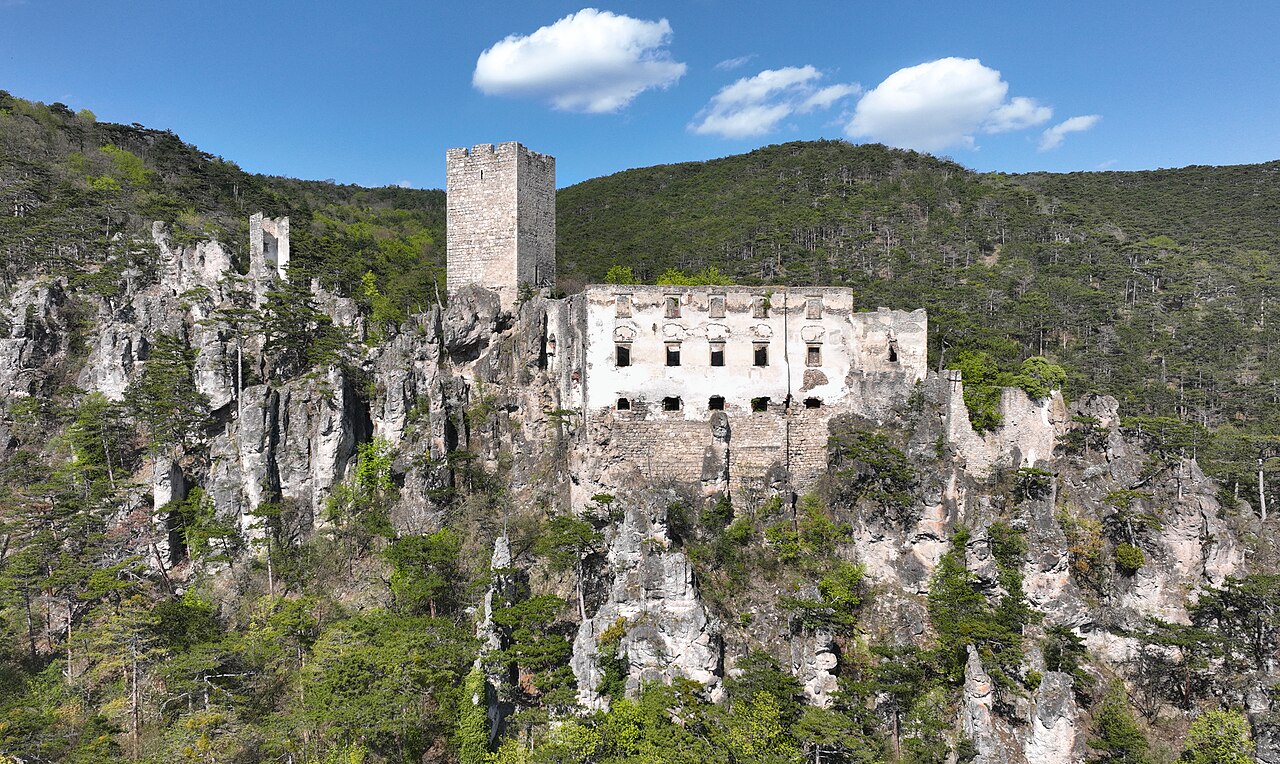
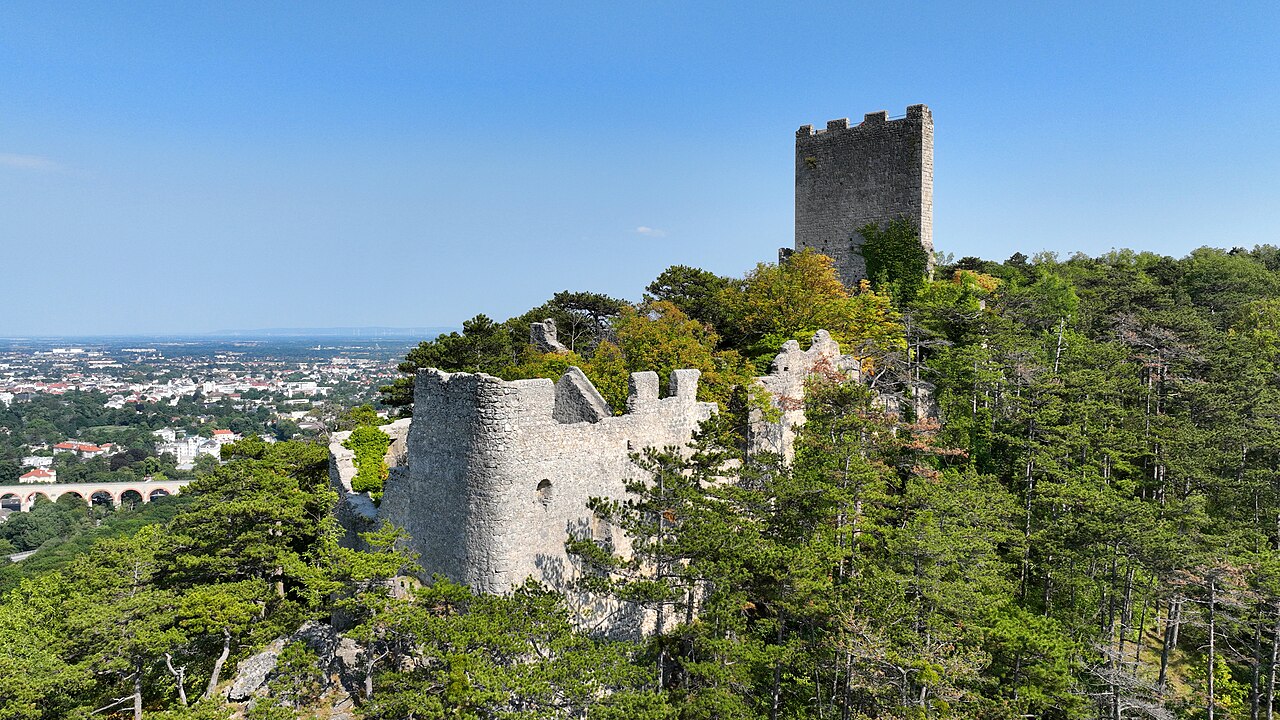
The castle’s layout and structures showcase typical medieval border fortress characteristics, with a focus on robust defense. The most well-preserved section is the bastioned round tower in the northeast, notable for its lower walls adorned with numerous notches likely used for mounting defensive fittings. Though originally taller, only the base of this tower remains today due to the collapse of upper floors over time.
Notable towers and walls
At the southwest corner, a strong elliptical tower with walls measuring three to four meters thick supported a defensive platform equipped with battlements and narrow arrow slits. These openings allowed defenders to fire upon attackers while remaining protected. Similar notches and vaulted firing chambers are found along the castle’s continuous stone walls, illustrating a well-planned defensive architecture designed to withstand sieges.
Gothic elements and interior structures
Some window frames dating from the 15th century remain intact, displaying the late Gothic style that was prevalent in castle architecture of the period. The inner courtyard is largely filled with debris, but beneath it lies a preserved cistern, an essential water storage feature for enduring prolonged sieges. Inside the ground floor, a large hall features a significant hole in its upper barrel vault, a curved ceiling form typical of medieval construction.
Spiral staircases and structural remnants
Fragments of a stone spiral staircase survive within one of the towers, providing insight into the vertical circulation within the fortress. Other original components of the complex have been lost, but the surviving elements, including a wide breach in one of the side walls, indicate episodes of deliberate demolition rather than mere decay.
Decline and preservation
By the 16th century, Burg Scharfeneck began to lose military significance. It was frequently used as collateral in financial dealings and suffered structural damage, notably from a lightning strike in 1555 that severely impacted the keep. Although expansions were undertaken by Max von Polheim afterward, the castle could not regain its former prominence.
Eventually abandoned as a residence and defensive site, the castle fell into ruin. Its proximity to the more dominant Rauhenstein fortress and economic challenges contributed to its decline. Today, the ruins are protected as a cultural heritage site under the care of Austrian federal forestry authorities, offering valuable insights into medieval border defense systems and architectural evolution.
Historical context and regional importance
Burg Scharfeneck occupied a sensitive borderland area, marking the frontier between Austria and Hungary. The castle’s history reflects broader regional conflicts and alliances, including the influence of Hungarian royal authority and Habsburg consolidation. Its changing ownership and architectural adaptations illustrate the shifting priorities in military strategy and feudal governance from the 11th to the 16th centuries.
The castle’s name first appeared around 1470, associated with Ulrich Kamper, who raised its profile despite its then-uninhabited state. Ownership reverted to the nearby Rauhenstein estate by 1517, underscoring the interconnected nature of regional noble holdings and the castle’s secondary role compared to larger fortresses.
Visitor experience and cultural heritage
Today, visitors to Burg Scharfeneck can explore the atmospheric ruins that reveal the castle’s medieval defensive layout and architectural details. The surviving bastioned towers, arrow slits, and Gothic window frames provide tangible connections to the past. The site’s location near Baden and the Schwechat River offers scenic views and a sense of the strategic landscape that shaped its history.
As a protected cultural heritage site, the ruins are an important educational resource for understanding medieval fortifications and the complex history of border castles in Austria. Preservation efforts ensure that Burg Scharfeneck remains accessible for future generations to study and appreciate.
- Key architectural features: bastioned round tower, elliptical tower with battlements, arrow slits, barrel vault hall, stone spiral staircase, cistern.
- Historical significance: strategic border fortress, ownership by Hungarian and Austrian nobility, connection to King Matthias Corvinus and Emperor Frederick III.
- Current condition: well-preserved ruins with notable structural remnants and protected cultural status.
Frequently asked questions (FAQ)
- When was Burg Scharfeneck originally built?
- Burg Scharfeneck was originally established around the 11th century, beginning as a wooden fortification before evolving into a stone castle.
- What architectural features can be seen at Burg Scharfeneck?
- Visitors can observe the bastioned round tower, elliptical tower with battlements, arrow slits, late Gothic window frames, a barrel vault hall, a stone spiral staircase, and a cistern.
- Who were some notable owners of Burg Scharfeneck?
- Notable owners include Johann von Scharpeneck, Hermann and Friedrich von Scharfeneck, Georg von Pottendorf, Ulrich von Grafeneck, and it was connected to King Matthias Corvinus and Emperor Frederick III.
- Why did Burg Scharfeneck decline in importance?
- The castle declined due to its reduced military significance in the 16th century, damage from a lightning strike in 1555, and economic challenges compared to nearby Rauhenstein fortress.
- Is Burg Scharfeneck accessible to visitors today?
- Yes, the ruins are accessible and protected as a cultural heritage site managed by Austrian federal forestry authorities, offering educational insights into medieval fortifications.
Information
Current owner
Austrian federal forestry authorities
Loading map...
Visitor reviews
No reviews yet. Been here? Write the first review and help other travelers!
Write the first reviewVisited this castle? Share your experience
Your review helps other travelers and adds first-hand knowledge to our encyclopedia.