Merkenstein Ruins
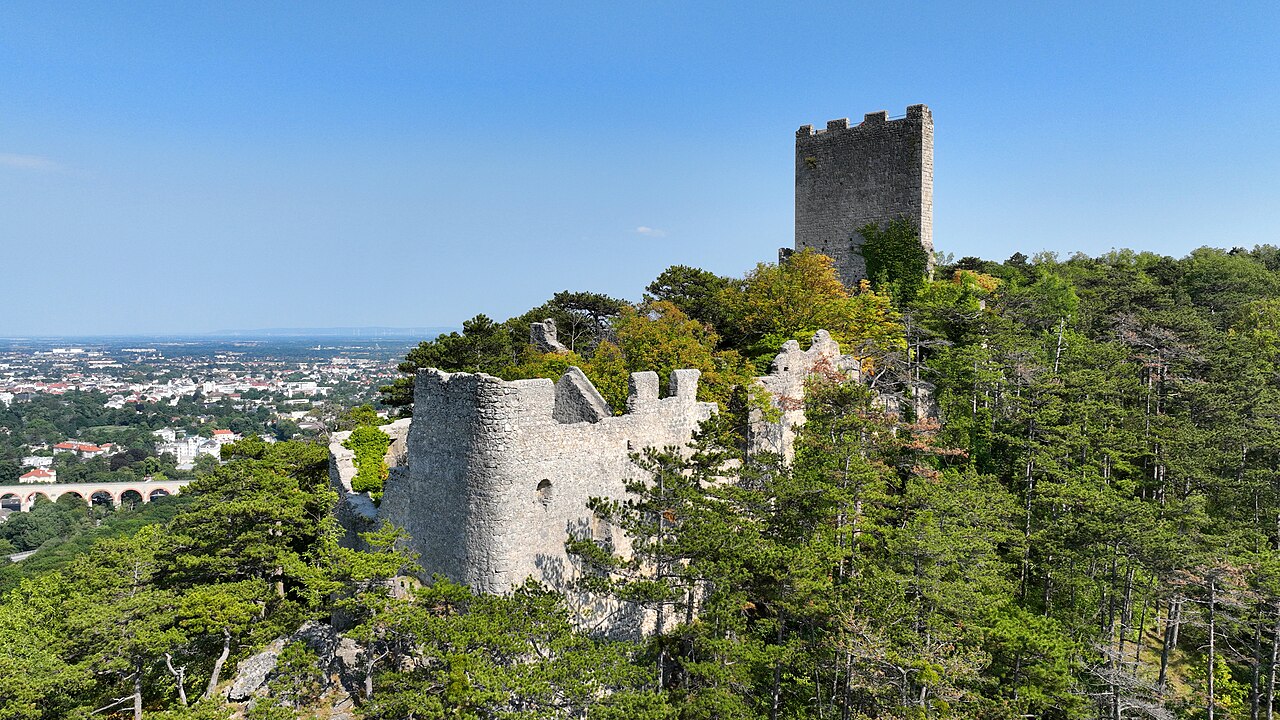
The Merkenstein ruins stand as a striking testament to medieval fortification in Austria, perched atop a hill near the municipality of Bad Vöslau. This hilltop fortress, or Höhenburg, offers a compelling glimpse into the strategic military architecture and noble lineage of the region from the 12th century through the early modern era. Its enduring rubble stone walls, some up to six meters thick, reveal the castle's robust defensive design that relied heavily on its commanding elevated position rather than multiple layers of fortifications.
First documented in the Codex Falkensteinensis around 1170, Merkenstein was originally constructed and held by the noble family bearing its name, who maintained possession until the early 14th century. The castle's history is marked by a succession of prominent owners, including the Wallsee family and later the Hohenberg family, each contributing to its evolving role in regional power dynamics. The fortress notably withstood a four-week imperial siege in 1482 during the conflict involving Hans III von Hohenberg and King Matthias Corvinus of Hungary, underscoring its military significance in late medieval Central Europe.
Historical ownership and conflicts
Merkenstein's ownership timeline reflects the shifting allegiances and fortunes of Austrian nobility. After the Merkenstein family, the castle passed to the Wallsee family, who held it for about a century until financial difficulties led to its sale to Stephan von Hohenberg in 1440. The Hohenberg tenure was marked by political intrigue, including Hans III von Hohenberg's alliance with Matthias Corvinus against Emperor Friedrich III, which precipitated a notable siege in 1482. Despite the siege's failure, the castle changed hands multiple times, returning to imperial control and later passing to the Heißperger and Dietrichstein families.
The castle's decline began with the Ottoman wars, culminating in the devastating siege and destruction by Turkish forces in August 1683. The assault resulted in significant loss of life and the burning of the fortress, which effectively ended its military use and left it in ruins. Subsequently, the castle's lordship included several surrounding settlements, emphasizing its role as a regional administrative center during its operational period.
Architectural features and ruins
The surviving ruins of Merkenstein primarily consist of thick outer walls constructed from rubble stone, characteristic of medieval defensive architecture. These walls, some reaching six meters in thickness, compensated for the absence of additional ring walls, creating a formidable barrier against attackers. The castle's layout, preserved in the footprint of the remaining walls, delineates the historic courtyard and defensive perimeter, showcasing the typical features of a hill castle designed to exploit natural topography for defense.
The fortress's elevated location provided strategic advantages, offering extensive views over the surrounding landscape and early warning of approaching threats. This positioning was a common feature of Höhenburg castles, which prioritized natural elevation combined with strong masonry to create defensible strongholds.
Merkenstein cave: natural and archaeological significance
Adjacent to the castle ruins lies the Merkenstein Cave, a natural cavity extending 72 meters with a vertical range of 15 meters, formed in Baden dolomite breccia. This cave has played a multifaceted role throughout history, serving as a refuse disposal site for the castle's occupants from the early Middle Ages until the late 17th century. A vertical shaft connected the castle kitchen directly to the cave, facilitating waste disposal.
Importantly, the cave also functioned as a refuge during the Turkish sieges of 1529 and 1683, evidenced by a protective wall dated to 1529 within its interior. Archaeological excavations have revealed a rich stratigraphy of artifacts spanning from the Copper Age Badener culture through the Hallstatt period, Roman times, and even traces from the last Ice Age. These findings underscore the cave's long-standing significance as both a natural shelter and a cultural site.
In the early 20th century, the cave's phosphate-rich earth was extracted for use as fertilizer, illustrating a more recent chapter in its varied history. Recognized as a natural monument since 1942, the cave is protected and accessible only via guided tours, preserving its ecological and archaeological integrity.
Later history and preservation efforts
Following its destruction in 1683, Merkenstein ceased to function as a fortress but remained an important landmark. Ownership passed through various hands, including the German Krupp family until the end of World War II. Post-war administration by the Soviet-controlled USIA and later the Austrian Republic led to its management by the Federal Forests.
Since 1978, the ruins have been privately owned, with careful restoration efforts aimed at preserving the site's historical and cultural value. The castle's connection to the arts is highlighted by two musical compositions dedicated to the ruins by Ludwig van Beethoven, reflecting its enduring place in Austria's cultural heritage.
Cultural and regional importance
Merkenstein's legacy extends beyond its military and architectural significance. The castle and its associated lordship historically encompassed several settlements, including Gainfarn, Großau, and Pottenstein, integrating administrative and economic roles within the region. Its dramatic history of sieges and ownership changes encapsulates broader themes of medieval and early modern European power struggles.
Today, the ruins and cave together offer a unique window into centuries of human activity, from prehistoric times through medieval fortification to modern conservation. Visitors to Merkenstein can explore a site rich in history, archaeology, and natural beauty, making it a valuable destination for those interested in Austria's medieval heritage and beyond.
Frequently asked questions (FAQ)
- How do I visit the Merkenstein ruins and cave?
- The Merkenstein ruins and cave are accessible to visitors, with the cave available only through guided tours to protect its natural and archaeological features. It is recommended to check local tourism information for current visiting hours and tour availability.
- What historical events is Merkenstein castle known for?
- Merkenstein is known for its role in medieval conflicts, including a notable four-week siege in 1482 during the conflict between Hans III von Hohenberg and Emperor Friedrich III, as well as its destruction during the Ottoman wars in 1683.
- What architectural features remain at Merkenstein?
- The ruins primarily consist of thick rubble stone outer walls up to six meters thick, reflecting medieval defensive construction. The castle's hilltop location contributed significantly to its defense strategy.
- Is Merkenstein cave significant archaeologically?
- Yes, the Merkenstein Cave contains archaeological finds from the Copper Age, Hallstatt period, Roman era, and the last Ice Age, demonstrating its long history of human use and natural importance.
- Can I explore the entire castle ruins freely?
- While the castle ruins are accessible, some areas may be restricted for safety and preservation reasons. Visitors should follow guidelines and signage to protect the site.
- Why is Merkenstein castle historically important?
- Merkenstein illustrates the evolution of medieval fortifications and noble ownership in Austria, with a history marked by sieges, political alliances, and its role as a regional administrative center.
Information
Sources & official resources
Verify the information above using these authoritative references.
Loading map...
Visitor reviews
No reviews yet. Been here? Write the first review and help other travelers!
Write the first reviewVisited this castle? Share your experience
Your review helps other travelers and adds first-hand knowledge to our encyclopedia.