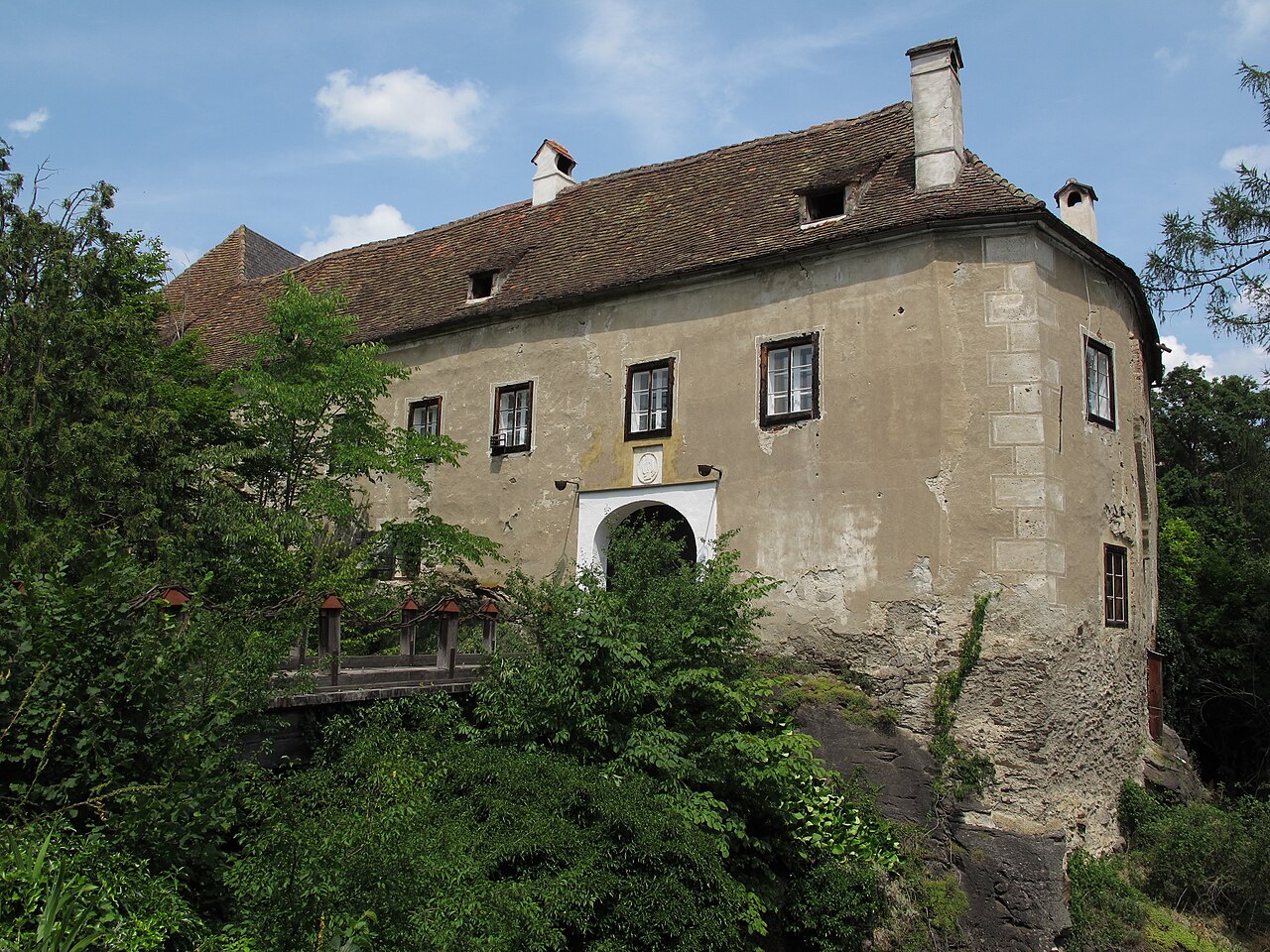
Schloss Kainberg
Schloss Kainberg stands as a remarkable example of a Renaissance hill castle nestled in the municipality of Kumberg, Austria. Its origins date back to the early 13th century, when it was initially established as a fortified manor by medieval European builders. Over the centuries, Schloss Kainberg has witnessed significant architectural transformations, noble ownership, and adaptations reflecting the region's complex social and political history.
Medieval origins and early history
The earliest documented reference to the estate is from 1218, naming Otto von Chunperch as its resident. At this time, the property was held as freehold land by a ministerial family closely connected to the influential Seckau Abbey. This ecclesiastical institution played a vital administrative and religious role in the region, which shaped the castle's early function and status.
The Kainberg family, who lent their name to the castle, maintained ownership for over three centuries. This long period of stability allowed the manor to develop both as a noble residence and a local power center. The castle's strategic position on a hill provided defensive advantages typical of hill castles constructed during the High Medieval period.
Renaissance transformation and architectural evolution
Between 1570 and 1575, the manor underwent a significant transformation under Otto VI von Ratmannsdorf, who redesigned it into a Renaissance-style castle. This renovation introduced characteristic elements such as the quadrangular layout enclosing a rectangular courtyard, which became central to the castle's design.
The castle is a three-story quadrangular building with arcades on three sides of the courtyard. Originally open, these arcades were largely glazed in the 19th century, blending functionality with aesthetic appeal. Each corner of the castle is fortified with a square tower topped by pyramid-shaped roofs, emphasizing both defense and symmetry.
A distinctive feature of Schloss Kainberg is the clock and bell tower located midway along the western wing. This tower, crowned with a lantern-like roof, houses a small chapel dedicated to the Three Holy Kings, integrating religious significance within the castle's fabric.
The southern wing features a round-arched entrance gate, serving as the main access point. Although the original defensive wall and moat have not survived, historical records indicate their presence, along with a now-lost rectangular tower at the southwestern corner. An original bastion in the southeast has been repurposed as a garden space, reflecting the castle's evolution from military stronghold to a noble residence.
Interior features and stylistic details
The northern wing, the oldest part of the complex dating from the 15th century, retains many original interior details, especially on the upper floors. This wing offers visitors a glimpse into the castle's medieval past through preserved architectural elements.
The interiors showcase a rich layering of styles from different periods. Notable features include neo-Baroque stucco ceilings that add decorative richness, a Renaissance-style coffered ceiling with painted wood grain imitation, and an 18th-century tiled stove illustrating historic heating methods.
The castle's large hall is adorned with stucco decorations featuring leaf and strapwork motifs from the early 18th century, reflecting the ornamental tastes of that era. An Empire-style stove, installed around 1800, further demonstrates the blend of functional and artistic elements within the castle.
Ownership changes and historical context
After the Kainberg family, the estate passed through various owners, beginning with Gilg von Saurau in 1547. Subsequent proprietors included notable figures such as Siegmund Friedrich Freiherr von Gleispach, the Seckau Abbey itself, and Georg Siegmund Graf Dietrichstein. These changes reflect the castle's integration into the shifting political and religious networks of the region.
Since 1841, the castle has been owned by the Wimpffen family, who continue to reside there. Their long tenure marks a period of continuity and preservation after centuries of more frequent transitions.
Castle's role and significance today
Today, Schloss Kainberg remains a well-preserved example of a hill castle that embodies centuries of architectural evolution and noble heritage. Its combination of medieval origins, Renaissance redesign, and later stylistic additions makes it a valuable cultural landmark in Austria.
The castle's unique features, such as the chapel within the clock tower and the blend of defensive and residential elements, offer insight into the multifunctional nature of noble estates in the region. Visitors can appreciate the castle's historic ambiance, architectural details, and the continuity of ownership that has helped maintain its character.
Frequently asked questions (FAQ)
- How do I visit Schloss Kainberg?
- Schloss Kainberg is privately owned by the Wimpffen family and is not regularly open to the public. Visitors should check for special events or private tours that may allow access.
- What architectural styles are visible at Schloss Kainberg?
- The castle features a blend of medieval origins with significant Renaissance remodeling, including arcades, square towers, and decorative stucco ceilings.
- When was Schloss Kainberg originally built?
- The castle's origins trace back to the early 13th century, with the earliest documented resident recorded in 1218.
- Can I see the chapel at Schloss Kainberg?
- The chapel dedicated to the Three Holy Kings is located within the clock and bell tower and may be visible during special visits or events, subject to owner permission.
- Why is Schloss Kainberg historically significant?
- Schloss Kainberg illustrates the evolution of a medieval fortified manor into a Renaissance noble residence, reflecting regional religious and political history over several centuries.
Information
Current owner
Wimpffen family
Loading map...
Visitor reviews
No reviews yet. Been here? Write the first review and help other travelers!
Write the first reviewVisited this castle? Share your experience
Your review helps other travelers and adds first-hand knowledge to our encyclopedia.