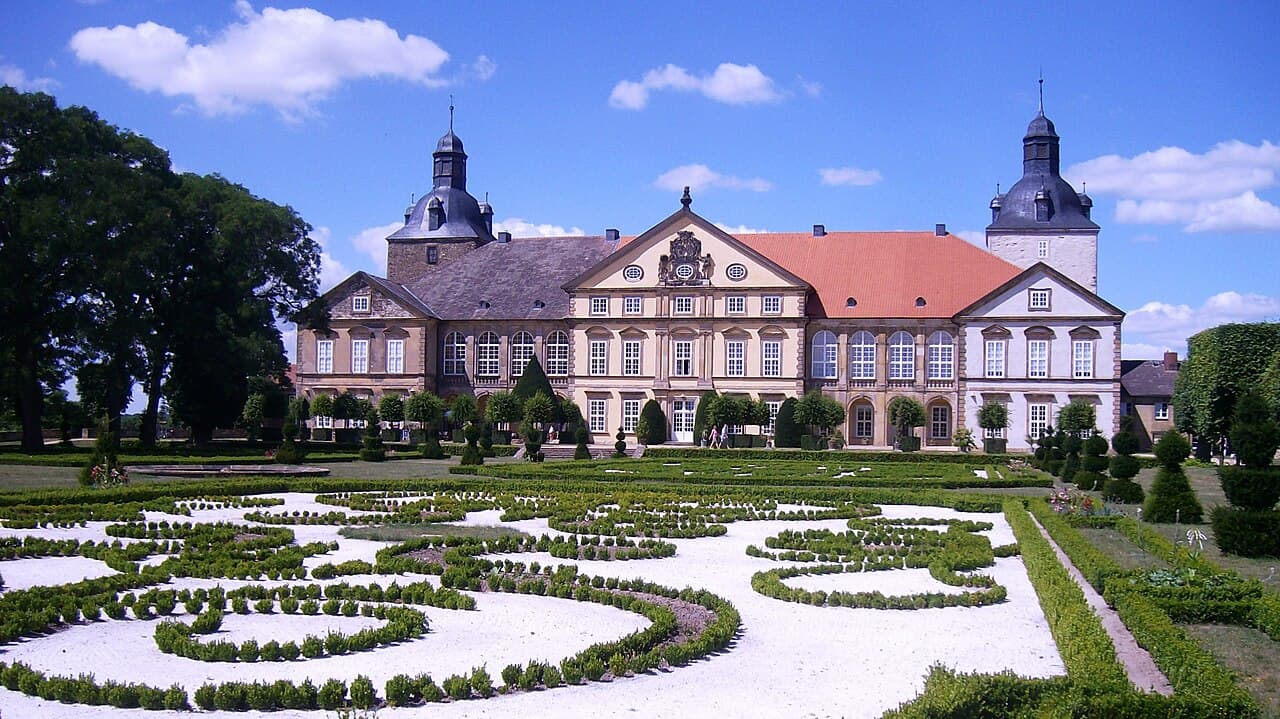
Schloss Hundisburg stands as a remarkable example of a historic hill castle in Germany, located in the municipality of Haldensleben. Its origins trace back to the early 12th century, with the fortress initially known as Hunoldäsburg. The site’s strategic position atop a prominent hill formed by the valleys of the Beber and Garbe streams made it a vital defensive and territorial stronghold throughout its history. Archaeological evidence indicates human presence since the Neolithic period, underscoring the location’s long-standing significance.
The castle’s early fortifications were constructed on a nearly circular plan, designed to control the important military route linking Lüneburg and Beverfurt. By 1196, Hundisburg was an allodial possession of the Margraviate of Brandenburg in the Altmark region, later coming under the control of the Archbishopric of Magdeburg through Archbishop Ludolph. Under his leadership, the fortress was expanded to enhance its defensive capabilities and administrative functions.
The medieval fortress and early ownership
Throughout the medieval period, Schloss Hundisburg endured multiple sieges, reflecting its strategic importance. In 1213, it was besieged by Emperor Otto IV, followed by successful captures in 1278 by Duke Albert I of Brunswick and in 1319 by Prince Henry II of Mecklenburg. Initially, the castle’s governance was managed by episcopal officers, but it was later entrusted to noble families such as the von Dreyleben, von Hordorf, von Alvensleben, and von Wanzleben.
By 1361, the castle became a hereditary fief for Alverich and Ludwig von Wanzleben, before passing to the von Alvensleben family in 1452. The 16th century saw significant Renaissance-style expansions under Ludolf X von Alvensleben. He constructed the so-called "Old Castle" in 1544, transformed the bergfried into a residential tower by 1568, initiated the building of the "New Work" from 1571, and added a new chapel in 1602.
Destruction and baroque reconstruction
The Thirty Years’ War (1618–1648) inflicted severe damage on Schloss Hundisburg, especially in 1630 when it served as the command center for Pappenheim during the siege of nearby Haldensleben. Restoration was completed in 1654, highlighted by the addition of the distinctive "Welsche Haube", a Baroque dome-shaped roof on the bergfried.
In 1691, Johann Friedrich II von Alvensleben inherited the estate and commissioned a comprehensive Baroque reconstruction of the castle and its gardens starting in 1693. The redesign was inspired by the ducal summer residence Schloss Salzdahlum and executed under architect Hermann Korb with plans by Johann Balthasar Lauterbach. This phase introduced a new main residential building (corps de logis) topped with a hipped roof, integrating the medieval bergfried alongside a newly constructed northern tower. The garden-facing façade featured double-story Venetian-style loggias set between three projecting risalits, emphasizing elegance and grandeur.
The castle’s interiors once included a garden hall, a grand staircase known as the "Kaisertreppe" or imperial staircase—considered one of the most advanced in Germany at the time—and a large festival hall. Adjacent to the residential quarters were a two-story Baroque chapel and crypts, stylistically related to chapels at Salzdahlum and Blankenburg. Unfortunately, much of this was destroyed in a fire caused by Soviet troops in November 1945.
Architectural features and surviving structures
The original medieval fortress was built on a circular layout with substantial remains of the ring-shaped defensive wall and the bergfried, which served as the main tower and southern fortification. Archaeological traces reveal three stone buildings inside the ring wall, particularly near the castle barn. The exact layout of the medieval courtyard and chapel remains uncertain.
The 16th-century Renaissance expansions introduced the "Old Castle" north of the bergfried, consisting of at least two three-story wings attached to the bergfried’s northern and eastern sides. The bergfried was converted into a residential tower with vaulted ceilings by 1568. The "New Work," begun in 1571 south of the courtyard, has surviving lower levels incorporated into the later Baroque structures.
Inside the bergfried, fragments of intricate wall paintings survive, featuring decorative pilasters, cornices, and ornamental vaulting, offering insight into the castle’s refined Renaissance interiors.
The Baroque reconstruction added the main residential building with its hipped roof and the northern tower, creating an imposing façade toward the gardens. The garden side of the building is notable for its Venetian-style loggias and risalits, reflecting influences from Schloss Salzdahlum.
Gardens and landscape design
The castle’s gardens were completed in 1719 and designed on terraces carved into the hill, requiring extensive earthworks and relocation of nearby village yards. They featured elaborate parterres, statues, bosquets (wooded groves), a maze, an outdoor theater, grottos, water features, and a diverse collection of exotic plants. The garden’s designer was trained at Schloss Salzdahlum, underscoring the regional influence in garden design.
In the 19th century, the gardens were transformed into an English landscape park by Johann Gottlob Nathusius, linking Althaldensleben and Hundisburg. This park covers approximately 100 hectares and is recognized as a cultural monument. It features meadows separated by tree groups and extended sightlines typical of English garden style.
After World War II, parts of the garden were repurposed for practical uses such as a football field and orchard. Since the 1990s, restoration efforts have aimed to revive the original Baroque garden layout, guided by well-preserved historical plans.
Modern restoration and current use
Following the devastating fire in 1945, restoration attempts in the 1960s were unsuccessful, leading to decades of neglect. In 1994, the city of Haldensleben acquired Schloss Hundisburg and began extensive restoration projects. Since 2001, some restored rooms have housed the sculptor Heinrich Apel’s collection and a historic library, enhancing the castle’s cultural significance.
The castle’s brewery was reconstructed between 2011 and 2012 and has resumed beer production on the historic premises, reconnecting the site with its traditional economic activities.
Conservation efforts have included rebuilding the northern section of the main residential building and restoring the exterior of the northern tower. The historic Baroque staircase, one of the earliest in Germany, has been structurally secured, though its full restoration remains incomplete. These ongoing projects aim to preserve Schloss Hundisburg’s architectural heritage and promote its role as a cultural landmark.
Frequently asked questions (FAQ)
- How do I get to Schloss Hundisburg?
- Schloss Hundisburg is conveniently located in Germany, easily accessible by car and public transport. If you are traveling by train, the nearest station is in the town of Hundisburg, from where you can take a short taxi ride or enjoy a pleasant walk to the castle.
- What is the historical significance of Schloss Hundisburg?
- Schloss Hundisburg dates back to the 18th century and serves as an important example of Baroque architecture in Germany. It has a rich history, having been a residence for various noble families, and today it stands as a symbol of the region's cultural heritage.
- When was Schloss Hundisburg built?
- Construction of Schloss Hundisburg began in 1743 and was completed in 1753. The castle was designed by the renowned architect Johann Heinrich Gottfried Trost, showcasing the grandeur of the Baroque style.
- Can I take guided tours of Schloss Hundisburg?
- Yes, guided tours are available at Schloss Hundisburg, offering visitors an in-depth look at its history and architecture. Be sure to check the schedule in advance as tours may vary based on the season and special events.
- Why is Schloss Hundisburg a popular tourist destination?
- Schloss Hundisburg attracts visitors due to its stunning architecture, extensive gardens, and rich historical background. Additionally, the castle hosts various cultural events and exhibitions throughout the year, making it a vibrant part of the community.
- Is it possible to visit Schloss Hundisburg year-round?
- Yes, Schloss Hundisburg is open to visitors year-round, although opening hours may vary by season. It's recommended to check the official website for the most current visiting hours and any seasonal events that may enhance your experience.
- What are the ticket prices for Schloss Hundisburg?
- Ticket prices for Schloss Hundisburg vary depending on the type of visit, such as general admission or guided tours. Discounts may be available for students, seniors, and groups, so be sure to inquire at the ticket office upon arrival.
- What is the best time to visit Schloss Hundisburg?
- The best time to visit Schloss Hundisburg is during the spring and summer months when the gardens are in full bloom and various events are held. However, autumn also offers a beautiful backdrop for a visit with its colorful foliage.
- Are there any nearby attractions to explore?
- Yes, there are several nearby attractions, including the picturesque town of Hundisburg and other historical sites in the region. Make sure to set aside time to explore the surrounding landscapes and local culture, which complement your visit to the castle.
Photo gallery

Information
Website
Visit websiteSources & official resources
Verify the information above using these authoritative references.
Loading map...
Visitor reviews
No reviews yet. Been here? Write the first review and help other travelers!
Write the first reviewVisited this castle? Share your experience
Your review helps other travelers and adds first-hand knowledge to our encyclopedia.



