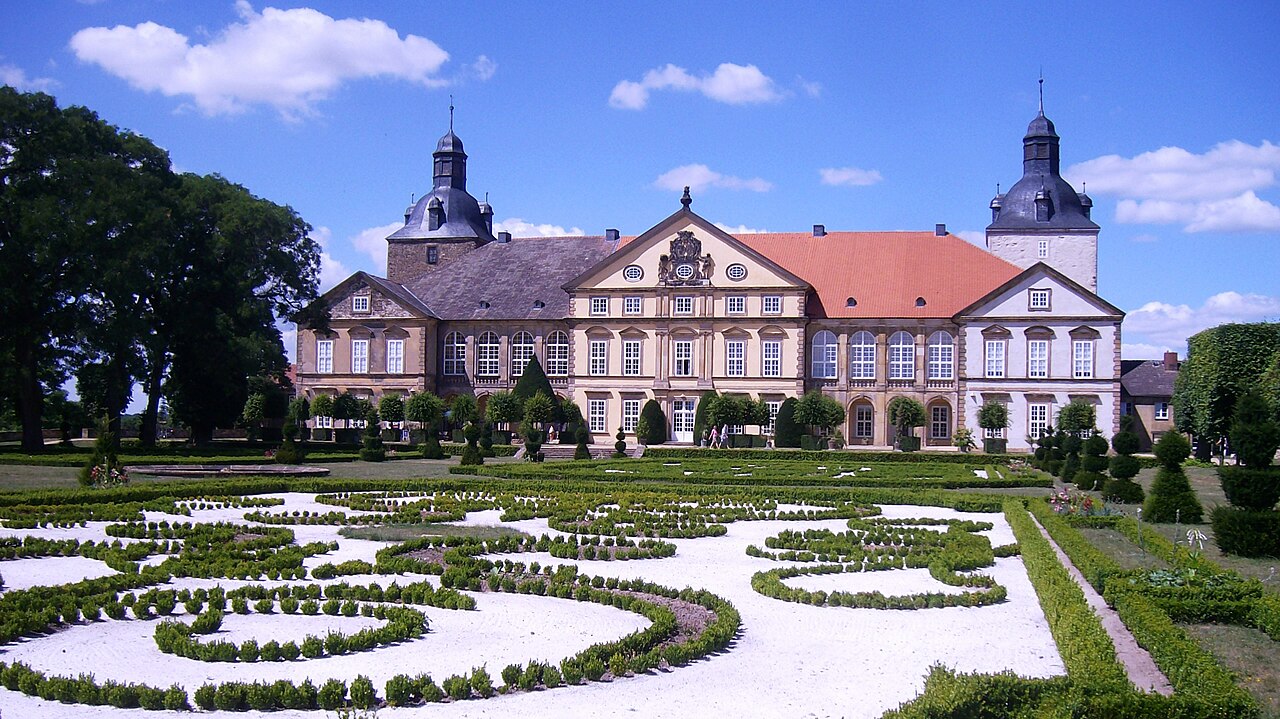
Burg Ummendorf
Burg Ummendorf stands as a remarkable example of a medieval hill castle in the municipality of Ummendorf, Germany. Founded in 1178 by the Archbishopric of Magdeburg under Archbishop Friedrich I of Wettin, the castle was strategically established to secure the northern boundaries of the archbishopric against neighboring territories such as Lower Saxony. This Romanesque fortress evolved over centuries into a Renaissance residence, reflecting the changing political, religious, and architectural trends of the region.
The castle's initial construction focused on defense, with the imposing bergfried tower as its centerpiece. This tower, over 20 meters tall, features robust Romanesque stonework on its lower floors, characterized by thick walls and rounded arches, typical of late 12th-century military architecture. The upper octagonal tower room, added in the 16th century, introduces Renaissance elements that symbolize the castle's gradual transformation from a purely defensive stronghold to a noble residence.
Historical development and ownership
From its inception, Burg Ummendorf was administered by ministeriales, a class of unfree knights serving the archbishopric, demonstrating the feudal system's role in medieval governance. By 1180, the lords of Ummendorf were recorded as vassals to the archbishopric, linking the castle's ownership directly to ecclesiastical authority.
Throughout the 13th and 14th centuries, control of the castle passed to local knightly families, including Hildebrand and Volbrecht von Oebisfelde by the mid-1300s. On April 13, 1389, Archbishop Albert of Magdeburg formally took possession of Burg Ummendorf and the surrounding village, appointing captains to govern the castle and maintain its administrative role.
During the 15th century, the noble von Veltheim family held the castle as a fief. Under Ludolf von Veltheim, Burg Ummendorf became notorious as a base for lawless knights engaged in banditry, prompting a military siege in 1430 by troops from Magdeburg to restore order. Subsequently, the castle was granted as a fief to the von Meyendorff family in 1463. Johann von Meyendorff acquired full ownership by purchasing the property outright in 1535.
Renaissance transformation and religious significance
Between 1535 and 1581, Johann von Meyendorff undertook extensive renovations that reshaped Burg Ummendorf into a Renaissance-style residence. The castle's layout was adapted into a distinctive three-winged complex, blending residential comfort with defensive features. The architectural details introduced during this period include ornate windows, decorative gables, and refined masonry work emblematic of Renaissance aesthetics.
Under Andreas von Meyendorff, the castle assumed an important role in the Protestant Reformation, serving as a local center for enforcing religious reforms. This shift mirrored broader political and religious changes sweeping through Germany in the 16th century.
Military conflicts and later history
The Thirty Years' War (1618–1648) marked a turbulent period for Burg Ummendorf, with the castle experiencing multiple occupations and military actions. In 1623, it was seized by Protestant forces led by Christian of Brunswick. Catholic imperial troops under Wallenstein took control in 1625, and in 1644, the castle served as a base for a regiment commanded by Königsmark. These events underscore the castle's strategic importance during one of Europe's most devastating conflicts.
Following the extinction of the von Meyendorff family line between 1650 and 1667, control reverted to the Archbishopric of Magdeburg. The castle's function shifted towards administrative uses, including operation as a stud farm. During the early 19th century, under French rule, Burg Ummendorf was gifted to Marshal Soult, a prominent military leader of Napoleon's era, before becoming part of the Prussian state domain.
In 1912, the municipality of Ummendorf purchased the castle, initiating a new chapter focused on preservation and public use. By 1924, a museum was established within the castle complex, evolving into today's Börde-Museum. The museum preserves and showcases the region's cultural heritage, including an historic herb garden with over 400 plant species traditionally used for medicinal and culinary purposes. Plans to repatriate a valuable collection of approximately 380 books, including Bibles and church prints from the 17th and 18th centuries originally housed at Burg Ummendorf, aim to enrich the museum's historical offerings.
Architectural features and preservation
The bergfried tower
The bergfried remains the dominant architectural feature of Burg Ummendorf. Its lower floors exhibit the characteristic Romanesque style with massive stone walls designed for defense. The later-added octagonal upper tower room reflects Renaissance influences, creating a unique blend of medieval and early modern architecture. Visitors can access the tower as part of the museum experience, gaining insight into medieval fortification techniques and the castle's historical significance.
The granary and castle wings
Another surviving medieval structure is the granary on the castle's west side, originally used to store grain and food supplies vital for enduring sieges. Its robust construction has allowed it to remain intact over centuries.
The castle's three-winged layout, largely the result of 16th-century renovations by Johann von Meyendorff, exemplifies Renaissance residential architecture. The wings accommodate museum exhibitions on agricultural technology, highlighting the castle's historical role in the rural economy. The south wing currently houses a primary school, integrating the castle into contemporary community life.
Cultural heritage and visitor experience
Burg Ummendorf today offers a layered historical narrative through its preserved structures and museum collections. It illustrates the evolution from a medieval fortress to a Renaissance noble residence and administrative center. The castle's herb garden, museum exhibits, and educational use contribute to its role as a cultural landmark in the region.
Visitors can explore the architectural features, including the bergfried tower and granary, while learning about the castle's complex history marked by feudal politics, religious reform, and military conflict. The Börde-Museum's collections provide valuable context about the local heritage, agriculture, and botanical traditions, making Burg Ummendorf a multifaceted destination for history enthusiasts and scholars alike.
Frequently asked questions (FAQ)
- How do I visit Burg Ummendorf and what are the opening hours?
- Burg Ummendorf is open to visitors as part of the Börde-Museum. Opening hours typically vary by season, so it is advisable to check the museum's official website or contact the municipality of Ummendorf for the most current visiting times.
- What architectural styles are represented at Burg Ummendorf?
- Burg Ummendorf showcases a blend of <strong>Romanesque</strong> architecture in its original bergfried tower and <strong>Renaissance</strong> elements in its three-winged residential wings, reflecting its evolution from a medieval fortress to a noble residence.
- What is the historical significance of Burg Ummendorf?
- Burg Ummendorf played a key role in securing the northern borders of the Archbishopric of Magdeburg. It witnessed feudal conflicts, religious reforms during the Protestant Reformation, and military actions in the Thirty Years' War, marking it as a site of considerable strategic and cultural importance.
- Is Burg Ummendorf accessible for visitors with limited mobility?
- The castle's historic structures, including the bergfried tower, may present challenges for visitors with limited mobility due to stairs and uneven surfaces. It is recommended to inquire in advance with the museum staff about accessibility accommodations.
- Are there any special exhibitions or events at Burg Ummendorf?
- The Börde-Museum within Burg Ummendorf hosts exhibitions on regional history, agriculture, and botany, including a historic herb garden. Seasonal events and educational programs are occasionally held, enhancing the visitor experience.
Information
Sources & official resources
Verify the information above using these authoritative references.
Loading map...
Visitor reviews
No reviews yet. Been here? Write the first review and help other travelers!
Write the first reviewVisited this castle? Share your experience
Your review helps other travelers and adds first-hand knowledge to our encyclopedia.