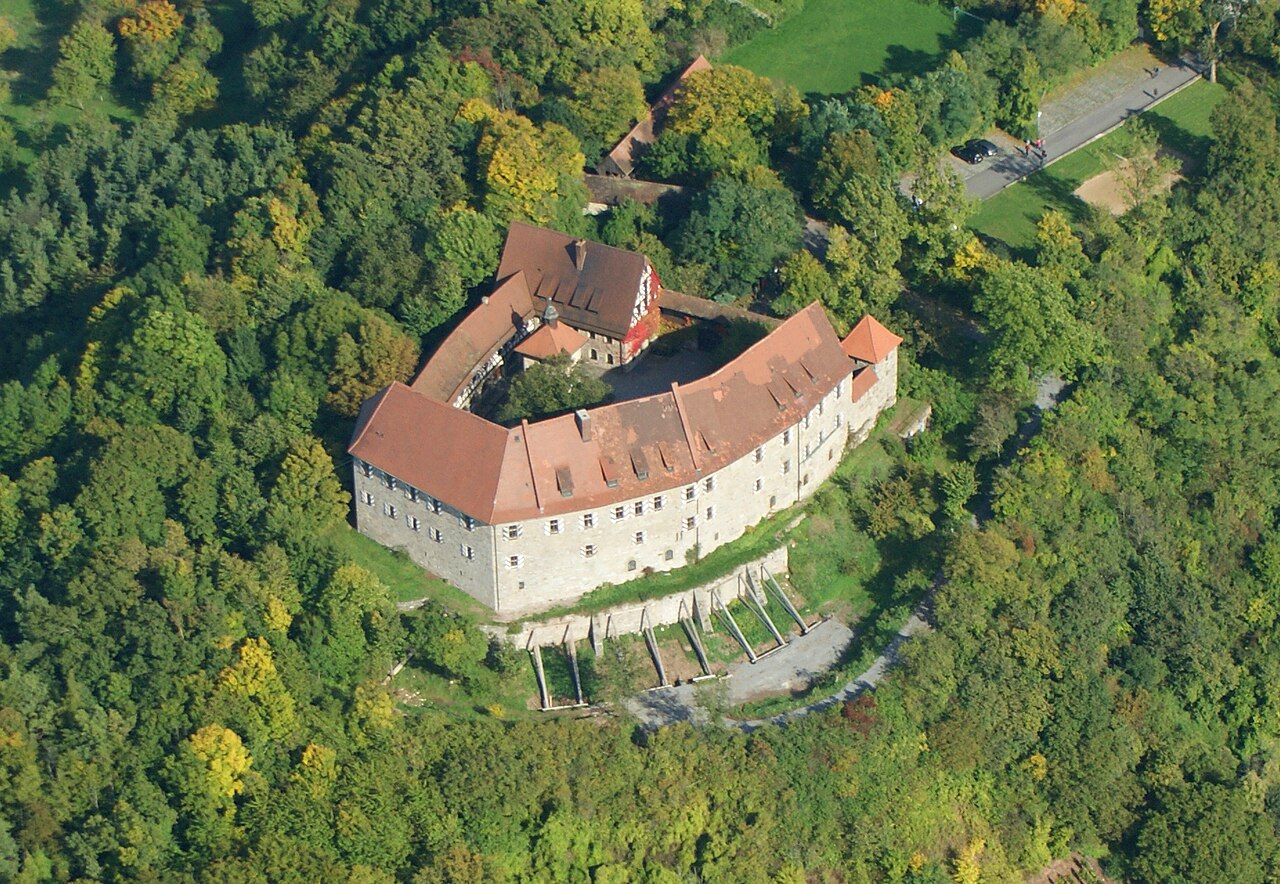
Schloß Frankenberg
Schloss Frankenberg is a historic hill castle located in the municipality of Weigenheim in the Bavarian region of Germany. Positioned strategically on a sandstone ridge at an altitude of 411 meters, the castle overlooks the expansive Ochsenfurter and Uffenheimer Gaus plains. Its location provided natural defensive advantages typical of medieval fortifications, with nearby hills reaching elevations up to 504 meters. The castle's setting amidst farmland, forests, and vineyards reflects its longstanding integration into the rural landscape.
Medieval origins and feudal context
The complex originally comprised two distinct castles: Hinterfrankenberg and Vorderfrankenberg. Hinterfrankenberg, the older of the two, was initially under the control of the Prince-Bishops of Würzburg. Vorderfrankenberg was established in 1256 by the Burgraves of Nuremberg amid territorial conflicts in the region. Around 1280, the Hohenlohe family acquired Vorderfrankenberg, which later passed through the hands of noble families such as the Seckendorff, Absberg, and Hutten lineages. Vorderfrankenberg functioned as an autonomous knightly lordship within the Ritterkanton Odenwald until the dissolution of the Holy Roman Empire.
Destruction and decline of hinterfrankenberg
Hinterfrankenberg endured significant destruction during regional conflicts. It was destroyed in 1462 by Sigmund von Schwarzenberg and again suffered devastation during the Margrave Wars in 1554, when Markgraf Albrecht Alcibiades led an assault that left the castle in ruins. After these events, Hinterfrankenberg was abandoned and fell into decay, leaving behind ruins characterized by a double tower, defensive ditches, and scattered wall fragments. A well, now largely filled in, remains among the ruins, underscoring the site's former military function.
Renaissance reconstruction and later ownership
Between approximately 1525 and 1555, Ritter Ludwig von Hutten undertook extensive reconstruction on the site of the older Absberg castle, demolishing much of the medieval remains to build a new residence in the early Renaissance architectural style. This reconstruction introduced balanced geometries and a more regularized plan, reflecting the transition from a medieval fortress to a stately home. The castle was originally designed as a quadrangular complex with four wings enclosing a central courtyard. Today, remnants of the eastern, southern, and parts of the western wings remain visible, while the medieval northern wing and a portion of the western wing reportedly suffered fire damage around 1700.
Following the end of the Hutten family line in 1783, ownership passed to Margrave Christian Friedrich Karl Alexander, who granted the estate to Ludwig Karl Wilhelm von Pölnitz. The Pölnitz family retained the property until 1971, after which it briefly belonged to the Freiherren von Lerchenfeld and later to entrepreneur Roland Belz in 2008. In 2014, the LIVIA Investment Group acquired Schloss Frankenberg and initiated ongoing restoration efforts to preserve the site's historical and architectural heritage.
Architectural features and grounds
The castle's remains include the Renaissance wings and the ruins of Hinterfrankenberg with its defensive ditches and double tower. The castle chapel and forecourt were restored in the 1990s, highlighting the site's religious and residential functions. A private cemetery located northwest of the Hinterfrankenberg ruins features a classical monopteros, a circular temple supported by columns, arranged with graves in a symbolic circular layout. Although currently stabilized with wooden supports, the monopteros remains a significant element of the estate's funerary architecture.
The estate historically included extensive vineyards covering approximately 29 hectares, along with forests, cultivated fields, and orchards, which supported agricultural activities. The estate's dairy, acquired in 2016, is part of adaptive reuse plans including conversion into a hotel, reflecting modern efforts to maintain the site's viability.
Cultural and historical significance
Schloss Frankenberg is connected to regional religious traditions through the Fränkischer Marienweg, a pilgrimage route passing through the castle grounds. The burial site of Karl Friedrich von Pöllnitz Frankenberg on a small island in a forest lake near the summit of the Scheinberg, the highest peak in the Steigerwald region, reflects 18th-century philosophical ideals inspired by Jean-Jacques Rousseau. This burial exemplifies a harmonious relationship with nature and social reform ideals of the period.
Today, Schloss Frankenberg stands as a testament to the layered history of medieval fortifications, Renaissance residential architecture, and the evolving noble ownership that shaped Bavaria's cultural landscape. Its ongoing restoration aims to preserve both its architectural heritage and its role within the broader historical narrative of the region.
Frequently asked questions (FAQ)
- How do I get to Schloß Frankenberg?
- Schloß Frankenberg is located in Weigenheim, Germany, and is easily accessible by car or public transport. The nearest major city is Würzburg, from where you can take a train or drive. Local buses also connect to nearby towns, making it convenient for visitors.
- What is the historical significance of Schloß Frankenberg?
- Schloß Frankenberg dates back to the 13th century and showcases the rich history of the Franconian region. Originally built as a defensive structure, it has witnessed various architectural styles over the centuries. Today, it stands as a testament to the medieval heritage of Germany.
- When was Schloß Frankenberg constructed?
- Schloß Frankenberg was constructed in the early 13th century, during a period of significant development in the region. Its construction reflects the strategic importance of the area at that time, serving both as a residence and a fortress. Over the years, it has undergone various renovations that highlight its historical evolution.
- Can I take guided tours of Schloß Frankenberg?
- Yes, guided tours of Schloß Frankenberg are available, providing visitors with in-depth knowledge about its history and architecture. These tours typically run on weekends and can be booked in advance. Check the castle's official website for specific tour schedules and availability.
- Why is the architecture of Schloß Frankenberg notable?
- The architecture of Schloß Frankenberg is notable for its blend of Gothic and Renaissance styles, showcasing the evolution of architectural design over the centuries. The castle features impressive stonework, intricate detailing, and commanding towers that reflect its historical significance. Visitors can appreciate the craftsmanship that has preserved its beauty through time.
- Is it possible to hold events at Schloß Frankenberg?
- Yes, Schloß Frankenberg offers venues for various events, including weddings and corporate gatherings. The picturesque setting and historic ambiance make it a unique location for special occasions. Interested parties should contact the castle administration for more details on availability and services.
- What are the opening hours for Schloß Frankenberg?
- Schloß Frankenberg is open to visitors from 10 AM to 6 PM, Wednesday through Sunday. During peak tourist seasons, extended hours may be available. It's advisable to check the official website or contact the castle for the most current information on opening times.
- What is the best time to visit Schloß Frankenberg?
- The best time to visit Schloß Frankenberg is during the spring and early autumn when the weather is mild and the gardens are in bloom. These seasons attract fewer crowds, allowing for a more enjoyable experience. Special events and festivals also take place during these times, enhancing your visit.
- How much are the ticket prices for Schloß Frankenberg?
- Ticket prices for Schloß Frankenberg are generally affordable, with discounts available for students and seniors. Family tickets are also offered for those visiting with children. For the most accurate pricing and any special offers, it's best to check the castle's official website before your visit.
- Are there any nearby attractions to visit along with Schloß Frankenberg?
- Yes, there are several nearby attractions, including the charming village of Weigenheim and the beautiful vineyards of the Franconian wine region. Additionally, you can explore other historical sites and castles in the area. This makes Schloß Frankenberg an ideal starting point for a day of sightseeing and cultural exploration.
Information
Website
Visit websiteSources & official resources
Verify the information above using these authoritative references.
Loading map...
Visitor reviews
No reviews yet. Been here? Write the first review and help other travelers!
Write the first reviewVisited this castle? Share your experience
Your review helps other travelers and adds first-hand knowledge to our encyclopedia.