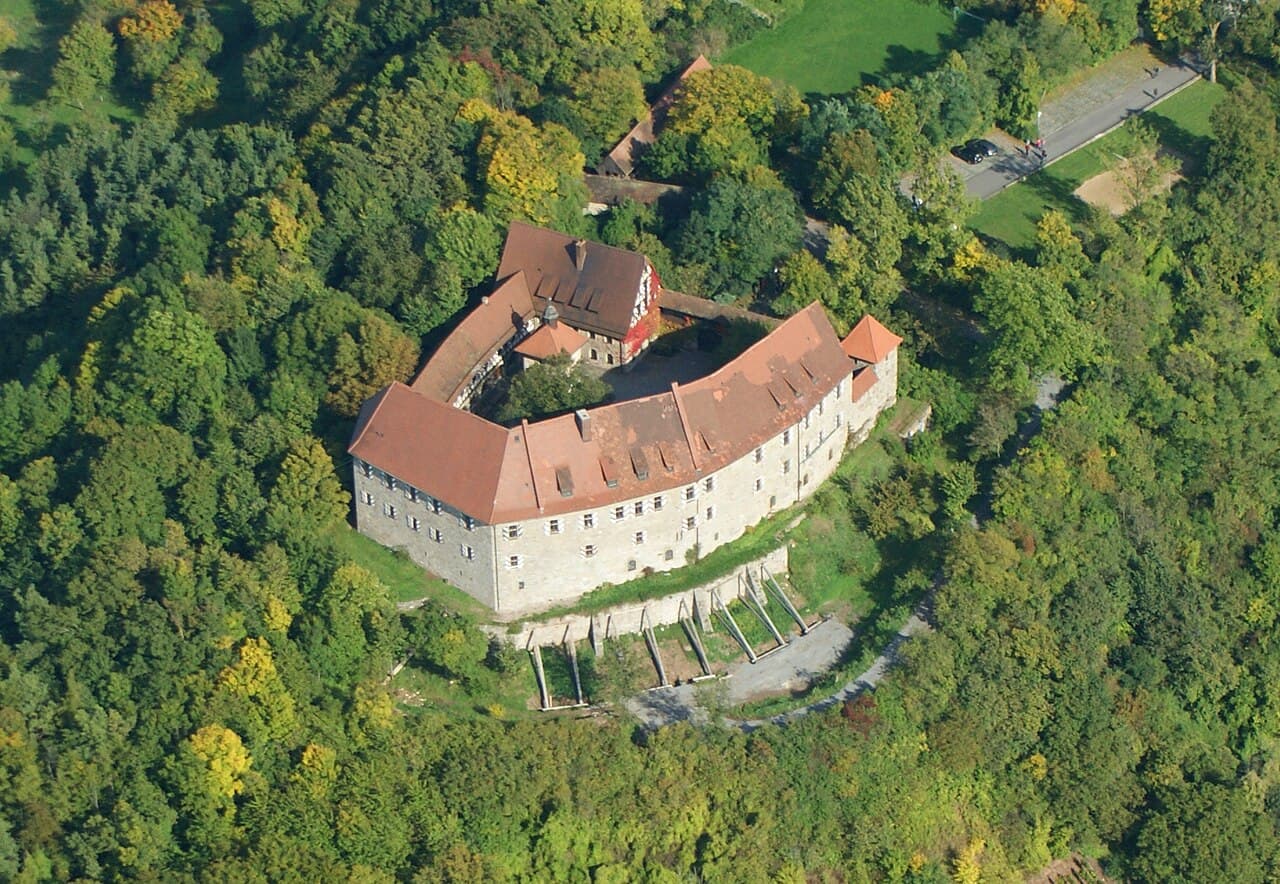
Hoheneck Castle stands prominently above the town of Ipsheim in Middle Franconia, Bavaria, Germany. This medieval hill castle is situated on the slopes of the Franconian Heights, a modest yet scenic forested hill range within the Frankenhöhe Nature Park. The castle overlooks the valley of the Aisch River and is surrounded by the extensive Hoheneck Forest to the east, reflecting the castle's strategic placement in a naturally defensible position. At the foot of the castle lies one of the few wine-growing regions in Middle Franconia, highlighting the area's agricultural significance alongside its military history.
Early history and ownership
Hoheneck Castle was first documented in 1132, marking its origins in the high medieval period. The castle's early history is tied to the noble families of the region, serving as a fortified residence and administrative center. In 1381, the castle and its surrounding lands were sold by Arnold von Seckendorff to Burggraf Friedrich V of Nuremberg. This acquisition was significant, as Friedrich V subsequently established the Oberamt Hoheneck, an administrative district centered around the castle, underscoring its importance as a local seat of power.
Destruction and rebuilding
In 1462, during the conflict between Margrave Albrecht of Brandenburg and the Hochstift Würzburg, Hoheneck Castle was burned down. This event was part of the broader regional struggles for control and influence in Franconia during the late medieval period. Despite this destruction, the castle was rebuilt and continued to serve as a strategic and administrative site in the region.
Modern era and current use
In 1953, the City of Nuremberg acquired Hoheneck Castle, making it the only castle owned by the city itself; the famous Nuremberg Castle is owned by the Free State of Bavaria. Since April 1984, the castle has been repurposed as a youth education center operated by the Youth Council of Kreis Nuremberg. This modern adaptation preserves the castle's heritage while providing a valuable community resource for education and cultural activities.
Architectural features and setting
Hoheneck Castle typifies the hill castle form common in the high medieval period, leveraging its elevated position for defense and surveillance. The castle's location on the slopes of the Franconian Heights offers commanding views over the surrounding landscape, including the Aisch valley and the Hoheneck Forest. The castle complex historically included defensive walls, residential quarters, and administrative buildings, characteristic of medieval fortress architecture. While specific architectural details have evolved over centuries, the castle's setting remains a defining feature of its character and historical significance.
Natural surroundings and cultural landscape
The castle's proximity to the Franconian wine region at its base connects it to the area's agricultural traditions. The surrounding forests and hills contribute to the castle's scenic and strategic value, providing natural resources and defensive advantages. The Franconian Heights and the Frankenhöhe Nature Park offer a rich ecological backdrop that enhances the castle's appeal to visitors and historians alike.
Visitor information and cultural significance
Today, Hoheneck Castle functions as a youth education center, reflecting a modern commitment to cultural preservation and community engagement. The castle's ownership by the City of Nuremberg ensures its maintenance and accessibility for educational purposes. Visitors can appreciate the castle's historical context, its architectural heritage, and its role in regional history while engaging with its contemporary function as a center for youth activities.
Hoheneck Castle remains a notable example of a high medieval hill castle in Bavaria, combining historical significance, architectural interest, and modern cultural use within a striking natural setting.
Frequently asked questions (FAQ)
- When was Hoheneck Castle first mentioned in historical records?
- Hoheneck Castle was first mentioned in 1132, marking its origins in the high medieval period.
- What is the current use of Hoheneck Castle?
- Since 1984, Hoheneck Castle has served as a youth education center operated by the Youth Council of Kreis Nuremberg.
- Who owns Hoheneck Castle today?
- The castle is owned by the City of Nuremberg, which acquired it in 1953.
- What significant event happened to the castle in 1462?
- The castle was burned down during the war between Margrave Albrecht of Brandenburg and the Hochstift Würzburg in 1462.
- Where is Hoheneck Castle located?
- Hoheneck Castle is located above Ipsheim in Middle Franconia, Bavaria, Germany, on the slopes of the Franconian Heights.
Photo gallery

Photo by Pegasus2•Public domain
Information
Current owner
City of Nuremberg
Loading map...
Visitor reviews
No reviews yet. Been here? Write the first review and help other travelers!
Write the first reviewVisited this castle? Share your experience
Your review helps other travelers and adds first-hand knowledge to our encyclopedia.



