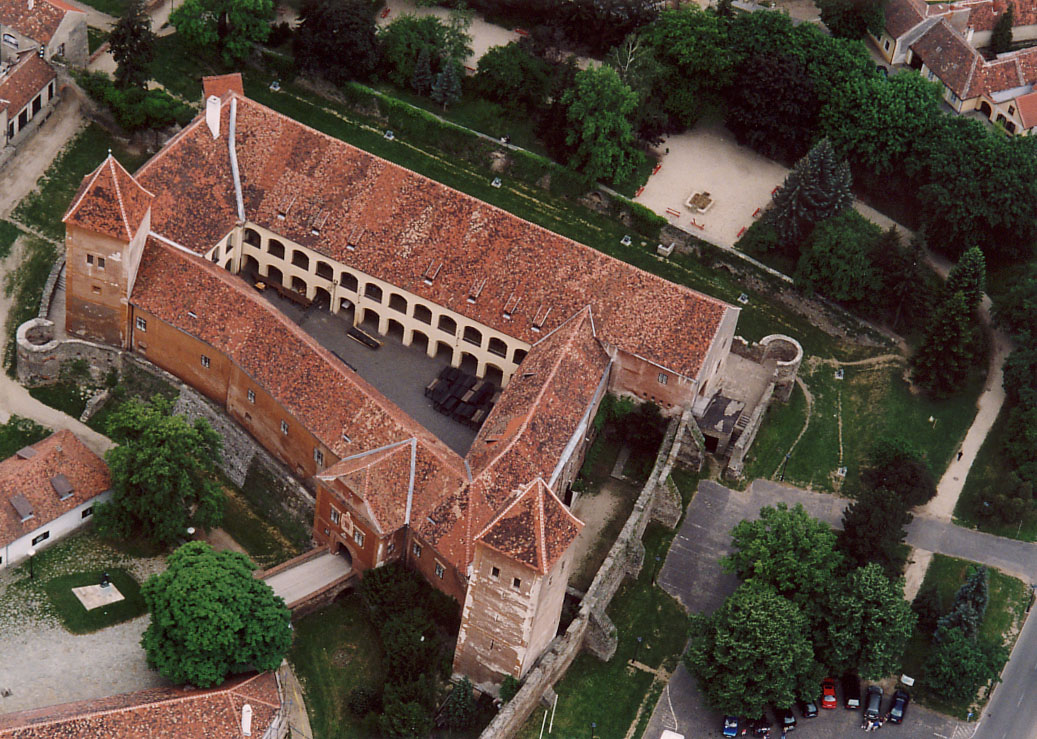
Schloss Deutschkreutz
Schloss Deutschkreutz is a distinguished Renaissance castle located in the municipality of Deutschkreutz, Austria, near the Hungarian border. Its origins date back to the late medieval period, first documented in 1492 as a fortress owned by the Hungarian noble family Kanizsay. Initially constructed as a stronghold, the castle's strategic position reflected the turbulent political landscape of the region, which was heavily influenced by Hungarian nobility.
The transformation from fortress to Renaissance residence
In 1535, the property passed by marriage to the Nádasdy family, a prominent Hungarian noble house. Around 1560, Thomas III Nádasdy initiated a significant transformation of the original fortress into a Renaissance-style castle, embracing architectural influences from Italy. This redesign marked a shift from purely defensive purposes to a more refined noble residence, emphasizing aesthetics alongside fortification.
The castle's Renaissance form was well established by 1597, when it appeared in historical records as a notable noble residence. The most substantial development occurred in 1625 under Paul Nádasdy, who expanded the castle into a four-winged building arranged around a central courtyard. This layout is characteristic of Renaissance architecture, promoting symmetry, harmony, and practical living spaces.
Paul Nádasdy also commissioned a chapel in 1632, enriching the castle's religious and cultural significance. The chapel was adorned with frescoes depicting religious scenes, reflecting the artistic tastes and spiritual devotion of the period.
Architectural features and design elements
The castle's design is distinguished by its two-story arcades bordering the central courtyard, which provide both structural rhythm and aesthetic appeal. Each corner of the castle is anchored by towers, a nod to its defensive origins while also enhancing its grandeur as a noble residence.
Inside, the castle once featured elaborate stucco decorations and was furnished with historic furniture and richly woven gobelins tapestries, contributing to an atmosphere of aristocratic elegance. Although the chapel and its frescoes were destroyed during the Soviet military occupation in the mid-20th century, other Renaissance elements of the interior survive, offering valuable insight into the castle's artistic heritage.
Historical ownership and significant events
The castle's ownership history is marked by notable figures and dramatic events. After the execution of Franz III Nádasdy for conspiring against Emperor Leopold I, the property reverted to the emperor and was sold in 1676 to Count Paul Esterházy. Despite the Esterházy family's limited use of the castle as a primary residence, the estate remained an important agricultural center well into the 20th century.
During World War II, the estate employed Hungarian Jewish forced laborers housed nearby in the Schafhof, emphasizing the castle's role within the broader historical context of the war. Following the war, the castle was occupied by Soviet forces from 1945 to 1955 and used as a military barracks. This period caused significant damage to the interior and led to the destruction of the chapel.
Modern restoration and cultural revival
In 1957, the castle came under the ownership of the local municipality of Deutschkreutz, marking a transition to civilian stewardship. The Austrian artist Anton Lehmden acquired the castle in 1966 and dedicated several decades to its restoration. Lehmden's efforts focused on preserving the castle's historical features and reviving its cultural significance by establishing a permanent exhibition of his artworks within the castle.
Today, Schloss Deutschkreutz stands as a testament to the Renaissance architectural style and the complex history of noble families in the region. Its four-winged structure, arcaded galleries, and corner towers continue to captivate visitors, while ongoing restoration ensures the preservation of its rich heritage.
Location and setting
Situated approximately five kilometers from the Hungarian border near Sopron, the castle is located at about 178 meters above sea level. Its position on a hill provides a commanding view of the surrounding landscape, characteristic of hill castles designed for both defense and status display. The construction materials reflect typical Renaissance masonry, though specific details remain undocumented.
The castle's setting near the border and its historical ties to Hungarian nobility underscore its importance as a cultural and historical landmark bridging Austria and Hungary.
Visitor information and legacy
Though not a primary residence today, Schloss Deutschkreutz serves as a cultural site with ongoing restoration efforts. The castle's history, architectural features, and connection to notable families make it an important destination for those interested in Renaissance architecture and Central European history. The legacy of Anton Lehmden's artistic contributions adds a unique cultural dimension, blending historical preservation with contemporary art.
Frequently asked questions (FAQ)
- How do I get to Schloss Deutschkreutz?
- Schloss Deutschkreutz is located in the town of Deutschkreutz, Burgenland, Austria, near the Hungarian border. It is accessible by car and local roads connecting to nearby towns such as Sopron.
- What architectural style is Schloss Deutschkreutz?
- The castle is primarily built in the Renaissance style, featuring a four-winged layout with arcaded galleries and corner towers typical of Renaissance architecture.
- When was Schloss Deutschkreutz built?
- The castle's origins trace back to 1492 when it was first documented as a fortress. Major transformations into a Renaissance castle occurred in the 16th and 17th centuries.
- Can I visit the chapel at Schloss Deutschkreutz?
- The chapel built in 1632 was destroyed during the Soviet occupation after World War II and no longer exists. Visitors can still admire other Renaissance architectural elements of the castle.
- Is Schloss Deutschkreutz open to the public?
- The castle is privately owned but has undergone restoration and cultural use. Visitors should check locally for access and opening hours as these can vary.
Information
Sources & official resources
Verify the information above using these authoritative references.
Loading map...
Visitor reviews
No reviews yet. Been here? Write the first review and help other travelers!
Write the first reviewVisited this castle? Share your experience
Your review helps other travelers and adds first-hand knowledge to our encyclopedia.