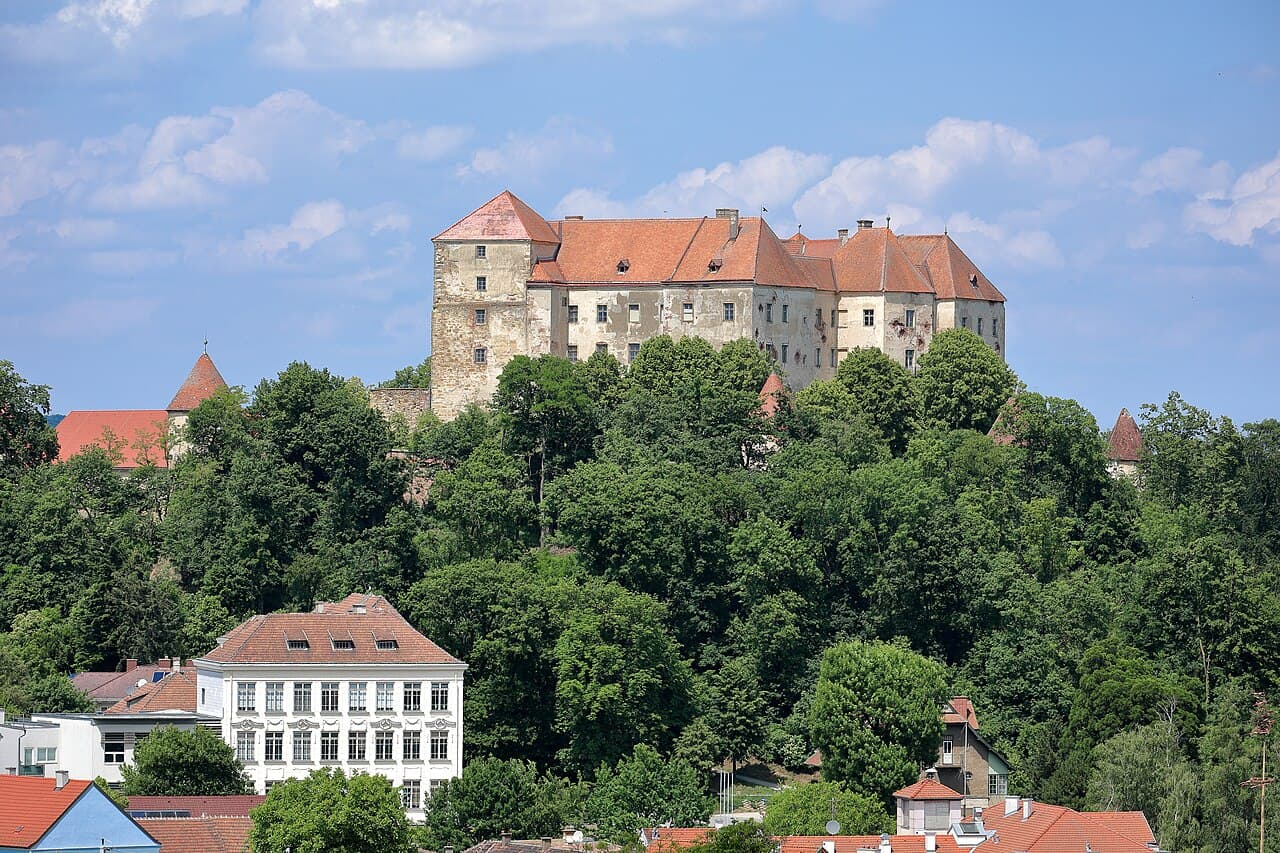
Burg Neulengbach
Burg Neulengbach stands prominently on a free-standing conical hill approximately 80 meters above the town of Neulengbach in the Viennese Forest region of Lower Austria. This hill castle commands a strategic vantage point that has been utilized since its founding in the 12th century. Originally constructed around 1189 by the high nobles known as the Hochfreien of Lengenbach, the castle was established concurrently with the founding of the local market town, marking it as a center of regional power and administration. Its location atop a rocky peak provided natural defenses that were later augmented by man-made fortifications.
The castle complex is architecturally distinctive, featuring a three-storey polygonal main building surrounded by a double ring of defensive walls. These walls are punctuated by eight circular towers strategically placed to maximize surveillance and defense capabilities. The entrance is marked by an annex with a richly decorated Renaissance portal, a key architectural feature that reflects the castle's significant transformation during the late 16th and early 17th centuries. Within the courtyard, visitors find Tuscan twin columns, a classical element that adds elegance and structural support, alongside a stone well basin that historically provided water to the inhabitants.
Historical development and ownership
The castle's history is deeply intertwined with the noble families and political shifts of medieval and early modern Austria. After its establishment by the Hochfreien of Lengenbach, the castle served as the administrative center for their lordship until the extinction of their line in 1236. Following this, control passed to the influential Babenberg dynasty, who were key rulers in Austrian history during the high medieval period.
During the late Middle Ages, Burg Neulengbach became the residence of provincial stewards (landesfürstlicher Pfleger), officials who managed the region on behalf of the ruling prince. The castle's strategic and economic importance is underscored by its frequent use as collateral in financial pledges, indicating its value beyond mere military function.
A pivotal moment in the castle's history came in 1565 when Rudolf Khuen von Belasy acquired the lordship of Neulengbach. Under the Khuen family's stewardship, the castle underwent extensive renovations and expansions, transforming it from a medieval fortress into a late Renaissance residence. This remodeling phase, spanning the late 16th and early 17th centuries, introduced architectural elements characteristic of the Renaissance, including the portal and courtyard features, while maintaining defensive structures.
Ownership of the castle changed hands multiple times in subsequent centuries, reflecting the shifting political and social landscape of the region. The Counts Pálffy took possession in 1646, followed by the Bartholotti von Partenfeld family after 1696. The Princes Lubomirski held the castle from 1740, succeeded by Freiherr Karl Abraham Wetzlar von Plankenstern in 1778. The Counts Fries acquired it in 1798, and finally, the Princes of Liechtenstein became owners in 1828. Each family contributed to the castle's legacy as a noble residence and administrative center.
Architectural features and renovations
Medieval origins and defensive structures
The original 12th-century construction of Burg Neulengbach focused on defense and control of the surrounding territory. The castle's polygonal shape is unusual and was likely designed to conform to the natural contours of the hilltop. The double ring of defensive walls provided multiple layers of protection, while the eight round towers allowed for comprehensive surveillance and defense against attackers.
The castle's elevated position on a rocky hill enhanced its natural defenses, making it difficult to assault. The walls and towers were constructed using local stone, ensuring durability. The polygonal layout also facilitated the defense of all sides, reducing blind spots. These features reflect typical high medieval military architecture adapted to the specific topography of the site.
Renaissance transformation under the Khuen family
Between the late 1500s and early 1600s, Burg Neulengbach underwent a significant transformation from a fortress to a more comfortable and representative residence. The Renaissance portal at the entrance is a key feature from this period, showcasing decorative stonework that contrasts with the castle's otherwise austere exterior.
The courtyard was redesigned to include Tuscan twin columns, a classical architectural style characterized by simplicity and strength. These columns support arcades that create a harmonious and elegant space within the castle walls. The presence of a stone well basin in the courtyard indicates the importance of a reliable water supply, crucial for both daily living and defense.
Although the castle was remodeled to reflect Renaissance aesthetics, it retained much of its medieval defensive character. The renovations balanced the need for security with the desire for a noble residence suitable for the social and administrative functions of the time.
Damage, preservation, and modern use
A significant event in Burg Neulengbach's more recent history was the devastating fire of January 1912, which destroyed all the castle's interior furnishings. Despite this loss, the main structure, including the polygonal building, towers, and courtyard, survived intact.
Following the fire, the castle changed ownership several times. In 1920, the City of Vienna purchased the property and repurposed it as a children's home, reflecting a shift from noble residence to public use. Later, in 1952, the Neulengbach Castle Association assumed ownership, followed by private ownership under Martin Wakonig from 1962.
In early 2023, the castle was gifted by Bruno Wakonig and his wife Margherita to their descendants, continuing a familial connection that preserves the castle's legacy. This modern stewardship reflects ongoing efforts to maintain and celebrate Burg Neulengbach's historical and architectural significance.
The castle's exterior walls bear visible scars from artillery fire sustained during World War II, particularly on the southeastern facade. These marks provide a tangible link to the 20th-century conflicts that affected the region, adding a layer of historical depth to the site.
Cultural significance and visitor experience
Today, Burg Neulengbach stands as a testament to the architectural and historical evolution of a noble residence that transitioned from a medieval fortress to a Renaissance home and beyond. Its well-preserved polygonal structure, defensive walls, and Renaissance details offer visitors insight into the complex history of Austrian nobility and regional governance.
The castle's location in the Viennese Forest provides a scenic backdrop, making it a notable landmark in Lower Austria. Visitors can appreciate the blend of military and residential architecture, the classical elements of the courtyard, and the historical narratives embedded in its walls.
While the interior furnishings were lost, the castle's exterior and courtyard remain accessible, allowing for exploration of its architectural features and an understanding of its historical context. The visible artillery damage and Renaissance portal serve as focal points for interpretation and education about the castle's multifaceted past.
Burg Neulengbach's enduring presence and layered history make it a valuable cultural asset, reflecting the broader story of castle development, noble lineage, and regional history in Austria.
Frequently asked questions (FAQ)
- How do I get to Burg Neulengbach?
- Burg Neulengbach is conveniently located in Neulengbach, Austria, easily accessible by public transportation and car. If you're traveling by train, the nearest station is just a short walk away, making it simple to include in your itinerary.
- What is the historical significance of Burg Neulengbach?
- Burg Neulengbach dates back to the 12th century and has played a vital role in the region's history as a defensive stronghold. Its rich past includes connections to prominent noble families and various historical events, which contribute to its cultural importance in Austria.
- When was Burg Neulengbach built?
- Construction of Burg Neulengbach began in the late 12th century, with significant modifications occurring over the ensuing centuries. The castle has undergone various restorations, preserving its medieval architecture while adapting to modern needs.
- Can I take a guided tour of Burg Neulengbach?
- Yes, guided tours are available at Burg Neulengbach, providing visitors with in-depth insights into the castle's history and architecture. These tours are typically conducted in multiple languages, ensuring a comprehensive experience for all guests.
- Why is Burg Neulengbach considered an architectural gem?
- Burg Neulengbach showcases a unique blend of medieval and Renaissance architectural styles, reflecting the evolution of castle design over centuries. Its well-preserved structures, including towers and walls, offer a glimpse into the architectural techniques of the past.
- Is it possible to host events at Burg Neulengbach?
- Yes, Burg Neulengbach offers facilities for hosting various events, including weddings and corporate gatherings. The stunning backdrop of the castle adds a unique charm to any occasion, making it a popular choice for event planners.
- What are the opening hours for Burg Neulengbach?
- Burg Neulengbach typically opens to visitors from April to October, with specific hours varying by day. It is advisable to check the official website or contact the castle directly for the most current information on opening times before your visit.
- What are the ticket prices for visiting Burg Neulengbach?
- Ticket prices for Burg Neulengbach vary depending on age and group size, with discounts often available for students and seniors. It is recommended to purchase tickets in advance online to secure your entry and avoid long queues.
- What is the best time to visit Burg Neulengbach?
- The best time to visit Burg Neulengbach is during the spring and early fall when the weather is mild, and the surrounding landscape is particularly beautiful. Additionally, visiting during weekdays may help you avoid larger crowds and enhance your experience.
- Are there any nearby attractions to explore after visiting Burg Neulengbach?
- Yes, there are several attractions near Burg Neulengbach, including picturesque hiking trails and charming local villages. You might also consider visiting the nearby town of Neulengbach, which offers its own historical sites and lovely cafes to enjoy.
Photo gallery

Information
Website
Visit websiteSources & official resources
Verify the information above using these authoritative references.
Loading map...
Visitor reviews
No reviews yet. Been here? Write the first review and help other travelers!
Write the first reviewVisited this castle? Share your experience
Your review helps other travelers and adds first-hand knowledge to our encyclopedia.



