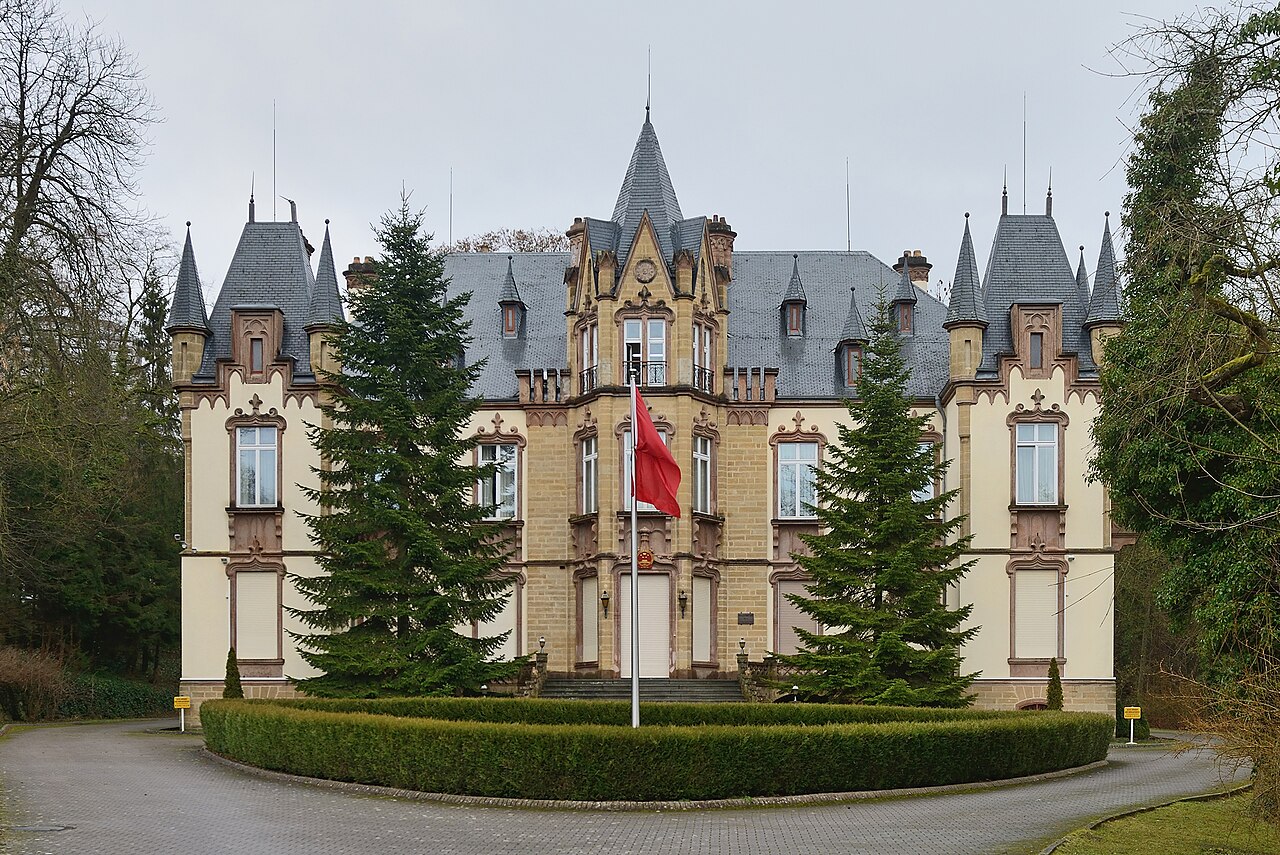
Schauwenburg Castle

Schauwenburg Castle in Bertrange, Luxembourg
Bertrange, Luxembourg, Luxembourg
Renaissance (15th–17th c.)
Well Preserved

Schauwenburg Castle in Bertrange, Luxembourg is a historic site with roots tracing back to the early 13th century. Originally, the location was occupied by the Lords of Bertrange, who maintained a fortified castle during the Middle Ages. While the earliest references indicate a medieval stronghold, the current structure primarily dates from the 16th century, reflecting the architectural transition into the Renaissance period.

Architectural evolution and features

The castle's existing form showcases characteristic elements of the Renaissance style, particularly visible in the windows of the eastern and northern wings. These windows are significant indicators of the castle's 16th-century origins. The façade was completed later, around 1710, adding a layer of early 18th-century architectural detail to the building's appearance. This blend of Renaissance and early modern elements highlights the castle's evolution over several centuries.

Structural layout and design

The castle was originally designed as a fortified residence, typical of the period's defensive architecture, though it gradually adapted to more residential and administrative functions. The building's layout includes multiple wings arranged around a central courtyard, a common feature in Renaissance castles that balanced defense with domestic comfort. The sturdy walls and window placements suggest a focus on both security and natural light.

Historical context and ownership

Throughout its history, Schauwenburg Castle has seen numerous owners and has served various roles. By the late 18th century, the d'Huart family, then residents of the castle, found the facilities insufficient for their needs. Around 1780, they constructed a larger residence nearby, known as the Château de Colnet d'Huart, marking a shift in local aristocratic habitation patterns.

The castle's changing ownership reflects broader social and economic shifts in Luxembourg over the centuries. Its uses have ranged from noble residence to administrative center, adapting to the needs of the community and its rulers.

Modern usage and preservation

In recent decades, Schauwenburg Castle has taken on a civic role. Since 2008, it has served as the temporary home of the Commune of Bertrange's administrative offices, effectively functioning as the town hall. This adaptive reuse has helped preserve the castle's structural integrity while keeping it relevant to the local population.

The castle is currently well-preserved, maintaining much of its Renaissance character alongside later architectural modifications. Its continued use ensures ongoing maintenance and public accessibility, contributing to the cultural heritage of Bertrange.

Architectural significance within Luxembourg

Schauwenburg Castle stands as a notable example of Renaissance architecture in Luxembourg, illustrating the transition from medieval fortifications to more comfortable noble residences. The castle's features, such as its Renaissance windows and 18th-century façade, provide valuable insight into the architectural trends and social history of the region.

Its proximity to other significant historic sites, including the Château de Colnet d'Huart, highlights the area's importance as a center of local aristocracy and governance through the centuries.

Visitor information and cultural role

While primarily serving administrative functions today, Schauwenburg Castle remains an important cultural landmark in Bertrange. Visitors can appreciate its architectural details from the exterior and understand its historical context within the town's development.

The castle's blend of medieval origins and Renaissance design elements makes it a point of interest for those studying Luxembourg's architectural heritage and the evolution of noble residences in the region.

Frequently asked questions (FAQ)

What is the historical significance of Schauwenburg Castle?
Schauwenburg Castle dates back to the 11th century and is one of the oldest fortifications in Luxembourg. It played a crucial role in the region's defense and served as a residence for various noble families throughout its history.
When was Schauwenburg Castle built?
Construction of Schauwenburg Castle began in the early 11th century, making it a significant landmark in Luxembourg's medieval history. The castle underwent various renovations and expansions over the centuries, reflecting the architectural styles of different periods.
Can I visit Schauwenburg Castle?
Yes, visitors are welcome to explore Schauwenburg Castle. Guided tours are available, allowing guests to learn about its rich history and architectural features.
What are the opening hours for Schauwenburg Castle?
Schauwenburg Castle is typically open to visitors from 10 AM to 5 PM, Wednesday through Sunday. It is advisable to check the official website for any seasonal changes or special closures.
Is there an entrance fee to visit Schauwenburg Castle?
Yes, there is a nominal entrance fee for visitors wishing to tour Schauwenburg Castle. Ticket prices are usually affordable, with discounts available for students and seniors.
When is the best time to visit Schauwenburg Castle?
The best time to visit Schauwenburg Castle is during the spring and early autumn months when the weather is mild. These seasons also offer beautiful landscapes, enhancing your experience as you explore the grounds.
Is Schauwenburg Castle accessible for individuals with mobility challenges?
While Schauwenburg Castle has some accessible areas, the historic nature of the site may pose challenges for individuals with mobility issues. It is recommended to contact the castle's administration in advance to inquire about specific accessibility options.
What nearby attractions can I visit while at Schauwenburg Castle?
While visiting Schauwenburg Castle, you can also explore the charming town of Bertrange and its local parks. Additionally, the capital city of Luxembourg, with its many museums and historic sites, is just a short drive away.

Information

Lowland Castle

Loading map...

Visitor reviews

No reviews yet. Been here? Write the first review and help other travelers!

Write the first review

Visited this castle? Share your experience

Your review helps other travelers and adds first-hand knowledge to our encyclopedia.

Write a review

(5/5)

0/2000 characters

Your review will be visible after admin approval

Nearby castles

2.5 km

Mamer Castle

Mamer, Luxembourg

Mamer Castle stands as a prominent municipal building in the commune of Mamer, located in the south-western region of Luxembourg. The castle complex is composed of four interconnected buildings, set within recently landscaped grounds that enhance its civic presence. At the main entrance, visitors encounter sculptures honoring two of Mamer's most celebrated sports figures: Nicolas Frantz, a two-time winner of the Tour de France, and Josy Barthel, Luxembourg's only Olympic gold medallist. Both athletes were born in Mamer, linking the castle to the town's rich cultural heritage. Historical background and origins The site of Mamer Castle has a history dating back to the 10th century, when the original castle was constructed. This early medieval fortress served as a local stronghold during a period marked by feudal conflicts and territorial defense. Over the centuries, the castle changed hands and underwent various transformations. However, by the time of the French Revolutionary Wars in the late 18th century, the original structure had fallen into a state of ruin. In 1798, during the French occupation, the castle lands were seized and sold to Thierry de Bastogne. This marked a significant shift in ownership and use, as the old medieval fortress was no longer maintained as a defensive structure. The site remained in a dilapidated condition until the early 19th century. 19th-century reconstruction and architecture In 1830, a new castle was constructed on the historic site by Frederic François, who was the police chief at the time. This new building was designed as a residential and administrative structure rather than a military fortress. It was surrounded by a two-metre-high wall, which provided a modest degree of enclosure and privacy, reflecting the architectural sensibilities of the period. The 1830 construction represents the modern period in the castle's architectural timeline, departing from medieval defensive features in favor of a more stately and functional design. The style of the building is utilitarian with some neoclassical influences typical of early 19th-century civic architecture in Luxembourg. Ownership and later developments After its construction, Mamer Castle passed through several private owners. In 1934, it was acquired by Jacques Fischer and Julie Kremer. Over time, the castle's role evolved from a private residence to a public building, ultimately becoming the town hall for the commune of Mamer. This transition reflects the broader trend of adaptive reuse of historic buildings in Luxembourg. Current use and cultural significance Today, Mamer Castle functions as the administrative center for the commune, housing municipal offices and serving as a venue for local government activities. The castle's grounds have been landscaped to provide a welcoming environment for residents and visitors alike, combining historical architecture with modern civic use. The sculptures of Nicolas Frantz and Josy Barthel at the entrance highlight the castle's role as a cultural landmark, celebrating local achievements in sports and fostering community pride. The castle is not only a symbol of Mamer's historical continuity but also a living part of its contemporary civic life. Architectural features and layout The castle complex comprises four main buildings arranged around courtyards, creating a cohesive administrative compound. The two-metre-high wall built in the 19th century encloses the property, providing a clear boundary while maintaining openness to the surrounding town. The architectural style is modest, with functional design elements suited to its role as a town hall rather than a defensive fortress. Although the original medieval castle no longer exists in its initial form, the site retains its historical significance through the preservation of the 19th-century structure and its integration into the town's urban fabric.

Modern (19th–20th c.)
Details
4.1 km

Chateau de Septfontaines

Luxembourg City, Luxembourg

Chateau de Septfontaines stands as a remarkable example of an 18th-century castle deeply intertwined with the industrial heritage of Luxembourg. Constructed between 1783 and 1784 by the Boch brothers, Jean-François and Pierre-Joseph, the castle is located in the Rollingergrund district of Luxembourg City. This period corresponds to the post-Renaissance era, reflecting architectural and cultural influences of late 18th-century Europe. The castle was purpose-built to serve as a residence for the Boch families, who had established their renowned porcelain factory nearby in 1767. At that time, Luxembourg was part of the Austrian Netherlands, and the location was strategically chosen for its abundant natural resources essential for porcelain production—namely clay, water, and wood for firing ovens. The design of the castle uniquely accommodated two families, with the first floor divided into separate bedroom sections for each, while the ground floor featured shared living spaces such as the dining room and lounge. The architectural design and layout The Chateau de Septfontaines exemplifies the refined architectural style of its era, blending functional design with elegant residential features. The building's layout reflects the dual-family occupancy, a somewhat unusual arrangement for a castle of this type, indicating its role as both a home and a symbol of industrial success. The castle's interiors are richly decorated, with porcelain artifacts displayed prominently on walls and windows, celebrating the Boch family's craftsmanship and legacy. Structural features and style The castle's architecture is characterized by its post-Renaissance style, incorporating classical elements that were popular in the late 18th century. The structure includes well-proportioned rooms with high ceilings and large windows that allow natural light to illuminate the porcelain collections inside. The building's exterior maintains a dignified presence, with balanced proportions and restrained decorative details typical of the period. Historical significance and ownership Jean-François and Pierre-Joseph Boch were pioneers in the European porcelain industry, and their factory at Rollingergrund became a center of innovation and craftsmanship. The castle not only served as their family residence but also stood as a testament to their commercial success. The Boch brothers were granted special privileges by Maria Theresa, Empress of Austria, including a ten-year tax exemption, which greatly facilitated their business growth. Throughout its history, the castle experienced various phases of occupancy and ownership. Notably, it was occupied by French troops at one point, reflecting the turbulent political landscape of the region. In 1914, the castle was sold, but it returned to the Boch family in 1970 when Luitwin von Boch repurchased it on behalf of the Villeroy & Boch company. He commissioned his cousin, Antoine de Schorlemer, to undertake an extensive 12-year renovation, restoring the castle's grandeur and adapting it for modern use. Connection to Villeroy & Boch and modern usage Villeroy & Boch, the world-famous porcelain manufacturer, has maintained a strong connection to Chateau de Septfontaines. Although the nearby porcelain factory closed in 2010, the castle remains an important site for the company. It is currently used for business conferences, receptions, and hosting management, partners, and clients visiting Luxembourg. The castle's interiors continue to showcase an impressive collection of porcelain pieces, illustrating the artistic and industrial achievements of the Boch family. This display not only honors the company's heritage but also enriches the cultural landscape of Luxembourg. Legacy and cultural importance The Chateau de Septfontaines is more than a historic residence; it is a symbol of Luxembourg's industrial and artistic heritage. Its preservation and continued use demonstrate the enduring legacy of the Boch family and their contributions to European porcelain manufacturing. The castle's blend of residential comfort and industrial association offers a unique insight into the lifestyle and ambitions of 18th-century industrial entrepreneurs. Visitors and business guests alike can appreciate the castle's architectural elegance and historical significance, making it a noteworthy landmark in Luxembourg's rich cultural tapestry.

Post-Renaissance (17th–18th c.)
Details
6.1 km
Dommeldange Castle — Luxembourg castle

Dommeldange Castle

Luxembourg City, Luxembourg

Dommeldange Castle is a distinguished Renaissance-era residence situated in Dommeldange, the northernmost quarter of Luxembourg City in the Grand Duchy of Luxembourg. Constructed in the 17th century, the castle originally served as a private home for prominent figures in the region's iron industry, reflecting the area's historical connection to metallurgy and forge operations. Today, it functions as the official residence and headquarters of the Embassy of the People's Republic of China, blending its rich heritage with contemporary diplomatic use. Historical background and origins The origins of Dommeldange Castle can be traced back to the early 1600s when Thomas Marchant, a notable forge operator, commissioned its construction. The castle was intended as a private residence, symbolizing both the wealth and social status associated with the local ironworks industry. This connection to the iron trade is a defining aspect of the castle's history, as Dommeldange was historically a hub for metallurgy and iron production, which played a critical role in Luxembourg's economic development during the Renaissance period. In the 19th century, the castle remained closely tied to the iron industry. By 1870, it was inhabited by Charles Collart, another influential figure in the forge business. This continuity highlights the castle's longstanding association with industrial leadership in the region. Architectural features and style Dommeldange Castle exemplifies Renaissance architecture with its balanced proportions and classical elements. While the castle retains much of its original character, it reflects the modest scale typical of private residences built for industrial entrepreneurs rather than grand aristocratic palaces. The structure likely features symmetrical façades, rectangular windows, and a pitched roof, common in Renaissance residential architecture. Although detailed architectural records are limited, the castle's enduring form and style contribute to its historical charm and cultural significance. Layout and construction materials The castle's layout is characteristic of a residential manor of its time, with a central building flanked by ancillary wings or outbuildings that supported domestic and industrial functions. Constructed primarily of local stone and brick, the materials reflect the practical and durable choices typical for the period and region. The use of these materials would have provided both structural stability and a degree of fire resistance, important considerations for a residence connected to ironworking activities. Transition to state ownership and diplomatic use In 1973, Dommeldange Castle was acquired by the State of Luxembourg, marking a significant transition from private industrial residence to public and diplomatic function. This acquisition preserved the castle and ensured its maintenance as a heritage site. Subsequently, the castle was designated as the residence and headquarters for the Chinese Embassy in Luxembourg, a role it continues to fulfill today. This diplomatic use has introduced modern amenities and security measures while respecting the castle's historical fabric. The integration of contemporary functions within a historic setting exemplifies adaptive reuse in heritage conservation, allowing the castle to remain a vibrant part of Luxembourg City's architectural landscape. Cultural and heritage significance Dommeldange Castle stands as a testament to Luxembourg's industrial heritage and Renaissance architectural traditions. Its preservation and current use highlight the importance of maintaining historical buildings as active participants in modern civic and international life. The castle's location in Dommeldange, a quarter known for its industrial past, further underscores the intertwined narratives of architecture, industry, and diplomacy in Luxembourg's history. Public access and visitor information As the castle currently functions as an embassy, public access is restricted. However, its exterior and surroundings can be appreciated by visitors interested in Luxembourg's architectural heritage and diplomatic quarters. The castle's presence enriches the cultural tapestry of Luxembourg City and offers a glimpse into the region's evolution from industrial hub to international center.

Renaissance (15th–17th c.)
Details