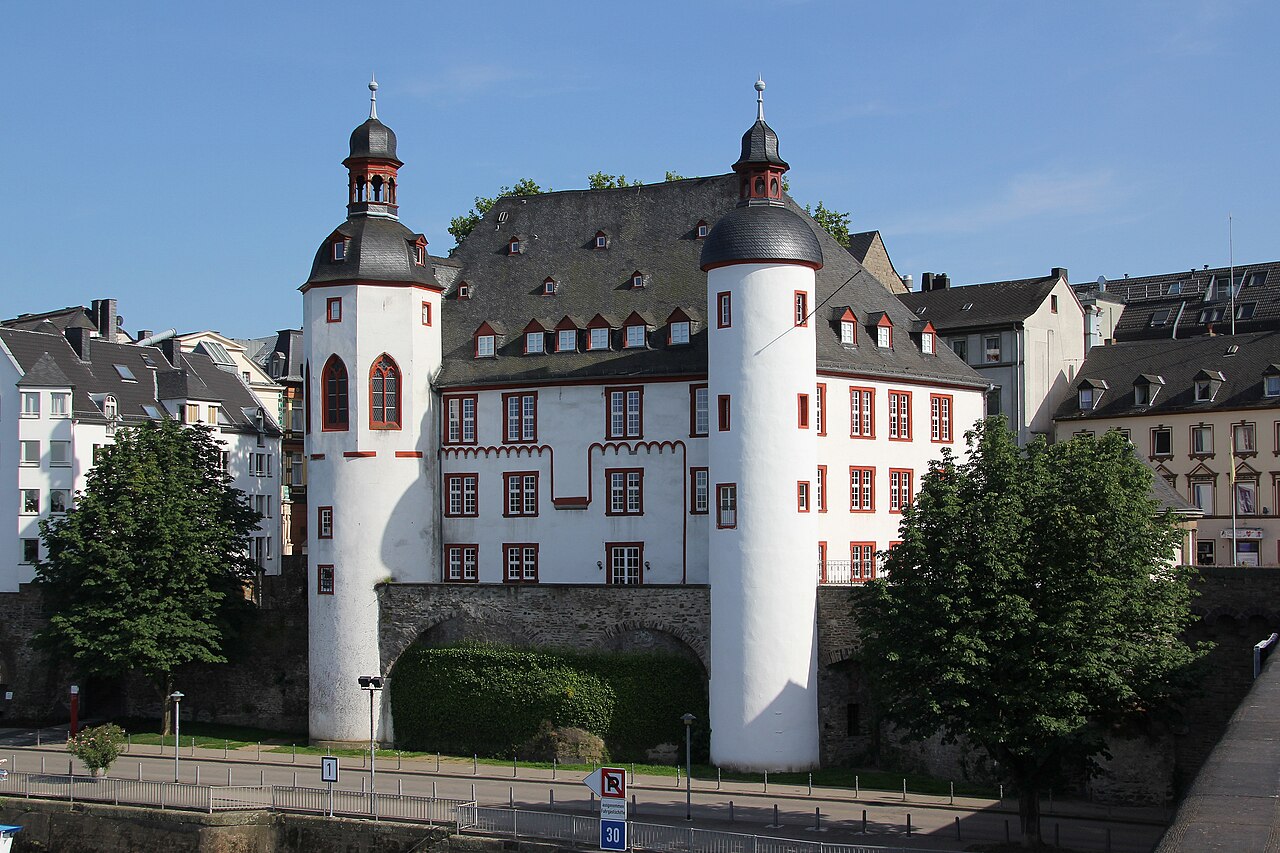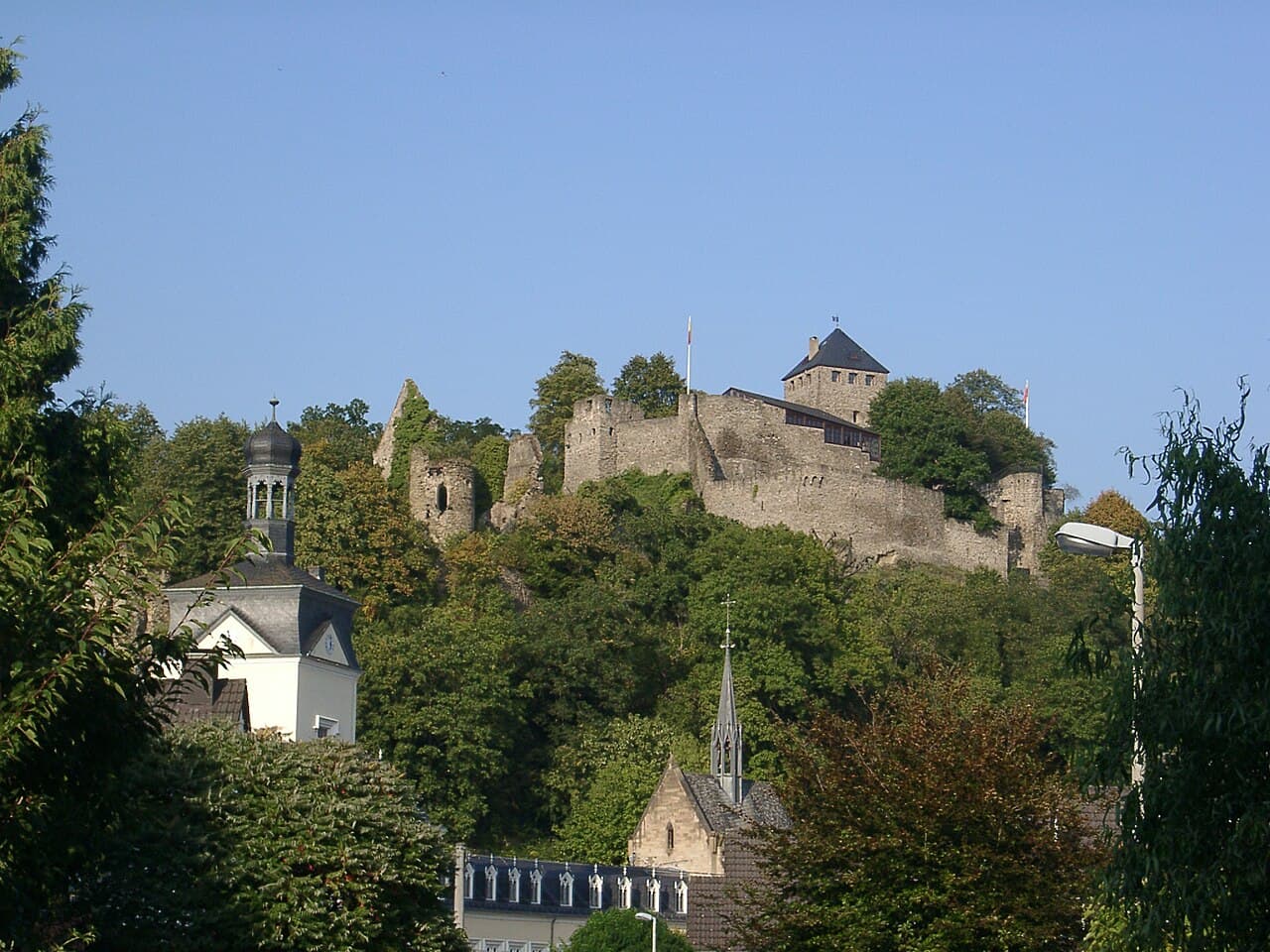
The ruins of Sayn Castle, located on the Kehrberg hill ridge in the Westerwald foothills, represent a significant example of high medieval spur castle architecture in the Rhineland-Palatinate region of Germany. Positioned strategically between the valleys of the Brexbach and Saynbach, the castle's elevated site provided natural defensive advantages with steep drops on the southern, western, and northern sides. The eastern approach, however, was fortified by a deep, wide artificial neck ditch and a formidable shield wall with a wall walk, emphasizing the castle's military importance during the 12th century.
Historical context and significance
Sayn Castle was the ancestral seat of the counts of Sayn and Sayn-Wittgenstein, a noble family influential in the region during the high medieval period. The castle's origins trace back to the 12th century, with archaeological evidence suggesting an even earlier predecessor, the Alte Burg or "Old Castle," from the 10th or 11th century, located further east on the same ridge. This earlier fortification's remnants indicate a long-standing strategic use of the site for regional control and defense.
Architectural features and layout
The bergfried and defensive structures
One of the most prominent surviving features of Sayn Castle is its roughly 20-metre-high bergfried, a tall tower that dominates the ruins. Constructed in the late 12th century, the bergfried's walls are exceptionally thick, measuring about 2.4 metres at the midpoint, highlighting its role as a last refuge and lookout point. This tower exemplifies typical high medieval military architecture, designed to withstand sieges and provide a vantage point over the surrounding landscape.
Extending from the bergfried is a wall with an allure (wall walk) that divides the inner bailey into two distinct courtyards. The castle's fortifications also include a 90-metre-long and 20-metre-wide zwinger in front of the southern enceinte, a narrow outer ward designed to trap attackers. This zwinger was protected by a small defensive tower to the east and a barbican to the west, further enhancing the castle's layered defenses.
Inner courtyards and residential buildings
Excavations have revealed that the palas, or main residential building, was originally situated on the south side of the smaller eastern courtyard but was later relocated to the western spur of the castle site. Today, only foundational remains survive, including a 25-metre-deep castle well and an octagonal staircase tower. These features indicate the castle's adaptation over time to meet residential and defensive needs.
At the southwestern corner of the inner ward, archaeologists uncovered the foundations of a castle chapel with a unique simultaneum design featuring three apses. The chapel's well-preserved, ornately decorated floor dates to around 1200, reflecting the cultural and religious significance of the site during the medieval period.
Surrounding structures and later additions
Below the castle ruins lies the village of Sayn, extending southwards, with Schloss Sayn at the foot of the hill. This Baroque palace, built in 1757, contrasts with the medieval ruins above. Between the schloss and the castle are two former castellan residences: the 15th-century Mittlere Burghaus, connected to the castle by a wall, and the 14th-century Von Steinschen Sitz (Stein Castle), associated with the lords of Stein from Nassau. These buildings illustrate the continued occupation and strategic importance of the site through later centuries.
Archaeological excavations and preservation
Recent excavations by the State Conservation Department have revealed critical insights into the castle's original layout and construction phases. The uncovering of the original access track through the southern gate zwinger offers a glimpse into medieval defensive strategies and the castle's functional design. Although the castle is now classified as ruins, key elements such as the bergfried, shield wall, and zwinger remain well-preserved, allowing visitors to appreciate the castle's formidable medieval architecture.
Visiting Sayn Castle today
Today, Sayn Castle stands as a notable archaeological site and a testament to the region's medieval heritage. Visitors can explore the ruins, including the towering bergfried and the extensive defensive walls, while also enjoying views of the surrounding Westerwald landscape. The proximity of Schloss Sayn and the historic castellan residences enriches the visitor experience, offering a layered understanding of the site's evolution from the high medieval period through the Baroque era.
Frequently asked questions (FAQ)
- How do I get to Sayn Castle?
- Sayn Castle is located in Bendorf, Germany, easily accessible by car or public transportation. If you are traveling by train, the nearest station is Bendorf, from where you can take a short bus ride or a pleasant walk to the castle.
- What is the historical significance of Sayn Castle?
- Sayn Castle dates back to the 13th century and has served as a noble residence for the Counts of Sayn. Its rich history includes various architectural renovations, reflecting the styles of different eras, which makes it an important landmark in the region.
- When was Sayn Castle built?
- Construction of Sayn Castle began in the early 13th century, with significant expansions occurring in the following centuries. The castle has undergone various modifications and restorations, particularly in the 19th century, which contribute to its unique architectural character.
- Can I visit Sayn Castle year-round?
- Yes, Sayn Castle is open to visitors throughout the year, although opening hours may vary by season. It's advisable to check the official website for specific visiting hours and any seasonal events that may be taking place during your visit.
- Why is Sayn Castle a popular tourist attraction?
- Sayn Castle attracts visitors due to its stunning architecture, picturesque location, and rich history. The surrounding gardens and park offer beautiful views, making it an ideal spot for photography and leisurely walks.
- Is it possible to tour the interiors of Sayn Castle?
- Yes, guided tours are available that allow visitors to explore the interior rooms of Sayn Castle, showcasing its historical artifacts and architectural details. These tours provide insights into the lives of the noble families who once resided there.
- What are the ticket prices for Sayn Castle?
- Ticket prices for Sayn Castle may vary depending on the type of tour you choose and any special exhibitions. Generally, adult tickets are reasonably priced, with discounts available for children and groups.
- What are the best times to visit Sayn Castle?
- The best times to visit Sayn Castle are during the spring and autumn when the weather is mild and the gardens are in full bloom. Additionally, visiting on weekdays can help you avoid larger crowds during the peak tourist season.
- Are there any nearby attractions to visit along with Sayn Castle?
- Yes, nearby attractions include the Sayn Park, which features beautiful landscapes perfect for walking and picnicking, as well as the charming town of Bendorf with its local shops and cafes. The region also offers various hiking trails that showcase the natural beauty of the area.

Information
Current owner
State Conservation Department
Loading map...
Visitor reviews
No reviews yet. Been here? Write the first review and help other travelers!
Write the first reviewVisited this castle? Share your experience
Your review helps other travelers and adds first-hand knowledge to our encyclopedia.