Grenzau Castle
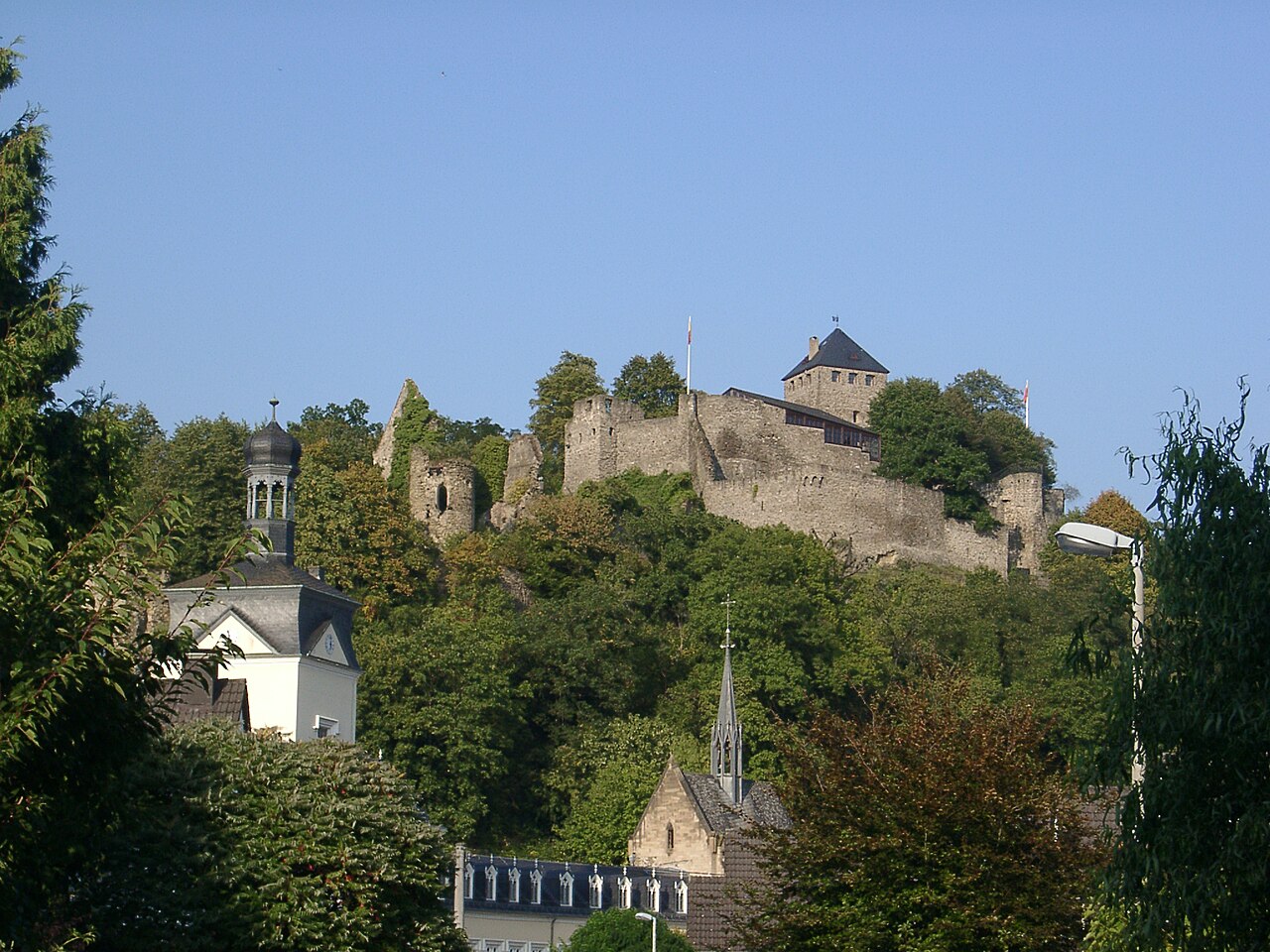
Grenzau Castle, locally known as Burg Grenzau, is a historic spur castle perched above Burgstrasse near Höhr-Grenzhausen in the Rhineland-Palatinate region of Germany. This castle is renowned for its unique triangular bergfried, a defensive tower standing 32 meters tall, which is unparalleled among German castles. Founded in the early 13th century by Henry I of Isenburg, Grenzau Castle has a rich history intertwined with regional power struggles, architectural evolution, and noble lineage.
Early history and strategic importance
Construction of Grenzau Castle began around 1210, with the first documented mention in 1213, when it was noted that Henry I had infringed the rights of the nearby Maria Laach Abbey. The castle was originally named Burg Gransioie, meaning "great joy" in Old French, a name that evolved into Grenzau by the mid-13th century. Strategically located, the castle controlled an important route from the Rhine valley near Bendorf into the Westerwald region, securing the Isenburg family's possessions and influence across the Lahn valley, including key territories such as Limburg and Meudt.
Medieval ownership and conflicts
Throughout the 14th century, Grenzau Castle was a focal point of regional conflicts and noble disputes. It was home to various branches of the Counts of Isenburg, who used it as a secondary residence and administrative center. In 1346, during the Grenzau Feud, Archbishop Baldwin of Trier captured the castle, and by 1347, Philip I of Isenburg recognized the overlordship of the Archbishopric of Trier. The castle also played a role in local governance, hosting a Kellerei (estate administration office) by the mid-15th century.
Fortifications and architectural developments
In 1557, the younger Salentine line of the Isenburg counts reinforced Grenzau Castle's defenses by adding artillery bastions and a roundel on the southern hillside, adapting the fortress to the evolving demands of warfare, particularly the use of firearms. The southern outwork, or Bollwerk, built around 1540, included a round artillery tower (Geschützturm) and two flanking walls (Flügelmauern), separated from the main enceinte by a neck ditch, providing layered defense.
Destruction and decline
During the Thirty Years' War, Grenzau Castle suffered significant damage when it was set ablaze by French troops on 14 March 1635. Although it remained under Isenburg control until the death of Count Ernest of Isenburg-Grenzau in 1664, the castle was badly damaged and subsequently returned to the Electorate of Trier. Over the 18th century, the castle gradually fell into disrepair. Notably, its chapel was demolished in 1788 and rebuilt elsewhere, and the roof of the bergfried collapsed in 1793, marking the castle's transition into a ruin.
Modern ownership and preservation efforts
Following the territorial reorganizations of the early 19th century, Grenzau Castle passed through various hands, including Nassau-Weilburg and the Kingdom of Prussia. In 1925, architect Rudolph Arthur Zichner acquired the site and made it available to the Nerother Wandervogel youth group. Later, in 1953, Professor Hans Spiegel purchased the castle and undertook significant preservation work, including archaeological excavations and partial reconstructions. Since Spiegel's death in 1987, his descendants have maintained the castle through a dedicated family society, ensuring its conservation and accessibility to the public during summer weekends.
Architectural features and remains
Grenzau Castle is notable for its mid-13th century triangular bergfried, which rises approximately 32 meters over four floors and stands prominently above the northern neck ditch. This triangular tower is unique in Germany and may reflect architectural influences from the Austrian Peilstein family. The castle's layout includes two baileys: an inner ward forming the core of the fortress and an outer ward to the west, though the latter has mostly not survived.
Defensive structures
The southern defenses feature the Bollwerk bastion with its round artillery tower and flanking walls, designed to withstand early artillery fire. The 14th-century gatehouse on the south side remains partially intact, including a small round tourelle that served as a lookout and defensive position. The castle was further protected by neck ditches that separated key defensive elements, enhancing its resilience against attackers.
Residential and administrative buildings
West of the bergfried lie the ruins of the palas, the main residential building that housed the castle's lords and administrative offices. Though fragmentary, these remains provide insight into the living conditions and governance functions within the castle. The former chapel, once integral to the castle's religious life, was dismantled and relocated in the late 18th century.
Cultural significance and visitor information
Today, Grenzau Castle remains a captivating ruin that offers a glimpse into medieval fortification techniques and noble life. Its unique triangular bergfried attracts architectural historians and castle enthusiasts alike. Although privately owned, the castle is accessible to visitors during summer weekends, providing an opportunity to explore its historical structures and enjoy panoramic views of the surrounding Rhineland-Palatinate countryside.
Visitors can appreciate the castle's layered defenses, the distinctive tower, and the ruins of its residential quarters, all set within a scenic hilltop location. The preservation efforts by the Spiegel family have ensured that Grenzau Castle continues to be a valuable cultural heritage site, reflecting the complex history of the Isenburg family and the broader medieval landscape of Germany.
Frequently asked questions (FAQ)
- How do I visit Grenzau Castle?
- Grenzau Castle is privately owned but open to the public during summer weekends. Visitors can explore the ruins and enjoy scenic views of the surrounding area.
- What makes Grenzau Castle architecturally unique?
- The castle features a rare triangular bergfried, a defensive tower unique in Germany, standing 32 meters tall and dating from the mid-13th century.
- When was Grenzau Castle built?
- Grenzau Castle was constructed around 1210 by Henry I of Isenburg and first mentioned in documents from 1213.
- What historical events affected Grenzau Castle?
- The castle was involved in the Grenzau Feud of 1346, captured by Archbishop Baldwin of Trier, and was burned by French troops during the Thirty Years' War in 1635.
- Is there an entry fee to visit Grenzau Castle?
- There is no entry fee to visit Grenzau Castle; access is free during the open summer weekends.
Information
Opening hours
Accessible during summer weekends
Ticket prices
Free
Current owner
Private owner
Address
Above Burgstrasse, Höhr-Grenzhausen, Germany
Loading map...
Visitor reviews
No reviews yet. Been here? Write the first review and help other travelers!
Write the first reviewVisited this castle? Share your experience
Your review helps other travelers and adds first-hand knowledge to our encyclopedia.