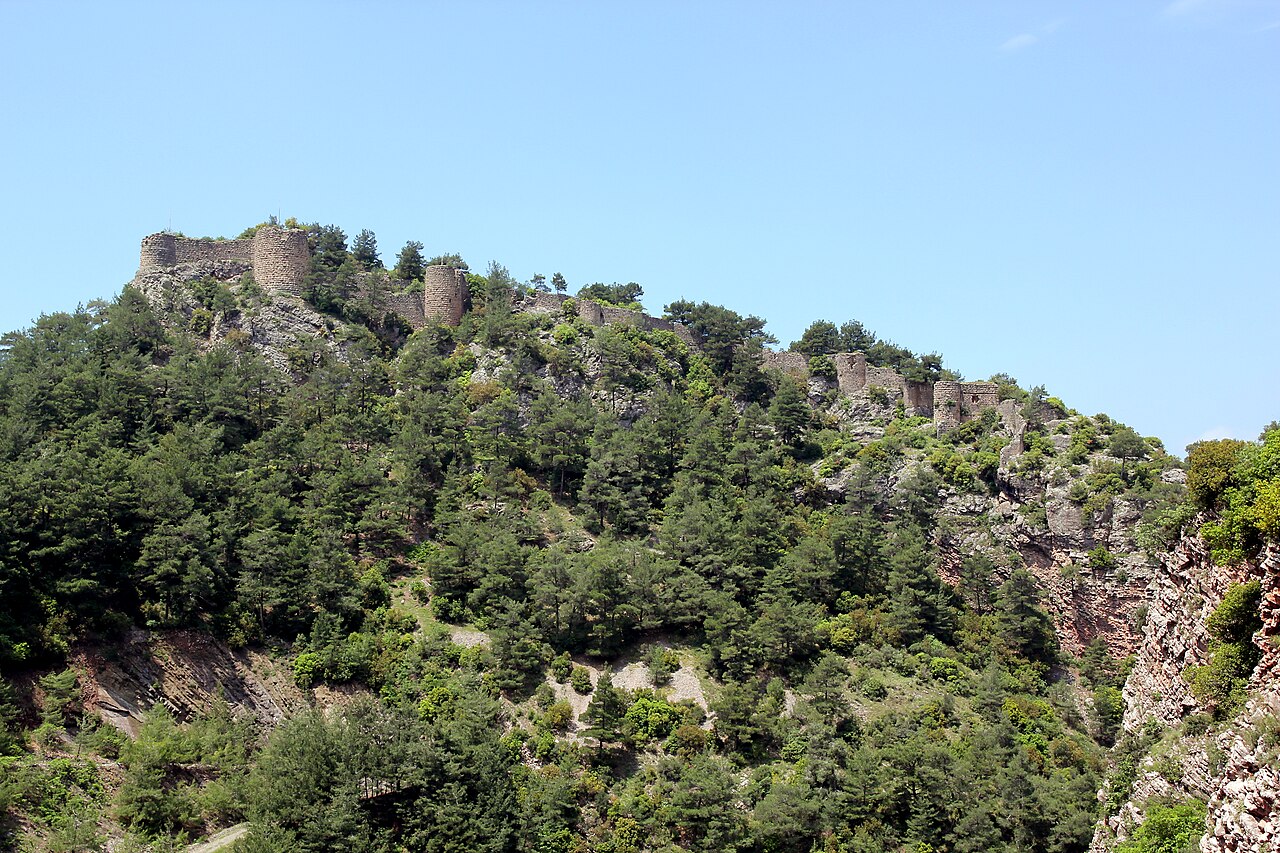
Savranda Castle
Savranda Castle, also known historically as Sarvandikar, Servantikar, or Savuran, is a prominent medieval fortress located on a limestone outcrop south of the village of Kalecik in the Osmaniye Province of Turkey. This high medieval castle was strategically positioned to control the Amanian Gates, a crucial mountain pass through the Nur Mountains (historically the Amanus Mountains), which served as a natural border between the historical regions of Cilicia and Syria.
Constructed most likely in the 11th century, Savranda Castle first appears in historical records in 1069, when it was garrisoned by Byzantine soldiers. Its location was vital for monitoring and controlling movement through the Amanian Gates, a key passage in medieval military and trade routes.
Historical significance and ownership transitions
During the First Crusade (1096-1099), the castle came under the control of the Crusaders. In the years 1101-1102, it gained notoriety as the prison site of Raymond IV, Count of Toulouse, who was held captive by Tancred, Prince of Galilee and regent of Antioch. This event underscores the castle's strategic importance during the Crusader period.
In 1135, the castle was seized by the Armenian baron Levon I of the Rubenid family from its Frankish lord, the Count of Maraş. However, the following year, Levon was captured by the Franks and ransomed with Savranda Castle included as part of the payment, illustrating the castle's value as a bargaining asset.
Between 1172 and 1175, Savranda returned to Armenian hands but was again handed back to the Prince of Antioch in 1185 as ransom for the release of Ruben III, Prince of Armenia, Levon I's son. This cycle of control highlights the castle's contested status amid the power struggles between Armenian and Frankish forces.
By the 1190s, the castle was controlled by Smbat, an Armenian baron from the Hethumid family, whose descendants maintained possession until the late 13th century. The castle sustained considerable damage during a significant earthquake in April 1269, reflecting the vulnerability of medieval fortifications to natural disasters.
In 1298, the castle was temporarily occupied by Mamluk soldiers. The Mamluks returned in 1337 to capture Savranda permanently, ending Armenian control. After this, the castle fades from historical records, marking the end of its active military role.
Architectural features and layout
Savranda Castle is notable for its commanding position on a precipice of an ascending limestone outcrop, with its defensive walls and towers following the natural contours of the rock. The castle's fortifications take advantage of the steep cliffs, providing formidable natural defenses on several sides.
The castle complex includes multiple fortified towers integrated into the curtain walls, designed to provide overlapping fields of fire and strong defensive positions. The walls themselves are constructed to adapt to the irregular terrain, demonstrating advanced medieval engineering skills.
Beneath the castle lies a canyon carved by the Akçasu Stream, adding an additional natural barrier. Historically, a medieval village existed below the castle, but it was submerged during the construction of the Kalecik Reservoir and Dam around 1980, which altered the surrounding landscape.
Interior and current condition
The interior of Savranda Castle is heavily overgrown with forest vegetation, which can make navigation challenging and potentially hazardous due to collapsed vaulted chambers and cisterns. Despite this, the castle remains freely accessible to visitors who are advised to exercise caution.
The castle's current state is partially preserved, with significant structural elements still visible, though some areas have suffered from natural decay and the effects of seismic activity. The region experienced a devastating earthquake in 2023, which likely caused additional damage to the already fragile ruins.
Cultural and historical importance
Savranda Castle stands as a testament to the complex history of the Cilicia region, reflecting the shifting control between Byzantine, Crusader, Armenian, and Mamluk powers. Its strategic location at the Amanian Gates made it a focal point in medieval military campaigns and political negotiations.
The castle's architectural adaptations to its rugged environment illustrate medieval military architecture's responsiveness to natural terrain. Its layered history offers insights into the regional dynamics of power, conflict, and cultural interchange during the high medieval period.
Visiting savranda castle
Visitors to Savranda Castle can reach the site by a short walk along a forest path leading to the entrance. The castle's remote and rugged setting offers a glimpse into medieval fortification strategies and panoramic views of the surrounding Nur Mountains.
Due to the overgrown interior and structural hazards, visitors should be cautious when exploring the castle grounds. There are no formal visitor facilities or guided tours, so preparation and appropriate footwear are recommended.
Frequently asked questions (FAQ)
- How do I get to Savranda Castle?
- Savranda Castle is accessible by a short walk along a forest path from the nearest village of Kalecik in Osmaniye Province, Turkey. The path leads directly to the castle entrance, but visitors should be prepared for a rugged terrain.
- What is the historical significance of Savranda Castle?
- Savranda Castle was strategically built in the 11th century to control the Amanian Gates, a key mountain pass in the Nur Mountains. It played a crucial role during the Byzantine, Crusader, Armenian, and Mamluk periods, reflecting the region's turbulent medieval history.
- Is Savranda Castle safe to explore?
- While the castle is freely accessible, the interior is overgrown and contains collapsed vaulted spaces and cisterns. Visitors should exercise caution and wear appropriate footwear to avoid accidents.
- When was Savranda Castle built?
- Savranda Castle was most likely constructed in the 11th century, with the first historical record dating to 1069.
- Can I visit Savranda Castle year-round?
- There are no official visiting hours or restrictions, so Savranda Castle can be visited year-round. However, the best time to visit is during the spring and autumn months when the weather is mild and the forest paths are more accessible.
Information
Loading map...
Visitor reviews
No reviews yet. Been here? Write the first review and help other travelers!
Write the first reviewVisited this castle? Share your experience
Your review helps other travelers and adds first-hand knowledge to our encyclopedia.