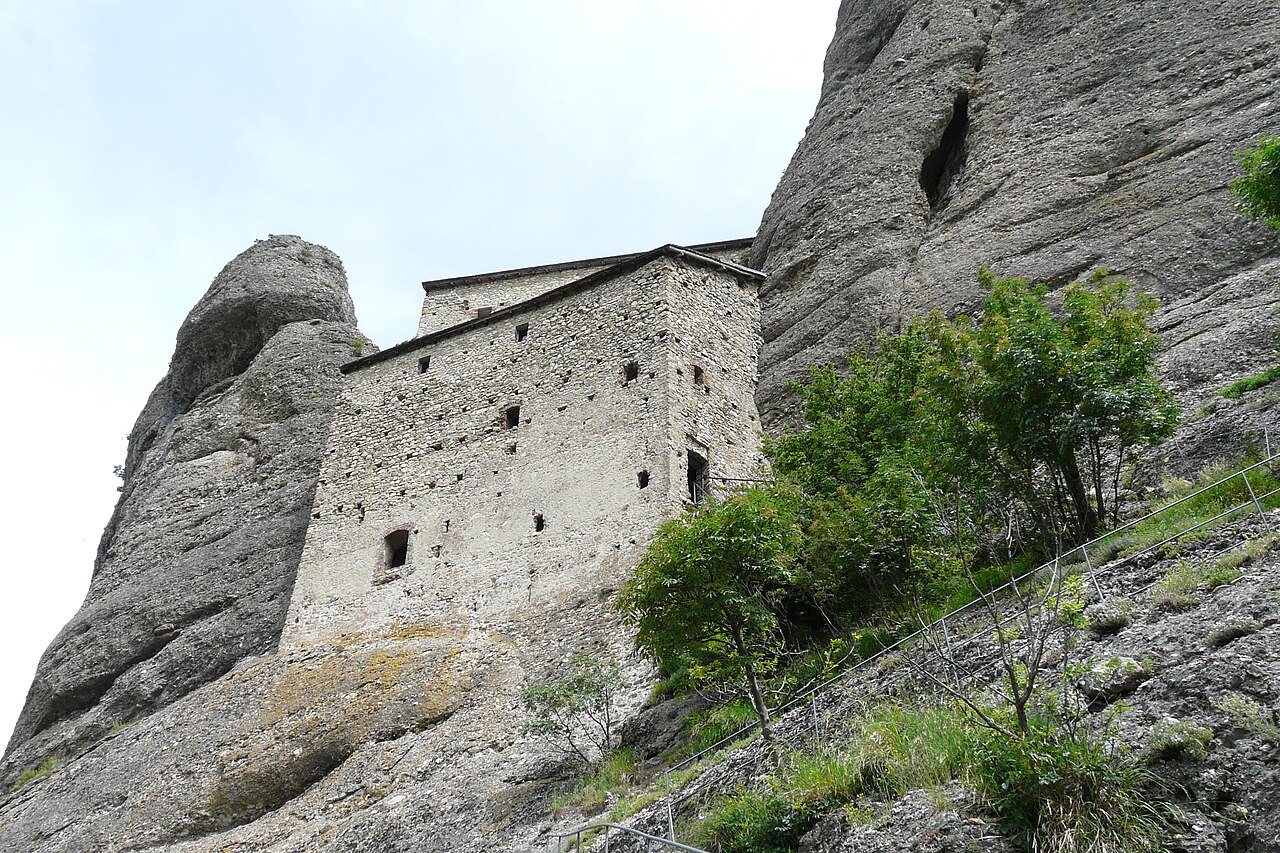
Savignone Castle
Savignone Castle stands as a significant high medieval fortress located in the town of Savignone, Italy. Its strategic placement on a conglomerate spur with a sheer cliff of approximately 150 metres on one side provided a formidable natural defense. The castle's most distinctive architectural feature is its semi-circular great tower accompanied by a robust rear rampart, which together formed the core of its defensive system. This positioning allowed control over the vital Scrivia Valley, an important corridor linking the powerful maritime republic of Genoa with the fertile Po Valley and the interior of northern Italy.
Historical background and the fieschi lineage
The castle came under the possession of the Fieschi family in the 13th century, a noble Genoese lineage with significant political and military influence in the region. The Fieschis were divided into two main branches, one of which was known as the Savignone lineage, descending from Ugo Fieschi, the founder of this branch. The fief of Savignone was a valuable asset for the family due to its strategic location and its role in overseeing traffic and trade routes through the valley.
During the 14th century, the castle changed hands several times among notable figures including Andronico Botta and Antoniotto Adorno, both influential in the politics of Genoa. However, it was Obietto Fieschi who managed to reacquire the castle, although he later lost it again amid the turbulent conflicts with the Sforza family, who sought to expand their control over the region. The Sforzas eventually gained possession of Savignone and the nearby Montoggio estates, marking a period of contest and rivalry.
The fieschi state and its decline
The most notable figure associated with Savignone Castle was Gian Luigi Fieschi, who successfully expelled the Milanese Sforza influence from the valley, establishing what became known as the "Fieschi state". This period marked the peak of the family's dominance in the area, with Savignone serving as a key stronghold.
The fortunes of the Fieschi family and their castle intertwined closely with the political ambitions and upheavals in Genoa. The infamous Fieschi conspiracy of 1547 dramatically altered the family's standing. Although the siege of Montoggio that followed had less direct impact on Savignone, it nonetheless contributed to the gradual decline of the Fieschi's influence. After these events, the castle and the family lost much of their former prominence in the history of Genoa and the Scrivia Valley.
Architectural features and defensive design
The castle’s architecture reflects its military purpose and the adaptations made over centuries of conflict. The semi-circular great tower was designed to provide a wide field of fire for defenders and to resist siege engines. The rear rampart fortified the less naturally protected side of the castle, ensuring a strong defensive perimeter.
Built primarily in the early 13th century, the castle’s stonework and layout are characteristic of high medieval military architecture in northern Italy. The use of the natural cliff as a defensive barrier reduced the need for extensive fortifications on that side, demonstrating a strategic use of the landscape.
Savignone castle in the context of regional history
Situated in the Liguria region, Savignone Castle played a crucial role in controlling the traffic between the coast and the interior. Its position allowed the Fieschi family to monitor and influence trade routes, which was essential for maintaining their power and wealth.
The castle’s history is intertwined with the broader political dynamics of Genoa, including alliances, conflicts, and power struggles with other noble families such as the Adornos and the Sforzas. These rivalries shaped the castle’s fate and the region’s history during the medieval and early Renaissance periods.
Current status and cultural significance
Today, Savignone Castle remains an important cultural and historical landmark. Although it is partially preserved, the castle’s ruins still convey its former strength and strategic importance. The site attracts historians, architects, and visitors interested in medieval military architecture and the complex history of northern Italy.
The castle’s legacy is preserved through local heritage efforts and serves as a tangible connection to the region’s medieval past, the power struggles of noble families, and the evolution of fortification techniques.
Frequently asked questions (FAQ)
- What is the historical significance of Savignone Castle?
- Savignone Castle, dating back to the 11th century, played a crucial role in the defense of the region during the Middle Ages. Its strategic location allowed it to oversee important trade routes, making it a key stronghold for local nobility.
- When was Savignone Castle built?
- The construction of Savignone Castle began in the early 11th century, with various renovations and expansions occurring over the centuries. Its architecture reflects the evolution of military design from the medieval period through the Renaissance.
- Can I visit Savignone Castle?
- Yes, Savignone Castle is open to visitors, allowing you to explore its fascinating history and stunning views. Guided tours are often available, providing insights into the castle's architecture and its historical context.
- What are the opening hours for Savignone Castle?
- Savignone Castle typically opens to visitors from 10 AM to 6 PM, but it’s advisable to check the official website or contact the castle for the latest information on hours and any special events.
- Is it possible to access Savignone Castle by public transport?
- Yes, Savignone Castle is accessible via public transport, with regular bus services connecting it to nearby towns. However, some walking may be required to reach the castle from the nearest bus stop, so be prepared for a short hike.
- What is the best time to visit Savignone Castle?
- The best time to visit Savignone Castle is during the spring and early autumn months when the weather is pleasant and conducive to exploring the outdoors. These seasons also offer beautiful views of the surrounding landscape.
- Are there any nearby attractions to Savignone Castle?
- Yes, nearby attractions include the charming village of Savignone, with its quaint streets and local shops, as well as hiking trails that offer scenic views of the Ligurian countryside. Additionally, the city of Genoa is just a short drive away, providing more cultural experiences.
- How much does it cost to visit Savignone Castle?
- Ticket prices for Savignone Castle are generally affordable, with discounts available for children, students, and seniors. It's best to check the official website for current pricing and any special offers or group rates.
Loading map...
Visitor reviews
No reviews yet. Been here? Write the first review and help other travelers!
Write the first reviewVisited this castle? Share your experience
Your review helps other travelers and adds first-hand knowledge to our encyclopedia.