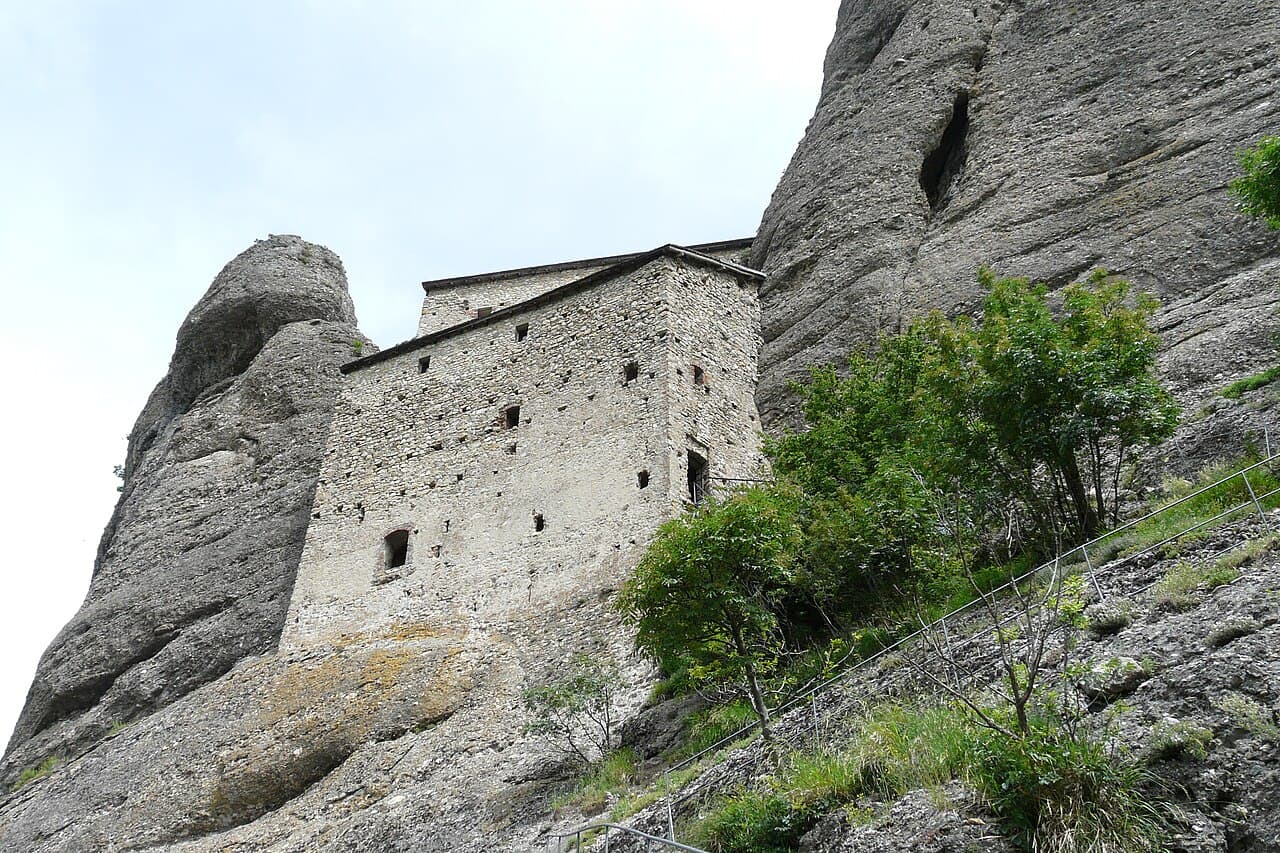
Pietra di Vobbia Castle
Pietra di Vobbia Castle stands as a remarkable example of medieval military architecture harmoniously integrated with its natural environment. Perched dramatically between two towering rock formations, this hill castle overlooks the strategic Scrivia Valley in northern Italy. Its unique location and construction make it a rare case of a fortress where human ingenuity and nature's defenses combine to create an almost impregnable stronghold.
Built around the year 1000 AD, the castle was designed to control vital medieval trade routes, notably the road connecting Vobbia to Canton Island along the historic Via del Sale (Salt Road) and the Postumia road. This positioning enabled the castle’s occupants to monitor and regulate traffic across four provinces: Genoa, Alessandria, Pavia, and Piacenza. The fortress’s name derives from the influential Opizzone della Pietra family, who held the feudal rights over the area and after whom the castle was named.
Architectural features and strategic location
One of the castle’s most striking features is its integration with the natural rock spurs on which it is built. The fortress is essentially embedded between two massive natural towers, which form part of the defensive system. This natural fortification made it exceedingly difficult for enemies to launch a successful assault, as evidenced by historical records of failed sieges and hostage situations, such as the 13th-century incident when the Republic of Genoa intervened to rescue captives held by the Opizzone family.
The castle’s layout is divided into two main sections situated on different elevations, maximizing the defensive advantage provided by the rugged terrain. The lower section, known as the forepart, is a three-story structure that once served as the initial line of defense and access point. Modern restoration has stabilized this area and added metal grid flooring to facilitate visitor access while preserving the original masonry.
Above the forepart lies a central hall with a square plan and vaulted ceiling, which remains accessible today. Restoration efforts have also reconstructed a roof with an attic space connected to the hall and a battlement walkway, indicating the dual residential and military functions of the castle. The battlement walkway allowed defenders to patrol and repel attackers effectively.
Water management and self-sufficiency
A critical feature of the castle’s design is its sophisticated water management system, essential for sustaining life during sieges. Beneath the western natural rock spur, known as the "torrione," lies a large cistern carved directly into the bedrock. This cistern collected rainwater channeled from the roofs through grooves carved into the stone, a system that remains partially preserved and visible today. A smaller cistern located under the central hall floor further emphasizes the castle’s self-sufficiency and the importance of water storage in medieval fortresses.
Historical significance and ownership
The earliest documented mention of the castle dates to the mid-13th century, specifically 1252, when the feudal lord Opizzone della Pietra is recorded as its owner. The castle served as a regional administrative and military center, exerting control over surrounding territories including the Alta Val Borbera beyond San Fermo hill.
Following the death of Guglielmo della Pietra, the castle passed to the powerful Spinola family, a noble house closely linked to the Republic of Genoa. The Spinola maintained control until the early 16th century, when ownership transferred by will to the Adorno family—another prominent Genoese lineage. Notable figures include Tolomeo Spinola, who bequeathed the castle in 1518, and Prospero Adorno, who formally acquired it in 1565. By 1575, the fortress was under the control of Girolamo Adorno.
The castle’s strategic importance persisted into the Renaissance. In 1579, it was briefly seized by bandits but quickly retaken by Giorgio Centurione acting on behalf of the Genoese Senate. This episode highlights the fortress’s continued military relevance during a period of political turbulence.
In 1620, sovereignty over the castle shifted when Emperor Matthias of Habsburg incorporated it into the Pallavicino fiefdom in Val Borbera. Although this reduced the castle’s autonomy, it remained a semi-independent enclave until the late 18th century. The domain governed from the castle extended to nearby localities such as Torre di Vobbia, Pareto in Val Brevenna, and Gordena in Alta Val Borbera.
Decline and restoration
The castle’s decline began during the upheavals of the late 18th century. In 1797, French Revolutionary forces entered the region, and following Napoleon Bonaparte’s abolition of imperial fiefs, the castle lost its feudal status. Its last private owner, Michele Bisio, abandoned the fortress, which was subsequently set on fire, causing significant damage.
After the destruction, the castle’s bronze cannons were melted down by the Bishop of Tortona to create bells for the Santa Croce church in Crocefieschi, symbolically linking the fortress to local religious heritage. Ownership passed from the Botta Adorno family to the Cusani Visconti family in 1882, and eventually to Giovanni Battista Beroldo in 1919. His descendants donated the castle to the Municipality of Vobbia in 1979, initiating preservation and restoration efforts that continue to protect the site today.
Architectural remains and visitor experience
The ruins of Castello della Pietra offer a vivid glimpse into medieval fortress design adapted to a rugged hillside environment. The castle is constructed from local conglomerate stone, typical of the region, and features robust stone masonry consistent with high medieval military architecture.
The site’s two-level layout maximizes natural defensive advantages, with the forepart serving as the initial barrier and the upper sections housing residential and defensive spaces. Visitors can explore the stabilized lower section with its modern walkways, access the vaulted central hall, and observe the battlement walkway, which provides panoramic views of the surrounding valley.
Archaeological studies have helped clarify the castle’s construction phases and defensive mechanisms, confirming that despite centuries of decay, the castle retains much of its original spatial organization and character. The integration of natural rock formations into the fortification system remains one of the castle’s most distinctive and impressive features.
Today, Pietra di Vobbia Castle stands as a testament to medieval military ingenuity and feudal power, offering visitors a unique opportunity to experience a fortress that blends seamlessly with its natural surroundings. Its restoration and preservation allow for educational visits that highlight the complex history and architectural sophistication of this rare hillside stronghold.
Frequently asked questions (FAQ)
- How do I get to Pietra di Vobbia Castle?
- Pietra di Vobbia Castle is located in Vobbia, Italy, and can be accessed by car or public transport. The nearest major city is Genoa, from which you can take a train or bus to reach the castle area.
- What is the historical significance of Pietra di Vobbia Castle?
- Pietra di Vobbia Castle dates back to the 13th century and played a crucial role in the defense of the territory against invaders. Its strategic location and robust architecture reflect the turbulent history of the region during the medieval period.
- When was Pietra di Vobbia Castle built?
- The construction of Pietra di Vobbia Castle began in the early 1200s, with significant renovations occurring in the following centuries. Its enduring structure showcases the medieval architectural style prevalent during its time.
- Can I visit Pietra di Vobbia Castle?
- Yes, visitors are welcome to explore Pietra di Vobbia Castle and its surroundings. Guided tours are often available, allowing you to learn about the castle’s history and architecture.
- Why is Pietra di Vobbia Castle popular among tourists?
- Pietra di Vobbia Castle attracts tourists due to its picturesque setting and rich historical background. The castle offers stunning views of the surrounding landscape, making it a perfect spot for photography and exploration.
- Is it possible to access the castle with limited mobility?
- While Pietra di Vobbia Castle has some paths that may be challenging for those with limited mobility, efforts have been made to improve accessibility. It is advisable to contact the castle management in advance for specific accessibility options and support.
- What are the opening hours for Pietra di Vobbia Castle?
- Pietra di Vobbia Castle typically opens to visitors from April to October, with varying hours during the peak season. It is recommended to check the official website or local tourism information for the most current opening hours before your visit.
- What are the ticket prices for visiting Pietra di Vobbia Castle?
- Ticket prices for Pietra di Vobbia Castle are generally affordable, with discounts available for children and students. Special rates may apply for guided tours, so it's best to review the pricing details on the official website before planning your visit.
- What nearby attractions can I visit while at Pietra di Vobbia Castle?
- While visiting Pietra di Vobbia Castle, you can explore nearby attractions such as the picturesque village of Vobbia and the beautiful natural landscapes of the surrounding region. Hiking trails and local eateries enhance your experience in this charming area.
Photo gallery

Information
Loading map...
Visitor reviews
No reviews yet. Been here? Write the first review and help other travelers!
Write the first reviewVisited this castle? Share your experience
Your review helps other travelers and adds first-hand knowledge to our encyclopedia.



