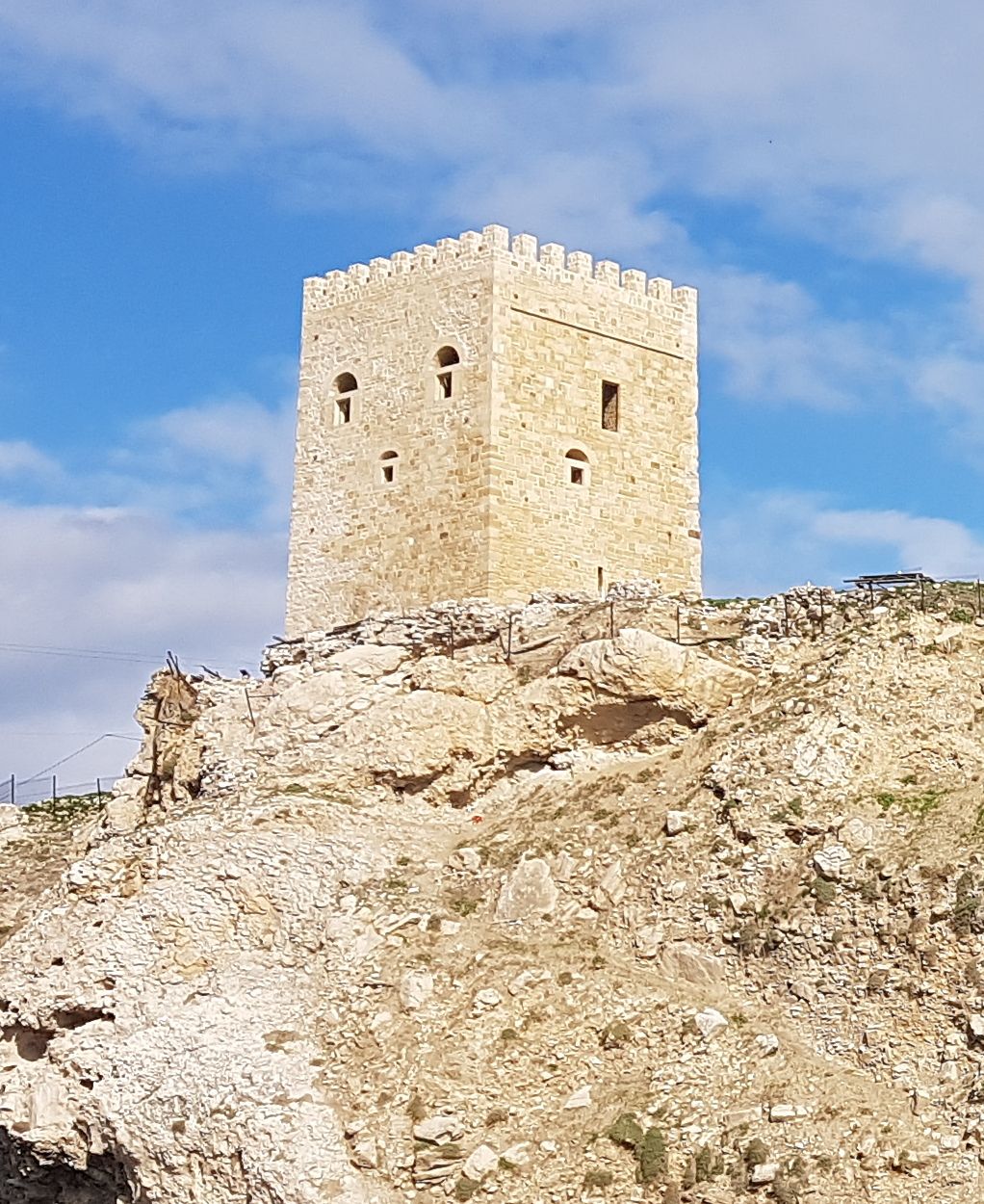
Sarıkavak Castle

Sarıkavak Castle in Hasanlı, Istanbul: Byzantine hilltop fortress
Hasanlı, Istanbul, Turkey
High Medieval (11th–13th c.)
Ruins

Sarıkavak Castle, also known locally as Sarıkavak Kalesi, is a historical fortress located west of the village of Hasanlı in the Istanbul province of Turkey. This Byzantine-era castle is situated on a steep hill, providing a commanding view of the surrounding landscape. Its strategic position likely served to control an important route between Şile and Gebze, as well as a ford across a tributary of the Yeşildere stream, which flows to the north and east of the castle hill.

Strategic location and historical context

Constructed during the Byzantine period, Sarıkavak Castle was part of a network of fortifications designed to protect the approaches to Constantinople and secure local transportation routes. The castle's placement on a steep, kidney-shaped hill allowed it to oversee and control movement along the nearby roads and waterways, which were vital for trade and military logistics.

Although detailed historical records about Sarıkavak Castle are scarce, its architectural features and location suggest it played a defensive role during the Middle Ages, particularly in securing the eastern approaches to the city of Istanbul. It may have also functioned as a watchtower or signal station within the Byzantine defensive system.

Architectural features and layout

The castle's kidney-shaped plan adapts to the natural contours of the hill. Significant remains of three towers still stand, indicating a well-fortified structure. These towers were likely used both for defense and as observation posts. The walls connecting the towers are partially preserved, constructed from local stone and mortar typical of Byzantine military architecture.

It is believed that the original entrance to the castle was located near the southern tower, along the eastern wall. This positioning would have provided a defensible access point, possibly protected by a gatehouse or barbican, although these features are no longer visible due to the castle's ruinous state and dense overgrowth.

The castle hill is currently covered in forest, and the ruins are heavily overgrown, making the remains difficult to spot except at close range. The natural vegetation has helped preserve some of the stonework but also obscures the full extent of the site.

Visiting Sarıkavak Castle today

Sarıkavak Castle is freely accessible to visitors, though reaching the site requires a considerable hike as there are no modern roads leading directly to it. The path to the castle passes through forested terrain, and visitors should be prepared for a moderately challenging trek. The remote location and natural surroundings offer a peaceful atmosphere for those interested in Byzantine history and medieval fortifications.

Visitors are advised to be cautious of the local wildlife, including wild turtles that inhabit the area around the ruins. Due to the castle's overgrown condition, exploration requires careful footing to avoid damaging the fragile remains or disturbing the natural habitat.

Preservation and archaeological significance

Currently, Sarıkavak Castle is in a state of ruins with only partial walls and towers standing. The site has not undergone extensive archaeological excavation or restoration, which leaves much of its history and architectural details to be uncovered. Its preservation is challenged by natural overgrowth and the absence of protective measures.

Despite limited research, Sarıkavak Castle remains an important example of Byzantine military architecture in the Istanbul region. It offers valuable insights into the defensive strategies employed along the approaches to the Byzantine capital and contributes to the understanding of medieval fortifications in northwestern Turkey.

Frequently asked questions (FAQ)

How do I get to Sarıkavak Castle?
Sarıkavak Castle is located west of Hasanlı village and requires a hike through forested terrain as there are no direct roads. Visitors should prepare for a moderately challenging walk to reach the site.
What is the historical significance of Sarıkavak Castle?
Sarıkavak Castle is a Byzantine fortress that controlled a strategic route between Şile and Gebze and guarded a ford across a tributary of the Yeşildere stream. It played a defensive role in the region during the Middle Ages.
Can I freely visit Sarıkavak Castle?
Yes, Sarıkavak Castle is freely accessible to the public. However, the ruins are overgrown and located in a remote area, so visitors should be cautious and respect the natural environment.
What remains of Sarıkavak Castle can be seen today?
Visitors can see substantial remains of three towers and several sections of defensive walls. The castle hill is forested and the ruins are heavily overgrown, visible mainly when standing close to them.
Is Sarıkavak Castle suitable for casual tourists?
Due to its remote location and overgrown state, Sarıkavak Castle is best suited for visitors interested in hiking, history, and archaeology rather than casual tourists seeking easy access.

Information

Hill Castle

Loading map...

Visitor reviews

No reviews yet. Been here? Write the first review and help other travelers!

Write the first review

Visited this castle? Share your experience

Your review helps other travelers and adds first-hand knowledge to our encyclopedia.

Write a review

(5/5)

0/2000 characters

Your review will be visible after admin approval

Nearby castles

15.7 km

Heciz Castle

Eski İstanbul Şile Yolu, Turkey

Heciz Castle, locally known as Heciz Kalesi, is a historic Byzantine fortress located east of the hamlet of Kalealtı in the Istanbul province of Turkey. This castle occupies a strategic position on a hill overlooking a bend in the stream that runs through the valley below, suggesting its original purpose was to control and monitor the important road connecting Constantinople (modern-day Istanbul) to the coastal town of Şile. Architectural layout and features The castle is notable for its triangular plan, a design that provided effective defense by minimizing blind spots and making the most of the natural terrain. Its location on elevated ground offered commanding views of the surrounding wooded valley, which was an advantage for surveillance and defense. Despite the overgrown and wooded nature of the site today, several structural elements remain visible. There are the ruins of three towers, some of which retain connecting wall fragments. These towers would have served as lookout points and defensive strongholds within the castle's perimeter. The walls, though partially ruined, indicate a robust fortification system typical of Byzantine military architecture. Currently, two entrances can be identified. The main entrance is situated in the south, adjacent to the largest ruined tower, and is believed to be the original gate of the castle. A second entrance on the western wall appears to be a later addition, possibly from a more modern period, reflecting changes in the site's use or access requirements over time. Within the castle's interior, no significant remains of buildings or chambers have been identified, likely due to centuries of decay and vegetation overgrowth. The absence of extensive interior structures suggests the castle primarily functioned as a military outpost rather than a residential complex. Historical context and significance Built during the Byzantine period, Heciz Castle was part of a network of fortifications designed to protect the approaches to Constantinople, the capital of the Byzantine Empire. Its position along the route to Şile indicates its role in controlling traffic and securing the region against potential threats from the Black Sea coast or inland incursions. While detailed historical records of Heciz Castle are scarce, its architectural characteristics and strategic location align with Byzantine defensive strategies of the Middle Ages. The castle likely served as a small garrison post, providing early warning and defense rather than a large-scale fortress. Current condition and visitor information Today, Heciz Castle is in a ruined and overgrown state, with much of its structure obscured by dense vegetation. The site is freely accessible to visitors, although the terrain can be challenging due to the natural undergrowth and wild animals such as turtles that inhabit the area. Visitors should exercise caution when exploring the ruins, as the uneven ground and remnants of walls and towers can pose hazards. The castle offers a quiet and somewhat isolated glimpse into Byzantine military architecture, though it is less developed as a tourist site compared to other castles in the region. Architectural significance within the region Heciz Castle exemplifies the typical Byzantine hill castle designed for strategic oversight rather than grand residential purposes. Its triangular shape is relatively uncommon and reflects a tailored adaptation to the local topography. The surviving towers and walls provide valuable insight into the defensive techniques employed in the Byzantine Empire during the Middle Ages. The castle's proximity to Istanbul, a city rich in historical fortifications, places it within a broader context of imperial defense systems that protected one of the most important cities in medieval Europe and Asia. Exploring the surrounding area The region around Heciz Castle is characterized by natural woodland and a rural landscape that has changed little since the castle's active use. The nearby road connecting Istanbul to Şile remains a significant route, linking the inland areas with the Black Sea coast. Visitors interested in Byzantine history and architecture may find Heciz Castle an intriguing, if modest, site to explore, especially for those seeking less crowded and more natural historical locations. The surrounding valley and stream add to the scenic value of the visit, providing a peaceful environment for hiking and outdoor activities.

High Medieval (11th–13th c.)
Details
18.4 km
Şile Castle — Turkey castle

Şile Castle

Şile, Turkey

Şile Castle, also known as Şile Kalesi or Ocaklı Ada Kalesi, is a historic fortress located on Ocaklı Island just off the coast of the town of Şile in the Istanbul province of Turkey. This castle occupies a strategic position on a small island guarding the entrance to a harbor, reflecting its original military purpose as a watchtower. The exact origins of Şile Castle are somewhat obscure, but it is generally accepted that it was initially constructed during the Byzantine Empire era, likely serving as a coastal lookout to protect maritime routes and the adjacent harbor. The fortress's location was critical for monitoring naval traffic and potential threats approaching the Bosphorus and the Black Sea coast. Historical background and ownership The castle's history is marked by several changes in control and phases of repair. Around 1305, the Genoese took possession of the fortress, utilizing it for their commercial and defensive needs in the region. Later, in 1396, the castle was conquered by the forces of the Ottoman Sultan Bayezid I, marking its integration into the expanding Ottoman realm. Throughout its history, Şile Castle underwent at least two significant repair campaigns: one during Byzantine times and another under Ottoman rule. These restorations aimed to maintain the castle's defensive capabilities and structural integrity. Architectural features and construction Şile Castle is built primarily from limestone quarried on Ocaklı Island. The castle has a square ground plan and originally rose to four stories in height. Its compact design reflects its function as a watchtower rather than a large fortress complex. The castle's walls and towers were designed to provide a vantage point over the surrounding sea and coastline. Despite its relatively modest size, the castle's construction demonstrates typical medieval military architecture adapted to the island environment. The use of local limestone not only provided sturdy walls but also integrated the structure visually into its natural surroundings. Decline and recent restoration After centuries of use, the castle eventually fell into disuse and was abandoned. Over time, it suffered from neglect and damage, including significant harm caused by illegal treasure hunters who excavated parts of the site in the 20th century. This activity contributed to the castle's deterioration and loss of original fabric. In 2015, Şile Castle underwent a controversial restoration intended to preserve and stabilize the structure. However, the restoration was widely criticized for its aesthetic choices, which many felt did not respect the castle's historical appearance. The castle was nicknamed the "SpongeBob Castle" due to its brightly colored and somewhat cartoonish look, which contrasted sharply with its medieval origins. Currently, Şile Castle is not accessible to visitors because it is located on an island without regular transport connections. Previously, access was possible via a cable car, but this is no longer operational. Plans have been proposed to build a walkway to improve access, which would allow visitors to experience the site more fully. Location and visitor information Situated near the town of Şile, the castle occupies a prominent position on Ocaklı Island in the Black Sea. The site offers scenic views of the coastline and the sea, making it an attractive destination for visitors interested in history and coastal landscapes. Although the castle's current appearance has sparked debate, the site remains significant for its historical associations with the Byzantine, Genoese, and Ottoman periods. The castle stands as a reminder of the strategic importance of this part of the Turkish coastline through the centuries. Future prospects Efforts to improve access and potentially enhance the castle's presentation may help restore some of its historical dignity. Any future restoration work will likely need to balance preservation with respect for the site's authentic medieval character.

Contemporary (20th–21st c.)
Details
26.2 km

Hereke Castle

Hereke, Turkey

Hereke Castle, known locally as Hereke Kalesi, is situated in the village of Hereke within the Kocaeli province of Turkey. This castle occupies a strategic position on a hill overlooking the Gulf of Izmit, serving historically as a coastal defense point. Its location provided control over maritime routes and protection for the harbor that was vital for the region's commerce and security. Historical origins and Byzantine period The origins of Hereke Castle date back to the 7th century, specifically around the 640s, during the Byzantine Empire. It was initially constructed as a fortress to guard the harbor and coastal approaches of the Gulf of Izmit. The settlement around the castle was originally called Ancryon, a name reflecting its Byzantine roots. Later, the name was changed to Hereke, reportedly in honor of Emperor Heraclius, who ruled the Byzantine Empire from 610 to 641 AD. During the Byzantine era, the castle was an important military installation, helping to secure the eastern approaches to Constantinople (modern-day Istanbul). Its position on a hill allowed for extensive surveillance of the surrounding area and early warning against naval threats. The castle remained under Byzantine control until the early 14th century. Transition to Ottoman rule and medieval conflicts Hereke Castle fell into Ottoman hands in 1326 after a siege led by Ali Bey on behalf of the Ottoman Bey Orhan I. This marked a significant expansion of Ottoman territory in northwestern Anatolia. However, the castle's control shifted briefly during the early 15th century due to the political turmoil following the Battle of Ankara in 1402, where the Ottoman forces suffered a defeat against Tamerlane. In the aftermath, Süleyman Çelebi, one of the sons of Sultan Bayezid I involved in the Ottoman Interregnum, ceded Hereke along with nearby Darıca and Eskihisar back to the Byzantines in 1403 in exchange for their support. This Byzantine possession was short-lived, as the Ottomans quickly reasserted control over the castle and surrounding region. Destruction and later history The castle was referenced by the 17th-century Ottoman traveler and writer Evliya Çelebi in his famous work, the Book of Travel (Seyahatname), indicating its continued recognition as a notable site. However, the 1509 Constantinople Earthquake caused catastrophic damage to the castle, leading to its complete destruction. Following this event, the castle was most likely abandoned and never fully rebuilt during the subsequent centuries. Modern reconstruction and tourism In recent years, local authorities decided to reconstruct Hereke Castle to revive its historical significance and develop it as a tourist attraction. The extent of the original ruins before reconstruction was limited, and much of the current structure is a modern rebuilding effort rather than a restoration of original fabric. Despite the lack of original remains, the castle offers visitors panoramic views over the Gulf of Izmit and the surrounding landscape. The site has become a point of interest for those exploring the region's history and natural beauty. Visitors are advised to be cautious of local security measures, including a notably fierce watchdog on the premises. Architectural features and layout Originally, Hereke Castle was a typical hill castle designed for coastal defense, featuring thick defensive walls and towers positioned to maximize visibility and control over the harbor. The castle's strategic design would have included battlements, a gatehouse, and possibly a moat or other defensive earthworks to repel attackers. The modern reconstruction attempts to replicate the castle's historical appearance, although it lacks the authentic medieval masonry and original architectural details. The rebuilt walls and towers are constructed to evoke the castle's past, providing a tangible connection to its historical role. Significance in regional history Hereke Castle played a role in the shifting power dynamics between the Byzantine Empire and the rising Ottoman state. Its capture marked a step in the Ottoman expansion into Byzantine territories in Anatolia. The castle's brief return to Byzantine control during the Ottoman Interregnum reflects the complex political and military struggles of the early 15th century. Though it suffered destruction and neglect, the castle remains a symbol of the region's layered history, illustrating the transition from Byzantine to Ottoman dominance and the impact of natural disasters on historical sites.

Renaissance (15th–17th c.)
Details