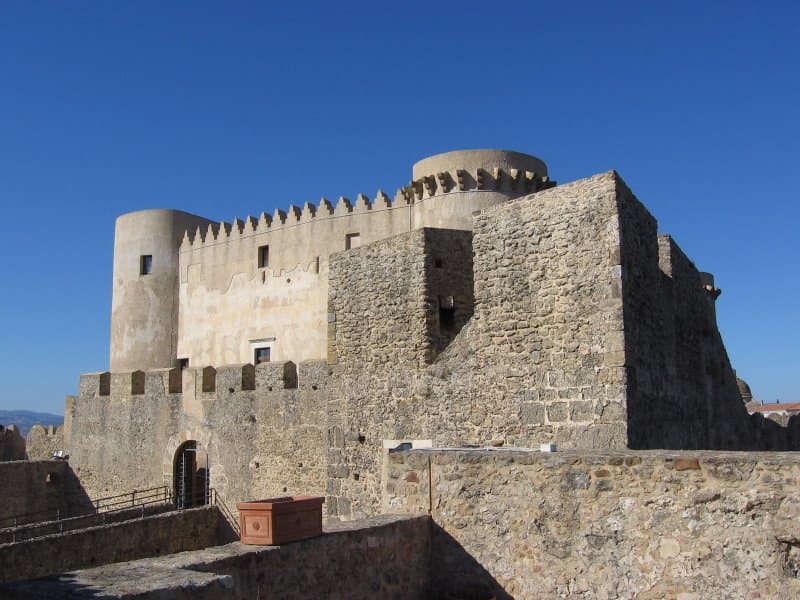
Santa Severina Castle
Santa Severina Castle, also known as Carafa Castle, is a monumental Norman fortress located in the town of Santa Severina in Calabria, Italy. Constructed in the 11th century by the Normans under the leadership of Robert Guiscard, the castle stands prominently on a rocky promontory overlooking the Neto River valley and the surrounding hills of the Marquisate of Crotone. This imposing hill castle covers approximately 10,000 square meters and represents a significant example of medieval military architecture, reflecting centuries of historical evolution and strategic importance.
The site of Santa Severina has a deep and complex history that predates the Norman construction. Archaeological evidence reveals continuous human presence since the Bronze Age and Iron Age, with early inhabitants likely belonging to the Oenotrian peoples. Over time, the area came under the influence of Greek-Italic cultures, followed by Roman and Byzantine rule. Between 840 and 886, the site functioned as an Arab kastron, a fortified military and religious complex, underscoring its enduring strategic significance in southern Italy.
The Norman foundation and early medieval significance
The castle was founded by Robert Guiscard, a Norman adventurer who was granted the duchy of Calabria and Apulia in 1076. Recognizing the strategic value of the rocky outcrop overlooking the ancient settlement of Siberene (the original name of Santa Severina), he ordered the construction of a robust fortress. The initial Norman structure included a square keep (donjon) and defensive walls enclosing the village below, designed to secure the territory from Saracen incursions and rival powers.
While the original donjon's remains have only recently been partially uncovered through archaeological efforts, this early Norman phase established the castle's fundamental layout and defensive purpose. The Normans' military expertise and political ambitions transformed Santa Severina into a key stronghold in the region.
Angevin enhancements and architectural expansion
Following the decisive Battle of Benevento in 1266, the Kingdom of Sicily fell under the control of the Angevin dynasty, led by Charles I of Anjou. The castle and its surrounding lands were incorporated into the royal domain, reflecting the strategic importance of Santa Severina within the kingdom's defensive network.
The Angevins undertook significant modernization of the fortress, constructing four cylindrical towers at the corners of the castle and surrounding the central keep with four curtain walls and bastions. This architectural evolution enhanced the castle's defensive capabilities, making it comparable to the most formidable fortifications of the period. The use of cylindrical towers was a military innovation that improved resistance against siege engines and artillery.
The Aragonese period and Carafa family rule
In 1444, the Aragonese dynasty assumed control of the Kingdom of Naples, including Santa Severina. Alfonso V of Aragon, known as "the Magnanimous," granted privileges to the city and supported the preservation and enhancement of the castle, countering local demands for its demolition. His successor, Ferrante I, further reinforced the town's autonomy and governance, solidifying the castle's role as a symbol of regional authority.
The early 16th century marked a turbulent chapter when the powerful Carafa family seized the castle after a siege in 1506. Andrea Carafa's lordship was characterized by harsh rule until his death in 1526. Under the Carafas, the castle underwent extensive renovations that far surpassed previous modifications. They added fortified curtain walls around the Angevin structure, constructed the Belvedere bastion, and installed distinctive battlements known as merli tribolati ("afflicted battlements"), which are visible on the castle walls and heraldic emblems.
Subsequent Carafa lords continued fortifying the castle, completing the curtain walls and enhancing the defensive structures near the Porta Nuova. Despite their architectural contributions, the family's financial difficulties eventually led to the loss of the fief.
Later ownership and transformations
After the Carafa tenure, the castle reverted to royal control and was granted to the Ruffo family in 1608, followed by Carlo Sculco in 1650, who was elevated to duke by King Philip II of Spain. In 1691, the castle was auctioned to Cecilia Carrara and later inherited by her son Antonio Greuther, linking the fortress to a Westphalian merchant lineage.
The abolition of feudalism in 1806 by Joseph Bonaparte ended noble dominion over Santa Severina and its castle. Church authorities administered the area until the unification of Italy in 1860.
During the 18th century, the Greuther family transformed the medieval fortress into a noble residence, adding vaulted ceilings on the first floor and creating a large hall adjacent to the spiral staircase. The interiors were embellished with decorative paintings, including a notable hall painted by artist Francesco Jordano around 1750, adding artistic and cultural value to the castle.
Architectural features and archaeological discoveries
The castle's layout reflects its layered history, with the central square keep flanked by four cylindrical towers each featuring a scarped base—a sloping stonework technique that strengthens the foundation against siege attacks. The surrounding curtain walls are reinforced by four projecting bastions aligned with the towers, demonstrating the defensive strategies of the Angevin and Carafa periods.
Archaeological excavations have uncovered a vaulted cistern essential for water storage during sieges, as well as remains of a Byzantine ecclesiastical complex, confirming the castle's earlier function as a religious and military center during the Arab kastron period. A nearby Byzantine burial ground revealed a tomb containing a skeleton with a 3rd-century BCE coin in the jaw, highlighting the site's long-standing cultural significance.
Traces from the Swabian period are visible in various parts of the castle, including the old round tower, the cut tower, the spiral staircase tower, and quadrangular battlements, illustrating another phase of medieval occupation and modification.
Modern use and museum functions
In the 20th century, the castle served as a boys' boarding school from the 1930s until the 1970s, a use that contributed to its preservation. Extensive restoration between 1994 and 1998 revealed the castle's foundations atop the ancient acropolis of Siberene and brought to light artifacts from Byzantine and Swabian periods.
Today, Santa Severina Castle houses the Santa Severina Museum, which displays archaeological finds from the castle and surrounding region, including protohistoric bronzes dating from the 15th to the 8th centuries BCE. The complex also hosts the Documentation Center for Calabrian Castles and Fortifications and the Museum of Contemporary Art of Santa Severina (MACSS). These institutions preserve and promote the castle's rich historical and cultural legacy.
Frequently asked questions (FAQ)
- How do I visit Santa Severina Castle?
- Santa Severina Castle is open to visitors, typically during daytime hours. It is advisable to check local tourism websites or contact the municipality for current opening times and guided tour availability.
- What is the historical significance of Santa Severina Castle?
- Santa Severina Castle is a key Norman fortress built in the 11th century, with layers of history from Byzantine, Arab, Angevin, Aragonese, and Carafa periods, reflecting southern Italy's medieval military and political history.
- Can I explore the archaeological remains within the castle?
- Yes, visitors can explore the castle's archaeological features such as the vaulted cistern, Byzantine ecclesiastical remains, and burial sites uncovered during restoration, providing insight into the site's long historical occupation.
- What architectural styles are evident in Santa Severina Castle?
- The castle exhibits a mix of Norman military architecture with later Angevin cylindrical towers and curtain walls, Carafa period battlements, and Swabian modifications, illustrating a layered medieval architectural evolution.
- Is Santa Severina Castle accessible for people with mobility challenges?
- Due to its medieval hilltop location and historic structures, accessibility may be limited. Visitors with mobility challenges should inquire in advance about available accommodations or guided assistance.
Photo gallery

Photo by User:Drnico•Public domain
Information
Sources & official resources
Verify the information above using these authoritative references.
Loading map...
Visitor reviews
No reviews yet. Been here? Write the first review and help other travelers!
Write the first reviewVisited this castle? Share your experience
Your review helps other travelers and adds first-hand knowledge to our encyclopedia.


