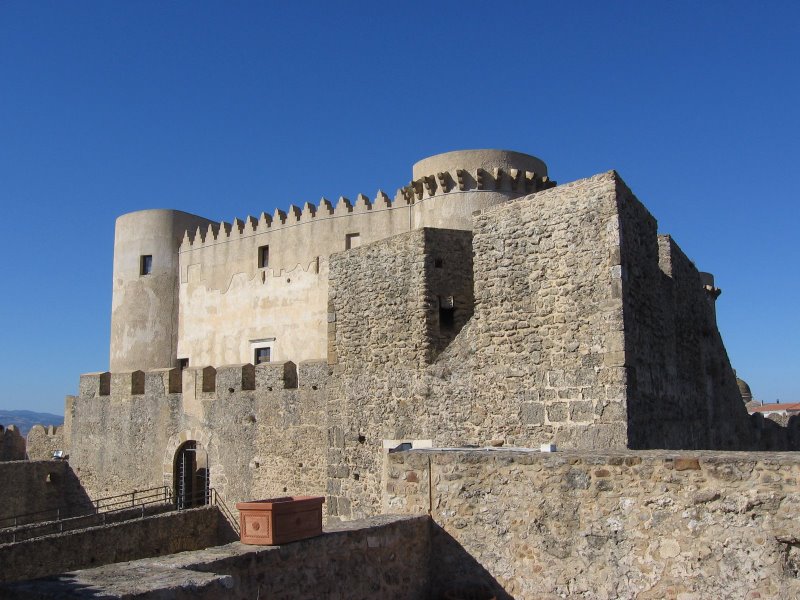
Castle of Charles V, Crotone
The Castle of Charles V in Crotone, Italy, stands as a remarkable example of military architecture reflecting centuries of strategic evolution. Originally constructed on the ancient acropolis of a Greek settlement, the castle's location has been a focal point of defense and control since antiquity. Its commanding position overlooking the sea and surrounding terrain, naturally protected by cliffs, has made it a key fortification from the early medieval period through the Renaissance.
Early history and strategic significance
The site's earliest known fortification dates back to around 840 AD, when a simple fortress was established to protect the city from Saracen raids and other incursions. However, the strategic importance of this location extends further back in time. Ancient historical records recount how Dionysius the Elder, the tyrant of Syracuse, captured the fortress by cunning during the conflict between Syracuse and Crotone between 380 and 378 BCE. This demonstrates the site's long-standing military value.
By the late 12th century, documentary evidence from 1192 confirms the castle's status as an imperial fortress. It was managed by officials from the imperial curia, who maintained garrisons often composed of foreign soldiers under direct royal command. This imperial oversight highlights the castle's importance in regional power dynamics.
Medieval transformations and ownership
During the late 13th century, under Angevin dominance, the castle was garrisoned by a small contingent of 15 men led by a royal castellan. The Angevin lords were responsible for repairing specific towers, and the influential Ruffo family was appointed as castellans in 1284. This period marked a phase of maintenance and adaptation to the evolving military needs of the time.
The castle's defenses were modified in response to the introduction of firearms, transitioning from an original pentagonal layout with five towers to a more regular quadrangular plan. Several towers were reconstructed with circular bases, such as the "Turri delo casi cavallo" and the centrally located "Marchisana" tower, which was heavily armed and positioned on raised ground for optimal defense and observation.
Renaissance reconstruction under charles v
The late 15th and early 16th centuries were marked by increased threats from the expanding Ottoman Empire. The Aragonese rulers initiated substantial upgrades to the fortress in response to events like the 1480 Ottoman sack of Otranto. The extensive construction campaign, known as the "Fabrica de Cotrone", began in 1484 and extended over a century, significantly enhancing the castle's defensive capabilities.
A pivotal transformation occurred in 1541 when Emperor Charles V ordered a comprehensive reconstruction to modernize the fortress according to contemporary military architectural principles. The project was initially overseen by the renowned architect Gian Giacomo dell’Acaya, later succeeded by Baron della Caya, Alfonso Brefeygna, and Jacopo de Amato de Cotrone. The massive undertaking employed over a thousand workers, reflecting both the scale and importance of the reconstruction.
Architectural features and defensive structures
The castle's layout evolved from a polygonal to a quadrangular plan, with walls primarily constructed of local stone and masonry. The fortress includes multiple specialized towers and bastions strategically positioned for defense and control. The "Adjutant" and "Commandant" towers, now restored, served as quarters for commanding officers and feature thick stone walls with narrow defensive openings.
Other notable towers include the "Turri delo casi cavallo" with its circular base and the "Turri Muza" (also known as "Santa Maria"), whose remains were uncovered during 2010 excavations. The "San Georgi" tower is documented but survives only in fragments.
The western perimeter is dominated by a truncated pyramid-shaped tower housing the main gate, accessed via a bridge combining masonry and a wooden drawbridge. Excavations in 2011 revealed the foundation of the "Della Manovella" tower, which contained the mechanism to operate the drawbridge. The castle's moat, a water-filled defensive ditch, further enhanced its protection.
Along the harbor side, the San Giacomo bastion served dual functions as a troop shelter and a lighthouse overseeing naval approaches. Although partially demolished in 1895, its remaining stairway leads to the "Porta del Soccorso", a secondary gate at the bastion's base.
The central "Marchesana" tower, once equipped with four cannons, was a key observation post and later a prison for forced laborers involved in harbor construction. It was damaged in the 1862 earthquake and subsequently demolished after collapsing in 1873. Beneath it lay a smaller tower with numerous arrow slits designed for archers and early firearm soldiers.
Internal buildings and religious structures
The castle complex housed several churches, including San Dionisio (built in 1601), the New Church, and San Carlo (erected in 1859). These religious buildings highlight the spiritual life within the fortress walls.
Additional internal structures included artillery magazines for weapon storage, the castellan's residence, a women's barracks, and the prison known as "La Serpe". These facilities illustrate the castle's multifunctional role as a military, administrative, and social center.
Later modifications and current status
Between the 17th and 19th centuries, further changes included the addition of a guardhouse and bell near the main gate and the construction of the Campana barracks in the early 1800s. These structures survive in varying conditions and have been the focus of recent restoration efforts.
Excavations and conservation projects have illuminated the castle's operational aspects, such as the drawbridge mechanism and tower functions, contributing to a comprehensive understanding of its transformation from a medieval stronghold into a Renaissance fortress.
Currently, the Castle of Charles V is state property under the care of the Soprintendenza per i Beni Archeologici della Calabria. Ongoing restoration aims to preserve key towers and barracks and to convert parts of the fortress into a museum dedicated to the ancient and medieval history of Crotone and its surrounding region.
Frequently asked questions (FAQ)
- How do I visit the Castle of Charles V in Crotone?
- The Castle of Charles V is open to visitors under the management of the Soprintendenza per i Beni Archeologici della Calabria. Check local tourism websites for current visiting hours and any guided tour availability.
- What is the historical significance of the Castle of Charles V?
- The castle reflects centuries of military architecture, evolving from an early medieval fortress to a Renaissance stronghold, and played a key role in regional defense against Saracen raids and Ottoman threats.
- Can I see original medieval and Renaissance architectural features at the castle?
- Yes, the castle preserves towers like the Adjutant and Commandant, which showcase thick stone walls, narrow defensive openings, and adaptations to firearms, illustrating its architectural evolution.
- Is the castle accessible for visitors with mobility issues?
- Due to the castle's historic structure and terrain, accessibility may be limited in some areas. Visitors with mobility concerns should inquire in advance about accommodations and accessible routes.
- When is the best time to visit the Castle of Charles V?
- Spring and early autumn offer pleasant weather for exploring the castle and its surroundings, avoiding the peak summer heat typical of Calabria.
Information
Sources & official resources
Verify the information above using these authoritative references.
Loading map...
Visitor reviews
No reviews yet. Been here? Write the first review and help other travelers!
Write the first reviewVisited this castle? Share your experience
Your review helps other travelers and adds first-hand knowledge to our encyclopedia.