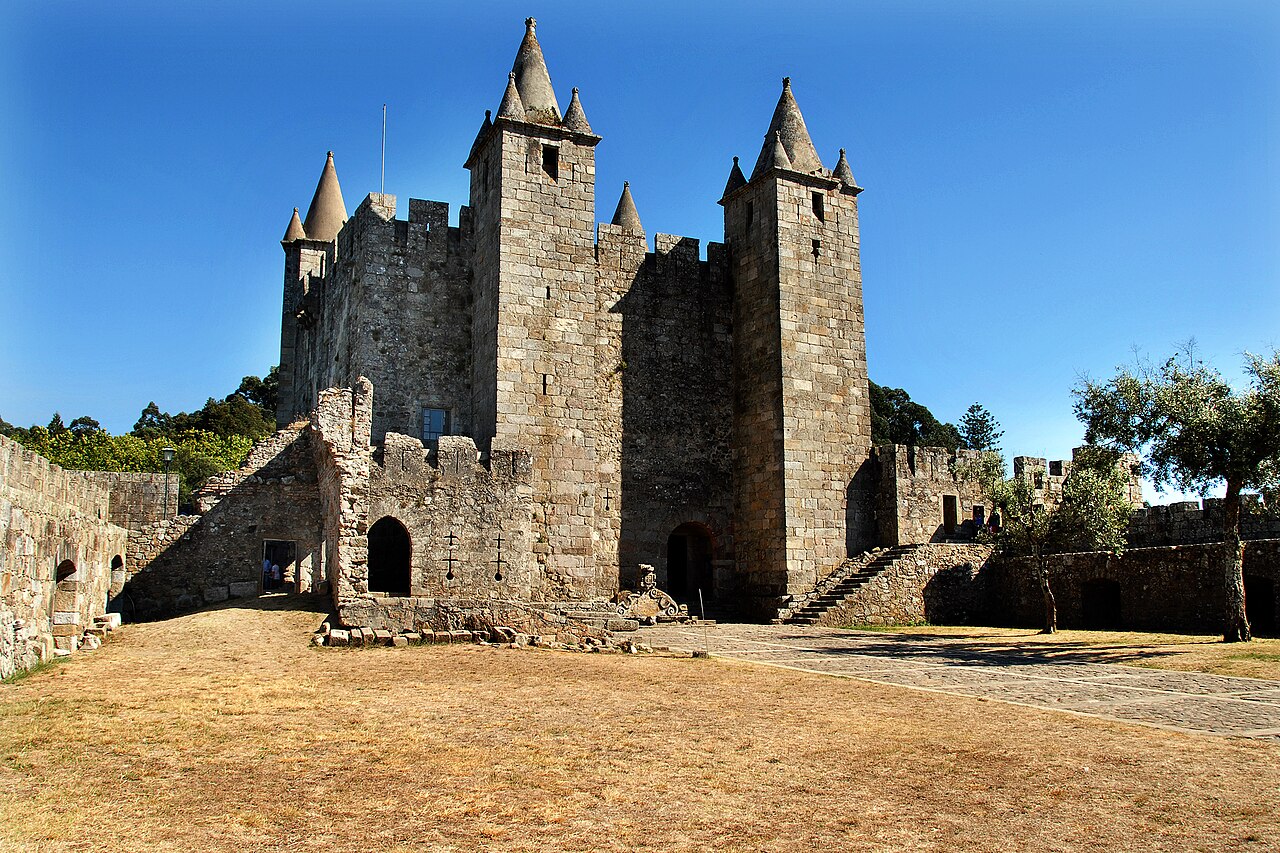
Santa Maria da Feira Castle
Santa Maria da Feira Castle stands as a monumental example of Portuguese medieval military architecture, located in the municipality of Santa Maria da Feira, within the district of Aveiro, Portugal. This fortress is celebrated for its diverse defensive features that evolved throughout the Middle Ages, playing a crucial role in the Reconquista and the assertion of autonomy for the County of Portugal. Recognized for its historical and architectural significance, it has been classified as a national monument since 1910.
The castle's origins are steeped in both legend and history. Tradition holds that the site originally hosted a temple dedicated to local indigenous deities, later transformed into a Marian shrine, giving the castle its name. Archaeological evidence, including tombstones and other Roman relics found within the castle's backcourt, confirms the presence of a Roman settlement dating back to the first century of the Roman Empire. This settlement was strategically positioned near the Roman road connecting Olissippo (Lisbon) and Bracara Augusta (Braga), underscoring the site's longstanding importance as a crossroads.
Medieval origins and strategic importance
In the mid-9th century, specifically in 868, Alfonso III of León established an administrative and military region known as Terra de Santa Maria, fortifying the existing military fortress at Civitas Sanctae Mariae. For centuries, the castle served as a forward base in the Christian efforts to reclaim territory from the Arab invasions advancing from the south. The fortress endured multiple assaults, notably twice in the year 1000 when forces under Al-Mansur captured and destroyed the local population before it was retaken by Christian armies. The reign of Bermudo III (1028-1037) saw continued attempts by Arab forces to seize the castle, but they were decisively defeated in the Battle of Caesar.
Governors such as Guterres and Mem Mem Lucidio undertook ambitious reconstruction projects to strengthen the castle and develop the surrounding lands. The region's importance was further emphasized by the granting of the Honra de Infanções, an honor typically reserved for Lisbon's elite magistrates and councilors, to local leaders. The earliest documented reference to the castle's structure dates to the 11th century, as recorded in the Chronica Gothorum, which mentions the construction of the lower keep and fortress walls.
The fair and the castle's name
Since 1117, Santa Maria da Feira became known for hosting one of Portugal’s most important fairs, established in the shadow of the castle. This event was so influential that it eventually lent its name to the town itself, cementing the castle's role as a central hub of commercial and social activity during the medieval period.
The castle and the formation of portugal
The castle was a focal point during the significant uprising of 1128 between Afonso Henriques and his mother, Queen Teresa, Countess of Portugal. This conflict was part of broader regional tensions involving the Iberian Peninsula's ruling families. Teresa’s alliances with Galicia and support for ecclesiastical claims by the Archbishop of Santiago de Compostela alienated local clergy and nobility, who sided with Afonso Henriques in his bid for control over the County of Portugal.
Pero Gonçalves de Marnel, the governor and alcalde of the castle, was among the nobles who opposed Teresa’s policies and supported Afonso Henriques. The decisive battle of São Mamede on June 13, 1128, which marked a turning point in Portuguese history, was influenced by the castle’s strategic position and the allegiances forged there. This battle is often regarded as the foundational moment for the independence of Portugal.
By 1251, the settlement of Santa Maria da Feira was officially recorded in the royal inventories of King Alfonso I, further confirming its growing importance. The castle and its lands were part of the dowry of Elizabeth of Aragon in 1300, reflecting its continued prominence in the region.
Architectural evolution and ownership
The 14th century saw the construction of the castle’s defensive walls, likely under the direction of Gonçalo Garcia de Figueiredo, alcalde in 1357. On September 10, 1372, King Ferdinand granted the lands of Santa Maria da Feira to João Afonso Telo de Meneses, Count of Barcelos. During the 1383-1385 crisis, the castle changed hands multiple times, reflecting the turbulent political landscape. After Meneses fled to Castile, the castle was controlled by Martim Correia before being captured by forces loyal to John, Master of Aviz, in 1385. Subsequently, the castle was entrusted to Alvaro Pereira and later João Rodrigues de Sá.
In 1448, the castle was donated to Fernão Pereira, who undertook extensive rebuilding efforts completed in the latter half of the 15th century. Under the Pereiras, the castle was transformed into a luxurious residence featuring guard towers, turrets, and reinforced conical defenses. The fourth Earl of Feira, Diogo Forjaz, commissioned a commemorative marker over the barbican to celebrate the construction of the clock tower, which stood until 1755.
Baroque additions and decline
During the 17th century, the castle's internal palacete was completed, although it was later destroyed, leaving only a fountain as a remnant. In 1656, Joana Pereira de Silva e Meneses, Countess of Feira, ordered the construction of a distinctive Baroque chapel with an octagonal shape, adding to the castle’s architectural diversity.
The extinction of the Feira accounts in 1708 led to the castle's transfer to the Casa do Infantado, marking the beginning of its decline. Neglect culminated in a devastating fire on January 15, 1722, which left the castle in ruins. In 1839, the ruins were purchased by General Silva Pereira, and in 1852, the royal family visited the site, though it remained largely abandoned.
Restoration and modern conservation
The castle was officially classified as a national monument in 1881. Restoration efforts began in earnest in the early 20th century, with the main well completed in 1877. Public restoration projects were initiated in 1905, led by architects including Fortunato Fonseca, with significant work completed by 1909. The visit of King Manuel II in 1908 renewed interest in preserving the castle, leading to the establishment of a commission dedicated to its protection.
Public access to the castle was inaugurated in 1950 under the direction of the Direcção Geral dos Serviços de Urbanização, although guided tours had been available since 1927. Between 1935 and 1944, the Direcção Geral dos Edificios e Monumentos Nacionais (DGEMN) carried out extensive restoration work, including clearing and reconstructing parapet walls and battlements, rebuilding access routes, and restoring the chapel's roof and walls. Architect Baltasar de Castro was instrumental in these efforts.
On January 13, 1963, the castle was illuminated for the first time, a project led by engineer Arantes e Oliveira and supported by the Ministry of Education. Minor renovations continued into the 1980s. Since June 1, 1992, the castle has been under the stewardship of the Instituto Português do Patrimonio Arquitectonico (IPPAR), later reorganized as IGESPAR. The Comissão de Vigilância do Castelo de Santa Maria da Feira actively manages the site, offering guided and interpretive tours to visitors.
Architectural features and layout
Santa Maria da Feira Castle exhibits a complex architectural evolution, reflecting its long history of military and residential use. The castle features a robust keep (donjon) as its central stronghold, surrounded by curtain walls fortified with multiple towers and battlements. The walls incorporate conical turrets and a fortified barbican protecting the main entrance, highlighting the castle’s defensive sophistication.
The 15th-century renovations introduced refined residential elements, transforming the fortress into a noble residence with enhanced comfort and aesthetic appeal. The Baroque chapel adds a unique religious dimension to the castle complex, illustrating the blend of military and spiritual functions over time.
The castle's strategic location atop a hill provides commanding views of the surrounding landscape, a critical advantage during its military use. Its proximity to historic trade routes and the Roman road underscores its enduring importance as a center of control and commerce.
Visitor experience and cultural significance
Today, Santa Maria da Feira Castle is a prominent cultural landmark and tourist attraction. Visitors can explore its well-preserved walls, towers, and restored chapel, gaining insight into Portugal’s medieval history and architectural heritage. The castle hosts various cultural events, including medieval fairs and reenactments, which celebrate its historical legacy and engage the public with living history experiences.
The castle’s interpretive programs and guided tours provide detailed context about its role in the Reconquista, the formation of Portugal, and its architectural transformations. Its status as a national monument ensures ongoing preservation efforts, making it an essential destination for those interested in medieval fortifications and Portuguese history.
Frequently asked questions (FAQ)
- What is the historical significance of Santa Maria da Feira Castle?
- Santa Maria da Feira Castle played a vital role in the Christian Reconquista and the establishment of the County of Portugal, serving as a military stronghold and noble residence throughout the Middle Ages.
- How do I visit Santa Maria da Feira Castle and what are the opening hours?
- The castle is open daily from 09:00 to 18:00. Visitors can explore the walls, towers, and chapel, with guided tours available to enrich the experience.
- What architectural styles are represented in the castle?
- The castle features a mix of medieval military architecture with later Renaissance and Baroque additions, including fortified walls, turrets, and a distinctive Baroque chapel.
- Is the castle accessible for visitors with mobility issues?
- While the castle has uneven terrain and some steep areas due to its hilltop location, efforts have been made to improve accessibility, but some sections may still be challenging for visitors with limited mobility.
- When is the best time to visit Santa Maria da Feira Castle?
- Spring and early autumn offer pleasant weather and fewer crowds, ideal for exploring the castle and enjoying outdoor cultural events hosted on site.
Information
Opening hours
09:00-18:00, daily
Ticket prices
€3 adult, €1.5 child
Current owner
Instituto Português do Patrimonio Arquitectonico (IPPAR)
Loading map...
Visitor reviews
No reviews yet. Been here? Write the first review and help other travelers!
Write the first reviewVisited this castle? Share your experience
Your review helps other travelers and adds first-hand knowledge to our encyclopedia.