Castle of Campo Maior
The Castle of Campo Maior is a prominent medieval military fortification situated in the municipality of Campo Maior, Portugal, near the Spanish border. This hill castle stands atop Santa Vitória hill at an elevation of 299 meters, commanding strategic views over the surrounding landscape. It formed a critical part of the first line of defense in the Portuguese Alentejo region, working in concert with other military forts such as Ouguela, Elvas, Olivenca, and Juromenha to secure the border against Spanish incursions.
Its origins are deeply rooted in the region's layered history, with evidence of prehistoric settlements followed by successive occupations by the Celts, Romans, and Muslim populations. The castle's location was of great strategic importance, overseeing key routes and serving as a defensive stronghold throughout its history.
In the early 13th century, the site was reclaimed from Moorish control by the Kingdom of León, with the first known charter granted circa 1260 by the Bishop of Badajoz, indicating the establishment of administrative organization. By the late 13th century, Portuguese forces took control, and the region was formally integrated into Portugal through the 1297 Treaty of Alcañices. Subsequently, King Denis ordered a significant reconstruction of the fortress in 1310 to bolster border defenses.
Architectural evolution and fortifications
The castle's architecture reflects centuries of military evolution, blending medieval defensive principles with Renaissance and early modern fortification techniques. The original medieval fortress was substantially enhanced during the 15th and 16th centuries under the reigns of Kings John II and Manuel I. These improvements incorporated the expertise of notable military engineer Duarte d’Armas, who introduced designs suited to the evolving art of warfare, including adaptations for artillery use.
The most transformative phase came during the Portuguese Restoration War beginning in 1640. From 1645 onward, under the direction of King John IV, the castle underwent comprehensive modernization. Engineer João Cosmander spearheaded the upgrades, which were continued by Nicolau de Langres and Luís Serrão Pimentel into the 17th and 18th centuries. These works added essential military features such as bulwarks, secondary walls, ammunition storage facilities, stables, and soldiers' quarters, transforming the castle into a formidable bastioned fortress suited to gunpowder warfare.
Layout and defensive structures
The fortress is characterized by a polygonal curtain wall with ten irregular sides, enclosing an irregular trapezoidal interior space. The walls are reinforced by multiple bulwarks named Boa Vista, São Sebastião, Vila gates, Lisbon, Curral dos Coelhos, Santa Cruz, Cavaleiro (also São João), Príncipe, Fonte do Concelho, São Francisco, and Santa Rosa. These bulwarks are strategically positioned to cover vulnerable approaches and provide overlapping fields of fire.
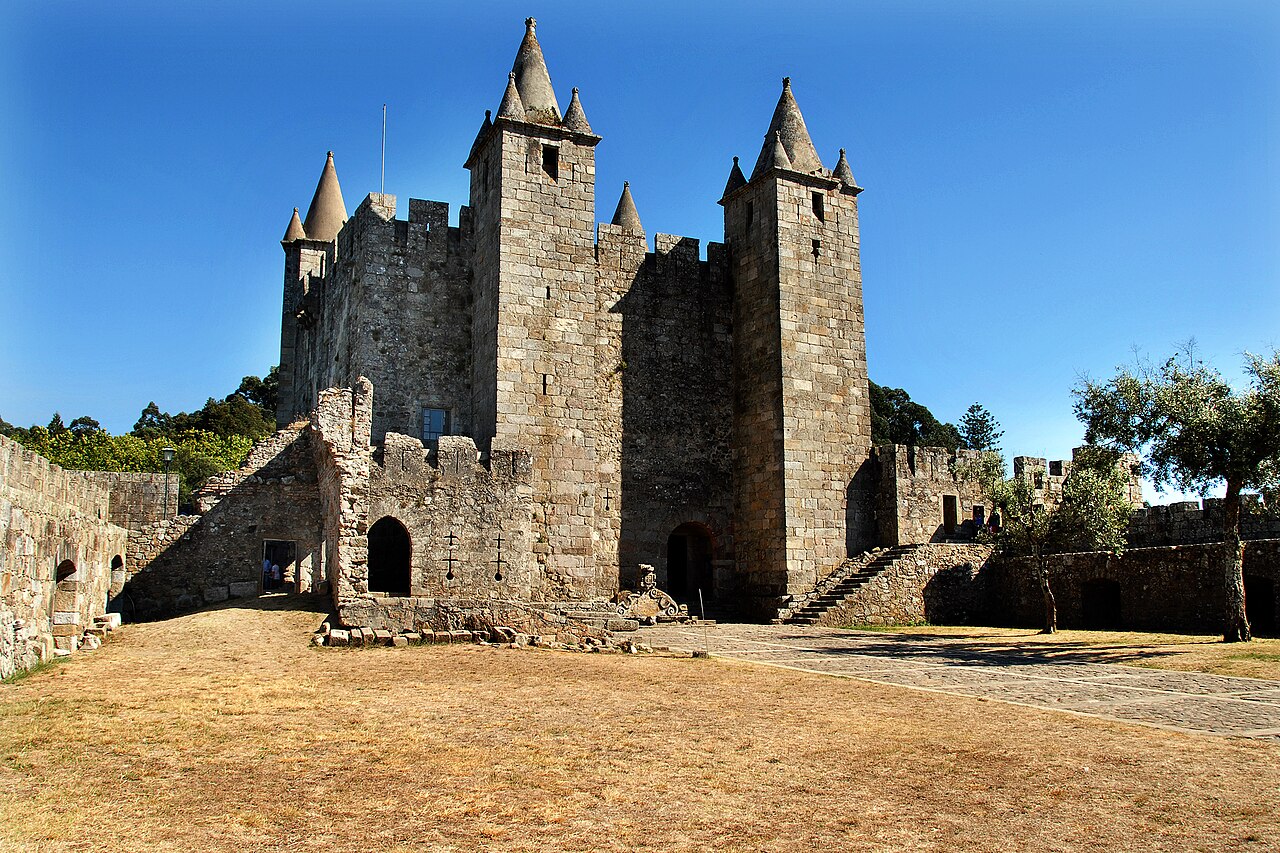
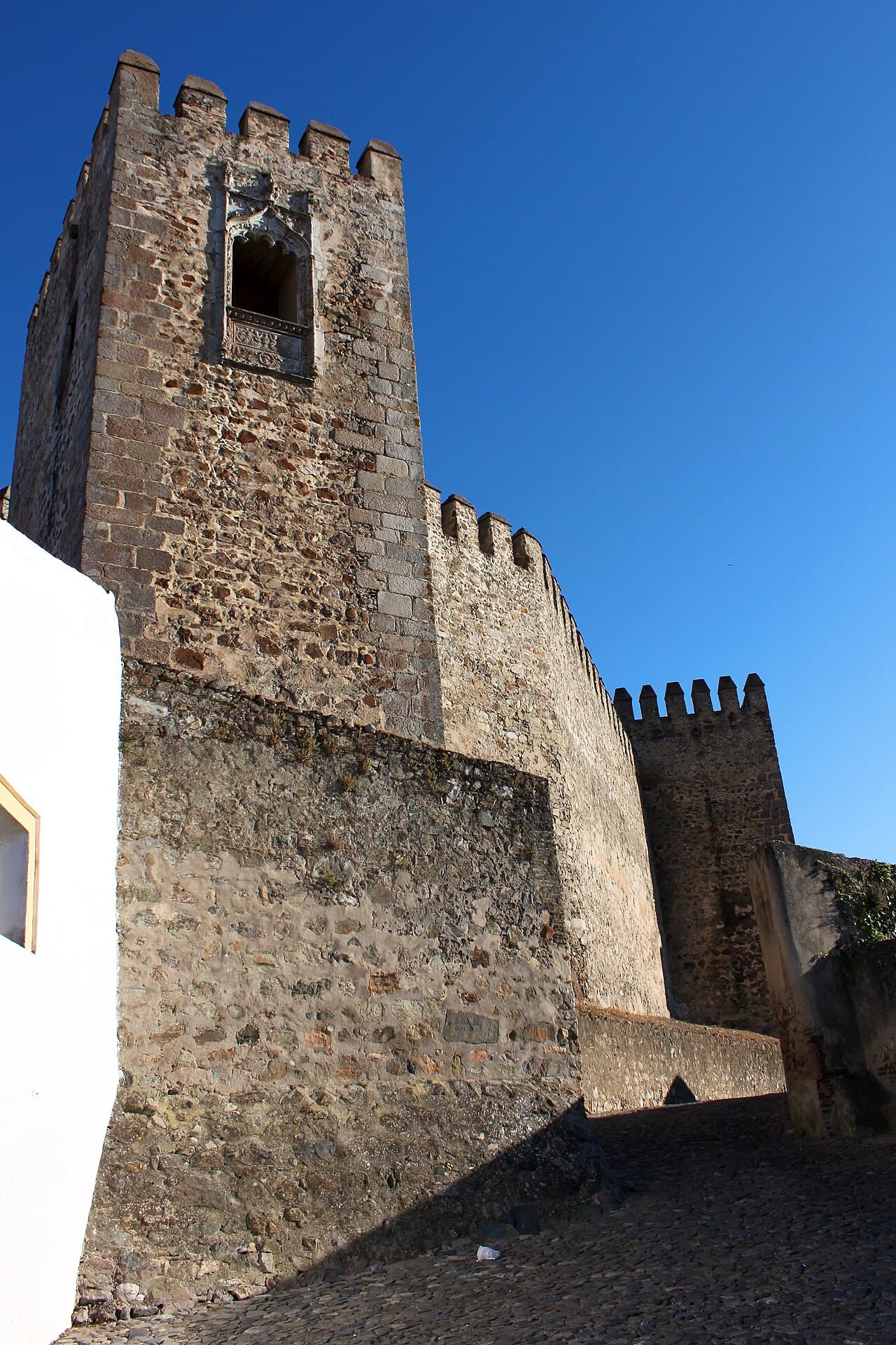
Additional counterscarps bolster the southern and northeastern defenses, where breaches in the walls are visible. Four turrets offer enhanced observation and firing positions. The castle originally had six towers; two remain intact, featuring battlemented walls and truncated pyramid-shaped domes. The northern tower is notable for its Renaissance-style window, an artistic embellishment reflecting the castle's historical layers.
Lower village enclosure and artillery adaptations
South of the main fortress lies the old village area, enclosed by lower elliptical walls with seven towers. Six of these towers are rectangular, while the northeast tower is octagonal and serves as the main entrance to this lower enclosure. These walls were built lower than the main curtain walls to accommodate cannon emplacements and barbettes, illustrating the adaptation of the fortress to gunpowder artillery.
A battlemented tower near a false gate on the southwestern side further strengthens the defenses in that sector. The Chapel of Senhor dos Aflitos occupies a southeastern position within the complex, underscoring the integration of religious and military functions.
Historical significance and military engagements
The castle has witnessed numerous military conflicts, reflecting its strategic importance. It endured a siege in 1712 during the Spanish War of Succession and again in 1762 during the Seven Years’ War. A catastrophic explosion in 1732, caused by a lightning strike on the powder magazine containing approximately 90,000 kilograms of gunpowder, devastated large portions of the castle and the surrounding town. King John V ordered the magazine's reconstruction in 1735 to restore the fortress's defensive capabilities.
During the early 19th century, the castle played a role in the Peninsular War, notably in the Battle of the Oranges (1810-1811), when control of the fortress shifted between Portuguese and Spanish forces. These events highlight the castle's enduring military relevance across centuries of Iberian conflict.
Preservation and current status
Declared a National Monument on March 18, 1911, the Castle of Campo Maior has undergone several restoration efforts throughout the 20th century. Significant works were carried out in the 1940s, 1960s, 1970s, and late 1980s, including restoration of the Chapel of Nossa Senhora dos Aflitos. In 1992, management was transferred to the Instituto Português do Património Arquitectónico (IPPAR).
Despite these efforts, the castle suffered partial wall collapses due to adverse weather in 2010, underscoring ongoing challenges in preservation. Today, the site includes residential areas, notably housing gypsy communities within the São Sebastião bulwark, and hosts cultural institutions such as a historical and military museum. The castle grounds also accommodate functional facilities related to storage, animal keeping, and waste management, reflecting a blend of heritage conservation and contemporary use.
Architectural and cultural importance
The Castle of Campo Maior stands as a testament to the complex military architecture of the Iberian Peninsula, showcasing the transition from medieval fortifications to modern bastioned defenses. Its layered history, from prehistoric occupation to Renaissance embellishments and early modern military engineering, offers valuable insights into the evolving nature of border defense and military strategy.
The castle's integration of artillery adaptations, extensive bulwarks, and living quarters illustrates the multifunctional role of such fortresses as both military strongholds and community centers. Its designation as a National Monument affirms its cultural and historical significance within Portugal's heritage landscape.
Frequently asked questions (FAQ)
- How do I get to the Castle of Campo Maior?
- The Castle of Campo Maior is located in the town of Campo Maior, Alentejo region, Portugal. It is accessible by car and local public transport. The castle is situated on Santa Vitória hill, near the center of town.
- What are the castle's opening hours and ticket prices?
- The castle is open daily from 10:00 to 17:00. Admission costs €3 for adults and €1.5 for children, with discounts available for groups and seniors.
- What is the historical significance of the Castle of Campo Maior?
- The castle played a crucial role in the defense of the Portuguese border against Spain from the 13th century onwards. It was involved in key conflicts such as the Spanish War of Succession and the Peninsular War, reflecting its strategic military importance.
- Can visitors explore the entire fortress?
- Visitors can explore much of the castle's exterior walls, bulwarks, and some interior military buildings. However, certain areas may be restricted due to preservation efforts or safety concerns.
- What architectural styles are represented in the castle?
- The castle exhibits a mixed architectural style, combining medieval defensive structures with Renaissance and early modern bastioned fortress elements, including artillery adaptations.
- Is the castle accessible for people with reduced mobility?
- Due to the castle's hilltop location and historic structure, accessibility is limited for visitors with reduced mobility. Some paths and areas involve uneven terrain and stairs.
- Are there any nearby attractions to visit along with the castle?
- Nearby attractions include the historic town center of Campo Maior, regional museums, and other border fortresses such as the forts of Elvas and Juromenha, which provide complementary insights into the area's military history.
Photo gallery

Information
Opening hours
10:00-17:00, daily
Ticket prices
€3 adult, €1.5 child
Current owner
State museum
Website
Visit websiteAddress
Sao Joao Bapista, Portugal
Sources & official resources
Verify the information above using these authoritative references.
Loading map...
Visitor reviews
No reviews yet. Been here? Write the first review and help other travelers!
Write the first reviewVisited this castle? Share your experience
Your review helps other travelers and adds first-hand knowledge to our encyclopedia.