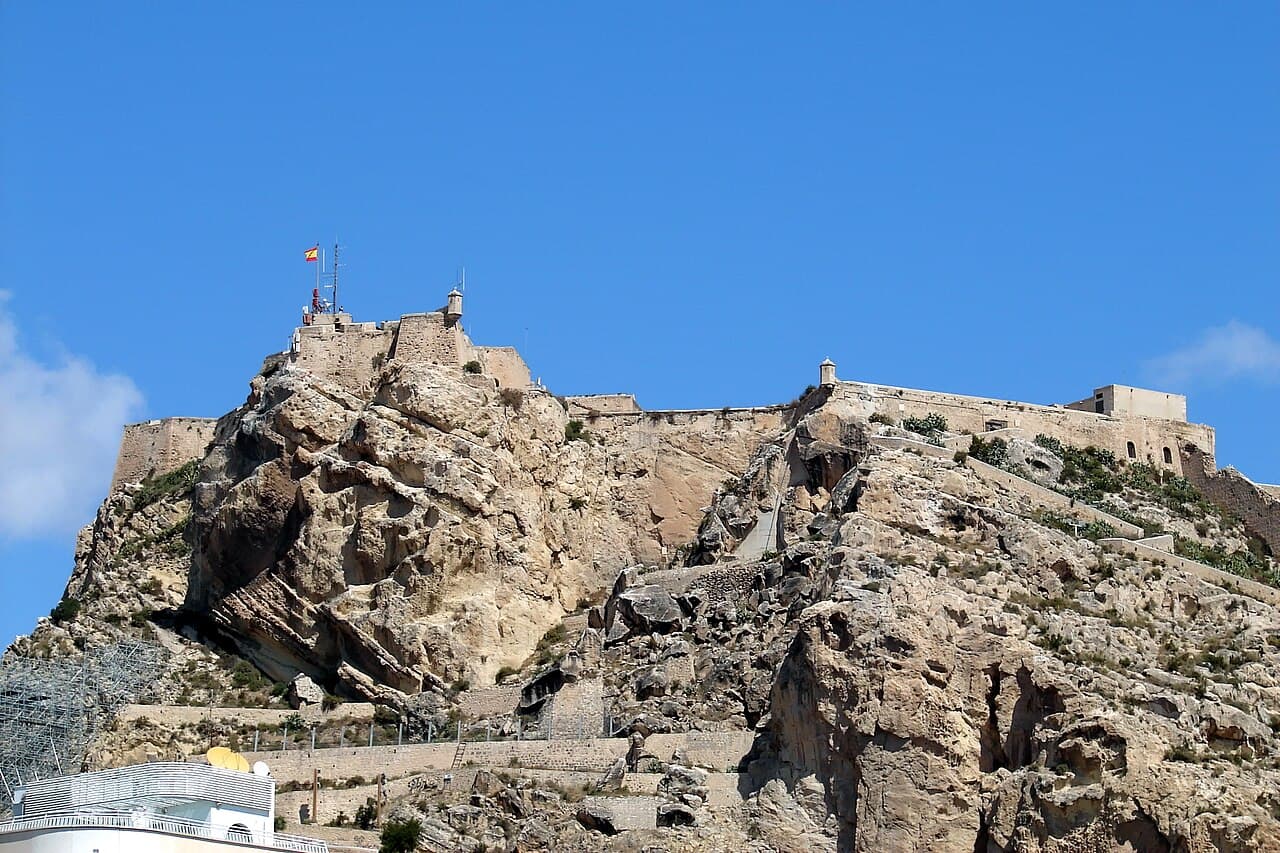
Santa Bárbara Castle — Spain castle

Santa Bárbara Castle

Santa Bárbara Castle in Alicante, Spain
Alicante, Valenciana, Comunidad, Spain
High Medieval (11th–13th c.)
Restored

Santa Bárbara Castle is a prominent hilltop fortress located in the heart of Alicante, Spain, perched atop Mount Benacantil at 166 meters elevation. This strategic position offers commanding views over the entire bay of Alicante, the surrounding lands, and the nearby San Fernando Fort. The castle's long and complex history spans from the 9th century during the period of Muslim rule on the Iberian Peninsula, through successive Christian reconquests and Renaissance military enhancements, to its current status as a well-preserved cultural monument open to the public.

Early origins and Muslim period

Archaeological evidence indicates that the site of Santa Bárbara Castle was significant long before the medieval fortress was constructed. Bronze Age, Iberian, and Roman artifacts have been found on the slopes of Mount Benacantil, suggesting continuous human presence and strategic importance. The earliest known fortification dates to the late 9th century, when the region was under Muslim control as part of Al-Andalus. The Arab geographer Al-Idrisi referred to the mountain as Banu-lQatil, possibly derived from Arabic terms meaning "peak of Alicante".

The original Muslim castle occupied what is now the upper enclosure of the fortress. In 917, the local Muslim governor al-Sayj al-Aslami revolted against the future caliph Abd al-Rahman III, leading to a prolonged siege during which al-Aslami held out within the castle until his surrender. Although no physical remains of this early castle survive today, its foundations form the base of the existing upper enclosure.

Christian conquest and medieval reconstruction

On December 4, 1248, the castle was captured by Castilian forces led by Alfonso X of Castile. The capture took place on the feast day of Saint Barbara, which inspired the Christian name of the castle. Later, in 1296, the fortress was taken by James II of Aragon, who initiated significant reconstruction efforts to restore and strengthen the castle after years of conflict.

During the reign of Peter IV of Aragon in 1381, further rebuilding took place, shaping much of the castle's medieval structure. These medieval fortifications established the castle as a key defensive stronghold in the region, guarding Alicante and its surroundings against potential invasions.

Renaissance transformation and military significance

The castle underwent a major transformation in the 16th century under the orders of Charles V, Holy Roman Emperor, and his successor Philip II of Spain. Although Charles V ordered the fortifications, construction began in 1562 during Philip II's reign. The castle was remodeled into a formidable Renaissance fortress featuring three enclosures with bastions, designed by renowned military engineers including Juan Bautista Antonelli, Vespasiano Gonzaga, and Giovan Giacomo Paleari Fratino.

This transformation reflected the evolving military architecture of the period, adapting the castle to withstand artillery attacks and modern siege tactics. The Renaissance fortifications included the Felipe II Hall, the Patio de Armas, the Baluarte de la Reina, and various guard corps buildings, which remain visible today.

Sieges and conflicts

Santa Bárbara Castle's strategic importance made it a target in several conflicts. In 1691, it was bombarded by French forces. During the War of the Spanish Succession (1706-1709), the castle was occupied by English troops until a significant explosion caused by mining operations by the forces loyal to Philip V led to the partial collapse of the fortress. This damage was so severe that the affected part of the mountain was never rebuilt.

Later, in 1873, during the Third Carlist War, the castle and the city of Alicante endured bombardment from cantonalist rebels aboard the frigate Numancia. Following this period, the castle's military role diminished significantly.

Decline, abandonment, and modern restoration

From the 18th century onward, the castle's military significance waned. It was occasionally used as a prison and eventually fell into disuse. By the late 19th century, the fortress was largely abandoned. It remained closed to the public until 1963, when restoration efforts enabled its reopening as a historic site.

Modern visitors can access the castle via a scenic hike over rocky terrain or by using the lifts installed inside Mount Benacantil, which provide convenient access to the upper levels. The castle grounds include the three main enclosures: the upper turret area with the oldest foundations, the middle enclosure with the Renaissance halls and bastions, and the lower area featuring the Revellín del Bon Repós and a monument to Félix Berenguer de Marquina, an illustrious local soldier and colonial administrator.

The castle also houses the Museum of the City of Alicante (MUSA), which occupies five rooms complemented by a Renaissance cistern. This museum showcases the rich cultural and military history of the fortress and the region.

Architectural features and layout

Santa Bárbara Castle is an exemplary model of layered fortification architecture, combining elements from its Muslim origins, medieval reconstructions, and Renaissance military engineering. The fortress is divided into three distinct enclosures:

  • The upper enclosure or "The Turret" houses the Torre del Homenaje and the oldest foundations dating from the 11th to 13th centuries, representing the original citadel.
  • The middle enclosure contains the main halls, including the Felipe II Hall, the Patio de Armas, the Baluarte de la Reina, and the ruins of the hermitage of Santa Bárbara. This area reflects the Renaissance fortification style completed in 1580.
  • The lower enclosure features the Revellín del Bon Repós dating from the 18th century and serves as the main entrance and parking area. It also hosts the monument to Félix Berenguer de Marquina.

The castle's walls, bastions, and gates illustrate the evolution of military architecture from the medieval period to the Renaissance, adapted to the natural rocky terrain of Mount Benacantil.

Visiting Santa Bárbara Castle today

Today, Santa Bárbara Castle is a popular tourist destination, offering visitors a chance to explore its extensive fortifications, learn about its rich history, and enjoy panoramic views of Alicante and the Mediterranean Sea. The site is open during daylight hours, with guided tours available for a small fee. Amenities include refreshments near the summit and convenient access via the mountain lifts.

The castle's well-preserved and restored condition makes it an exceptional example of Spanish military architecture and a key cultural landmark in the Valencian Community.

Frequently asked questions (FAQ)

What is the historical significance of Santa Bárbara Castle?
Santa Bárbara Castle is one of the largest medieval fortresses in Spain, showcasing a rich history that dates back to the 9th century. It has witnessed various cultural influences, including Islamic and Christian rule, making it a significant symbol of Alicante's heritage.
When was Santa Bárbara Castle built?
Construction of Santa Bárbara Castle began in the 9th century during the Islamic period and continued through the following centuries. The castle was expanded and modified, particularly in the 13th century, reflecting the evolving architectural styles of the time.
Can I visit Santa Bárbara Castle year-round?
Yes, Santa Bárbara Castle is open to visitors throughout the year, allowing you to explore its stunning architecture and breathtaking views of Alicante. However, it's recommended to check specific opening hours and any seasonal closures before planning your visit.
What are the opening hours of Santa Bárbara Castle?
Santa Bárbara Castle typically opens from 10 AM to 8 PM during the summer months and from 10 AM to 6 PM in the winter. These hours can vary on public holidays, so it's a good idea to verify the schedule on the official website before your visit.
Is it possible to reach Santa Bárbara Castle by public transport?
Yes, you can easily reach Santa Bárbara Castle using public transport. Buses frequently run from the city center, and there are also options for taxis or rideshare services, making it convenient for visitors.
What is the ticket price for visiting Santa Bárbara Castle?
Admission to Santa Bárbara Castle is free, allowing everyone to enjoy its historical and architectural beauty without cost. However, certain guided tours or special exhibitions may have a fee, so check ahead for any additional charges.
What is the best time to visit Santa Bárbara Castle?
The best time to visit Santa Bárbara Castle is during the spring and fall when the weather is mild, making it enjoyable to explore the grounds. Early mornings or late afternoons can also provide a more peaceful experience with fewer crowds.
Are there any nearby attractions to visit while at Santa Bárbara Castle?
Yes, while visiting Santa Bárbara Castle, you can also explore other nearby attractions such as the Explanada de España, a beautiful promenade, and the Alicante Museum of Contemporary Art. The castle's location offers stunning views of the city and the Mediterranean Sea, making it a perfect starting point for your exploration.
Is Santa Bárbara Castle accessible for individuals with mobility challenges?
Santa Bárbara Castle has made efforts to improve accessibility for all visitors. There are designated pathways and ramps to help individuals with mobility challenges navigate the site, although some areas may still present challenges due to the castle's historical structure.

Photo gallery

Santa Bárbara Castle
Click to view

Photo by H.Helmlechner•CC BY-SA 4.0

1 photo • Click any image to view in full screen

Information

Hill Castle

Address

Behind Diseminado Santa Barbara 46, Alicante, Spain

Sources & official resources

Verify the information above using these authoritative references.

Loading map...

Visitor reviews

No reviews yet. Been here? Write the first review and help other travelers!

Write the first review

Visited this castle? Share your experience

Your review helps other travelers and adds first-hand knowledge to our encyclopedia.

Write a review

(5/5)

0/2000 characters

Your review will be visible after admin approval

Nearby castles

4.7 km

Huércal-Overa Castle

Huércal-Overa, Spain

Huércal-Overa Castle, known locally as Castillo de Huércal-Overa, is a significant late medieval fortress perched on a mountain overlooking the town of Huércal-Overa in the province of Almería, Spain. This castle occupies a strategic location that historically controlled access through a vital mountain pass, playing a crucial role in the turbulent border conflicts between the Nasrid Emirate of Granada and the Christian kingdoms of Castile and Aragón during the 13th and 14th centuries. The historical context and strategic importance The castle's origins are linked to the intense frontier struggles of the late medieval period. The region around Huércal-Overa was a contested borderland between the Muslim Nasrid Emirate of Granada and the expanding Christian realms. The Nasrids constructed the castle in the second half of the 14th century, likely building upon an earlier fortification, to secure this mountain pass and strengthen their defensive line. This defensive position was part of a network of fortifications, including the nearby Santa Bárbara Castle, designed to protect the frontier against incursions. Military engagements and sieges Huércal-Overa Castle witnessed several military actions during its active use. In 1407, a Christian raiding party from Lorca captured the castle. However, their occupation was short-lived as a Muslim army from Granada soon besieged the castle. During this siege, several towers were undermined and collapsed, leading to the Muslims recapturing the fortress. The castle changed hands multiple times over the following decades: it was taken again by Christian forces in 1436, only to be reclaimed by the Muslims ten years later. The final Christian conquest occurred in 1488 when the Almanzora valley, including Huércal-Overa, surrendered to Ferdinand II of Aragon. The fall of the Emirate of Granada in 1492 marked the end of the castle's military relevance. Architectural features and archaeological findings For many years, the surviving tower of Huércal-Overa Castle was thought to be merely a watchtower. However, archaeological excavations conducted in the last decade have revealed evidence of a much larger fortification complex. The findings indicate that the castle was more than a simple tower; it included multiple defensive structures such as towers, walls, and possibly battlements designed to withstand sieges and control the mountain pass. The castle's architecture reflects typical late medieval military design adapted to the rugged terrain. The use of stone masonry and the layout of the fortifications aimed to maximize defensive capabilities while allowing surveillance over the surrounding landscape. The surviving tower, which dominates the site, offers insight into the castle's original scale and function. Later modifications and use During the Spanish Civil War in the 1930s, the tower was repurposed as a bunker. This military reuse involved modifications such as the insertion of openings for machine guns, altering the original medieval structure to suit 20th-century warfare needs. Preservation and current status By the 21st century, the tower was in a state of deterioration. In 2010, restoration efforts rebuilt the tower and established a small museum within it. While these interventions helped preserve the structure and prevent further decay, they also altered the tower's historical ambiance by introducing modern elements. Today, Huércal-Overa Castle is accessible to visitors for a modest entrance fee. It offers a compelling glimpse into the region's medieval frontier history and military architecture. The castle's elevated position provides panoramic views of the surrounding landscape, enhancing its appeal as a cultural and historical attraction. Visiting Huércal-Overa Castle The castle's location on a mountain next to the town makes it a popular site for tourists interested in history and architecture. Visitors can explore the restored tower and learn about the castle's role in the late medieval conflicts between Muslim and Christian forces. The museum displays artifacts and information about the castle's construction, military history, and later adaptations. While the castle is relatively small compared to other fortresses in Spain, its historical significance and scenic setting make it a noteworthy destination for those exploring the province of Almería. Frequently asked questions When was Huércal-Overa Castle built? The castle was built in the second half of the 14th century by the Nasrid Emirate of Granada, likely on an earlier fortification site. What was the castle's purpose? It served as a defensive fortress to protect a strategic mountain pass on the frontier between Muslim and Christian territories during the late medieval period. Is the castle open to visitors? Yes, the castle is open to the public for a small fee, featuring a museum inside the restored tower. What remains of the original castle? The main surviving structure is the tower, which was part of a larger fortification complex uncovered through archaeological excavations. How was the castle used during the Spanish Civil War? The tower was used as a bunker with openings added for machine guns, modifying its medieval structure for modern military purposes. Where is Huércal-Overa Castle located? It is located on a mountain next to the town of Huércal-Overa in the province of Almería, Spain.

Late Medieval (14th–15th c.)
Details
9.2 km

Marquis de los Vélez Castle

Cuevas del Almanzora, Spain

Marquis de los Vélez Castle, also known locally as Castillo del Marqués de los Vélez, is a prominent historical fortress located in the heart of Cuevas del Almanzora, a town in the province of Almería, Spain. This castle represents a significant example of military and residential architecture from the late medieval and Renaissance periods, reflecting the region's complex history of conquest and settlement. The origins of the castle site date back to the late 13th or early 14th century, when an Arab defensive watchtower was likely established here. This early fortification was part of the broader network of Muslim military structures designed to control and defend strategic points in the territory during the time of the Nasrid Kingdom of Granada. The watchtower's remains were later incorporated into the castle's keep, preserving a tangible link to the Islamic period of southern Spain. The construction and architectural layout The present castle was primarily constructed in the first half of the 16th century by Don Pedro Fajardo y Chacón, the 1st Marquess of Los Vélez. Don Pedro was a notable nobleman and military leader who also commissioned the nearby Vélez-Blanco Castle and Mula Castle in Murcia around the same period. The castle's design reflects the transitional architectural styles of the era, combining defensive features with residential and administrative functions. The castle has an irregular rectangular layout, enclosed by robust walls that create a fortified perimeter. Inside these walls are several key structures, including the former palace of the Marquis and a keep that likely integrates the original Arab tower. This keep served as the strongest defensive point and a residence for the lord of the castle. Casa de la Tercia: a neoclassical addition Within the castle grounds stands the Casa de la Tercia, a fortified warehouse built in the 18th century in the neoclassical style. This building was originally used to collect and store taxes, reflecting the castle's role as an administrative center. Over time, the Casa de la Tercia was repurposed as a prison, adding to the site's diverse historical functions. Historical significance and cultural heritage The castle's strategic location in Cuevas del Almanzora made it a key military and administrative site during the turbulent period of the Reconquista and subsequent consolidation of Christian rule in Andalusia. Its construction by the Marquess of Los Vélez marked the assertion of noble power in the region and the transformation of former Islamic fortifications into Renaissance-style residences. Today, the castle houses the Museo Antonio Manuel Campoy, which contains one of Andalusia's premier collections of modern art. This collection was amassed by the renowned Spanish art critic Antonio Manuel Campoy and includes works by celebrated artists such as Pablo Picasso, Joan Miró, and Antoni Tàpies. The museum also features a gallery of Francisco de Goya lithographs and a small archaeology section dedicated to the El Argar Bronze Age culture, highlighting the region's deep historical roots. Current use and visitor information The castle is currently restored and serves multiple community functions. Apart from the museum, the castle also contains a public library and a police station, integrating heritage with contemporary civic life. Visitors can freely access the castle during opening hours, although some facilities like the museum and library may occasionally be closed for maintenance or special events. The castle's architecture retains an Arab influence visible in the design of its keep and overall layout, offering visitors a glimpse into the layered history of southern Spain. Its blend of medieval fortification, Renaissance palace elements, and neoclassical additions make it a unique site for those interested in military architecture, noble residences, and cultural heritage. Architectural features worth noting Keep incorporating the original Arab watchtower – the oldest part of the complex, showcasing Islamic military architecture. Irregular rectangular walls – designed for defense and to enclose the palace and administrative buildings. Casa de la Tercia – an 18th-century neoclassical warehouse and former prison. Palace of the Marquis – residential quarters reflecting Renaissance noble architecture. Legacy of Don Pedro Fajardo y Chacón Don Pedro Fajardo y Chacón played a crucial role in the architectural and political landscape of southeastern Spain during the 16th century. His construction of the Marquis de los Vélez Castle, along with other castles such as Vélez-Blanco and Mula, exemplifies the transition from medieval fortresses to Renaissance palatial complexes. These castles symbolized the consolidation of noble power and the Christian reconquest of former Muslim territories. Marquis de los Vélez Castle remains a significant monument illustrating this historical transformation, preserving elements from its Islamic origins through to its Renaissance and neoclassical phases.

Late Medieval (14th–15th c.)
Details
20.3 km

Cristal Tower

Villaricos, Spain

Cristal Tower, known locally as Torre de Cristal or Castillo de Villaricos, stands prominently next to the beach in the village of Villaricos, within the province of Almería in southern Spain. This historic coastal artillery tower was constructed between 1763 and 1772 during the reign of Charles III of Spain, replacing an earlier defensive structure on the same site near the mouth of the Almanzora River. Historical context and strategic importance The tower was part of a network of coastal fortifications built in the 18th century to protect the Spanish Mediterranean coastline from pirate raids and enemy naval incursions. It shares architectural and functional similarities with other regional fortifications such as the Macenas and Mesa Roldán towers, also located in Almería. These towers were designed to provide overlapping artillery coverage along vulnerable stretches of the coast. Architectural design and features Cristal Tower is an artillery tower of the horseshoe type, a design characterized by a curved, open-backed structure that allowed for wide fields of fire while providing protection for the garrison. The tower's original entrance was situated on the first floor and was accessed via a rope ladder, a defensive feature intended to impede attackers. The tower is composed of multiple levels serving distinct purposes. The lowest level housed storage rooms for gunpowder and supplies, essential for maintaining the tower's artillery operations. The first floor contained the kitchen and living quarters for the soldiers stationed there. The roof was equipped with two 24-pounder cannons, formidable artillery pieces capable of defending the coastline from enemy vessels. Construction materials and techniques The tower was constructed using robust stone masonry, typical of coastal fortifications of the period, designed to withstand cannon fire and the corrosive effects of the marine environment. Its thick walls and strategic positioning near the river mouth maximized its defensive capabilities. Later history and usage In the second half of the 19th century, the tower's military role shifted as it was transferred to the Carabineros Corps, a paramilitary force responsible for customs and border protection. Later, in 1941, control passed to the Guardia Civil, Spain's national law enforcement agency, reflecting the tower's continued strategic importance. By the late 20th century, the tower's military use had ceased. It underwent restoration in the early 1990s to preserve its structure and historical significance. Today, the tower's exterior is freely accessible to visitors, offering a glimpse into Spain's coastal defense heritage. Visitor information and current status While the exterior of Cristal Tower can be visited without restriction, access to the interior is limited. At one point, the tower served as a local tourist office, although no current opening hours are publicly available. Visitors can appreciate the tower's architectural features and its commanding position overlooking the sea. The tower's location next to the AL-7107 road and its proximity to the beach make it an accessible site for those exploring the coastal region of Almería. Significance in Spanish coastal defense heritage Cristal Tower exemplifies the 18th-century efforts by the Spanish Crown to fortify the Mediterranean coast against maritime threats. Its horseshoe artillery design reflects military architectural trends of the period, emphasizing both defense and offensive artillery capability. The tower contributes to the understanding of Spain's historical maritime security and the evolution of coastal fortifications.

Post-Renaissance (17th–18th c.)
Details

