Santa Àgueda Castle
Santa Àgueda Castle stands as a monumental testament to the complex historical tapestry of Menorca, Spain. Perched atop an elongated plateau near the town of Ferreries, this hill castle commands sweeping views of the surrounding landscape, underscoring its strategic importance through the ages. The castle's location has been a focal point of occupation since prehistoric times, evolving through Roman, Muslim, and Christian influences, each leaving indelible marks on its structure and legacy.
Ancient origins and roman influence
The site of Santa Àgueda Castle reveals a layered history beginning with the prehistoric Talaiot culture during the Iron Age, which first recognized the defensive potential of this elevated terrain. Archaeological findings confirm that the Romans later utilized the location, as evidenced by the discovery of Roman pottery and coins. The construction of an ancient Roman road leading up to the summit suggests the presence of a military camp or fortified outpost, establishing the site as a key strategic point in the Roman period.
Muslim fortification and architectural evolution
The fortress that largely defines Santa Àgueda today was originally constructed by Muslim rulers during the High Medieval period, likely in the 10th or 11th century. Built upon an earlier Roman castra, the castle's initial design reflected typical Moorish military architecture characterized by a polygonal layout and robust defensive towers. The central section of the castle spans approximately 1.5 hectares and features a distinctive seven-sided plan with sixteen round towers, some measuring between four to six meters in diameter. Over time, some round towers were replaced with square ones, indicating architectural adaptations responsive to evolving military needs.
The castle was expanded during the rule of the Almoravid dynasty in the late 11th and 12th centuries, and further enhanced under the Almohads in the 13th century. The latter period saw the addition of the Casa d’Armes, an armory complex occupying about 0.8 hectares with an irregular shape stretching 155 meters in length. This addition underscores the castle's role as a fortified military hub during the turbulent period leading up to the Christian reconquest.
Defensive features and water systems
Santa Àgueda's fortifications include a prominent central donjon or keep, which served as the last defensive refuge within the castle. The fortress is divided into three main sections: the central polygonal core, a large northwestern wing, and the northeastern armory. The northwestern section, measuring approximately 275 by 80 meters, encloses nearly 2.8 hectares and contains an advanced water supply system with two large cisterns. These cisterns, measuring roughly 28 by 6 meters and 15 by 9 meters respectively, feature remnants of masonry and tiles, illustrating sophisticated medieval engineering to sustain the garrison during sieges.
Access to the castle was controlled through the northwestern wing, reached by a winding path that preserves remnants of the original Roman road, highlighting the continuity of strategic access routes over centuries.
Christian conquest and subsequent history
In 1287, King Alfonso III of Aragon launched a campaign to conquer Menorca, with Santa Àgueda Castle serving as the final bastion of Muslim resistance. The emir Abu Umar ibn Said sought refuge within its walls before surrendering, marking the end of Muslim rule on the island. Following the conquest, Menorca was incorporated into the Crown of Aragon, transforming the castle's political and cultural context.
The fortress sustained damage after its capture, particularly from partial demolition ordered around 1343 by King Peter IV of Aragon, Alfonso III's grand-nephew. Despite this, the site retained religious significance when Eleonora of Aragon, Peter IV's daughter, established a chapel dedicated to Saint Agatha of Catania within the ruins. This chapel became the focal point of an annual pilgrimage celebrated every February 5th, cementing the castle's spiritual legacy and influencing its modern name, Santa Àgueda.
Architectural remains and cultural significance
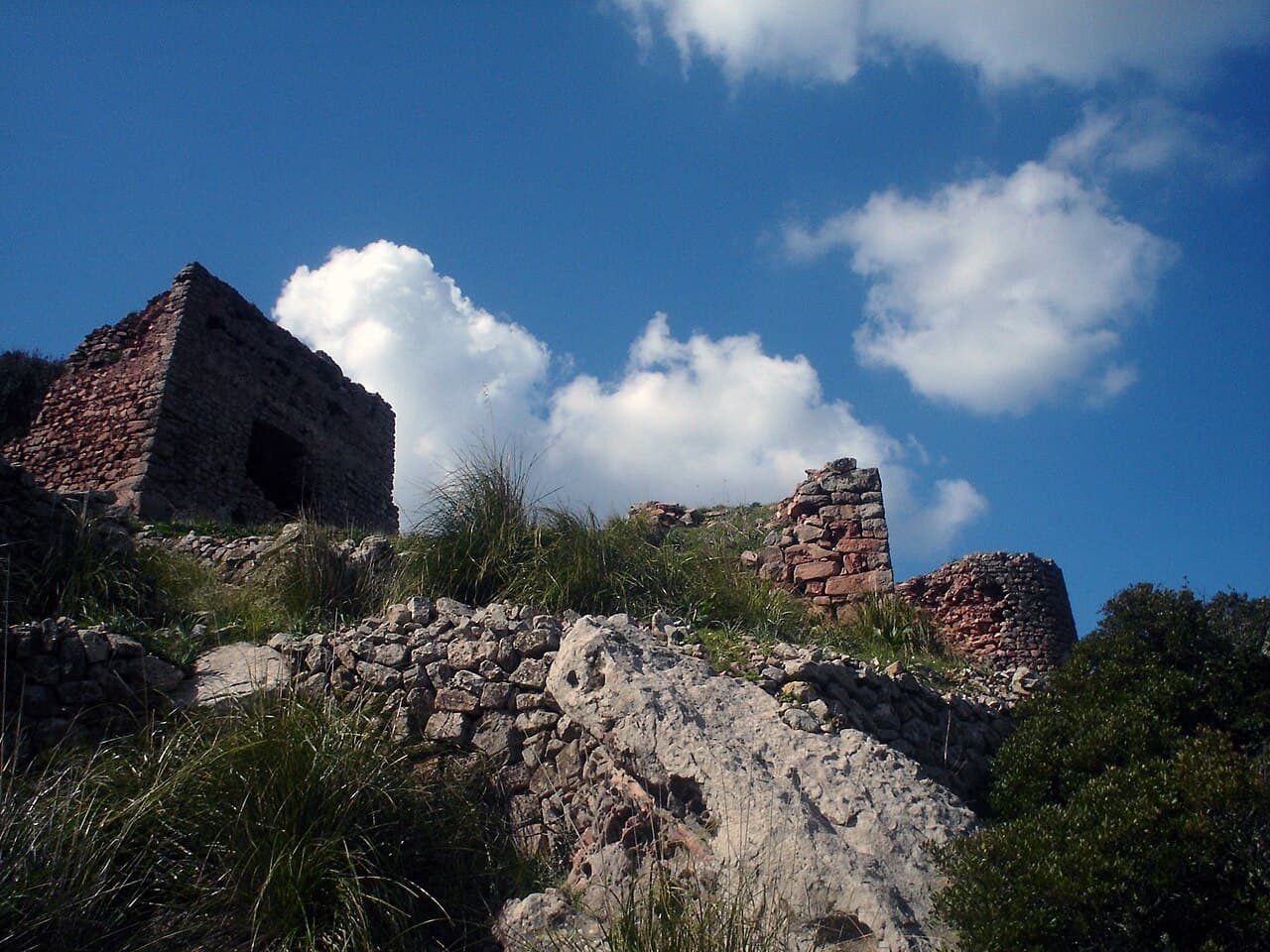
Today, Santa Àgueda Castle occupies roughly five hectares on its hilltop, divided into the three adjoining sections that reflect its historical phases. Though the castle is in a state of partially preserved ruins, its surviving masonry, towers, cisterns, and segments of the ancient Roman road provide a tangible connection to its layered past.
The central polygonal section with its original towers and donjon reveals the castle's Moorish architectural heritage, while the large northwestern wing and northeastern armory illustrate medieval expansions and adaptations. The absence of the chapel today contrasts with its historical role as a religious site, yet the castle remains a cultural landmark on Menorca.
Local folklore enriches the castle's mystique, including legends of a hidden golden calf statue beneath its walls, adding a mythical dimension to its historical narrative. The site's recognition as a cultural heritage monument in the late 20th century has ensured its protection and public ownership, allowing visitors to explore its evocative ruins and appreciate its significance in Mediterranean history.
Visiting santa àgueda castle
Santa Àgueda Castle is accessible by hiking trails that ascend the plateau, offering visitors a chance to experience its commanding views and historic atmosphere firsthand. The preservation of the Roman road path enhances the journey, connecting visitors with the site's ancient origins. Interpretive signage and local guides provide insights into the castle's architectural features and historical episodes, enriching the visitor experience.
While the castle remains a ruin, its evocative remains and panoramic vistas make it a compelling destination for those interested in medieval fortifications, Moorish architecture, and the history of the Balearic Islands. The annual pilgrimage to honor Saint Agatha, though no longer centered at the castle, continues to reflect the enduring cultural resonance of this historic site.
Photo gallery

Public domain
Information
Loading map...
Visitor reviews
No reviews yet. Been here? Write the first review and help other travelers!
Write the first reviewVisited this castle? Share your experience
Your review helps other travelers and adds first-hand knowledge to our encyclopedia.