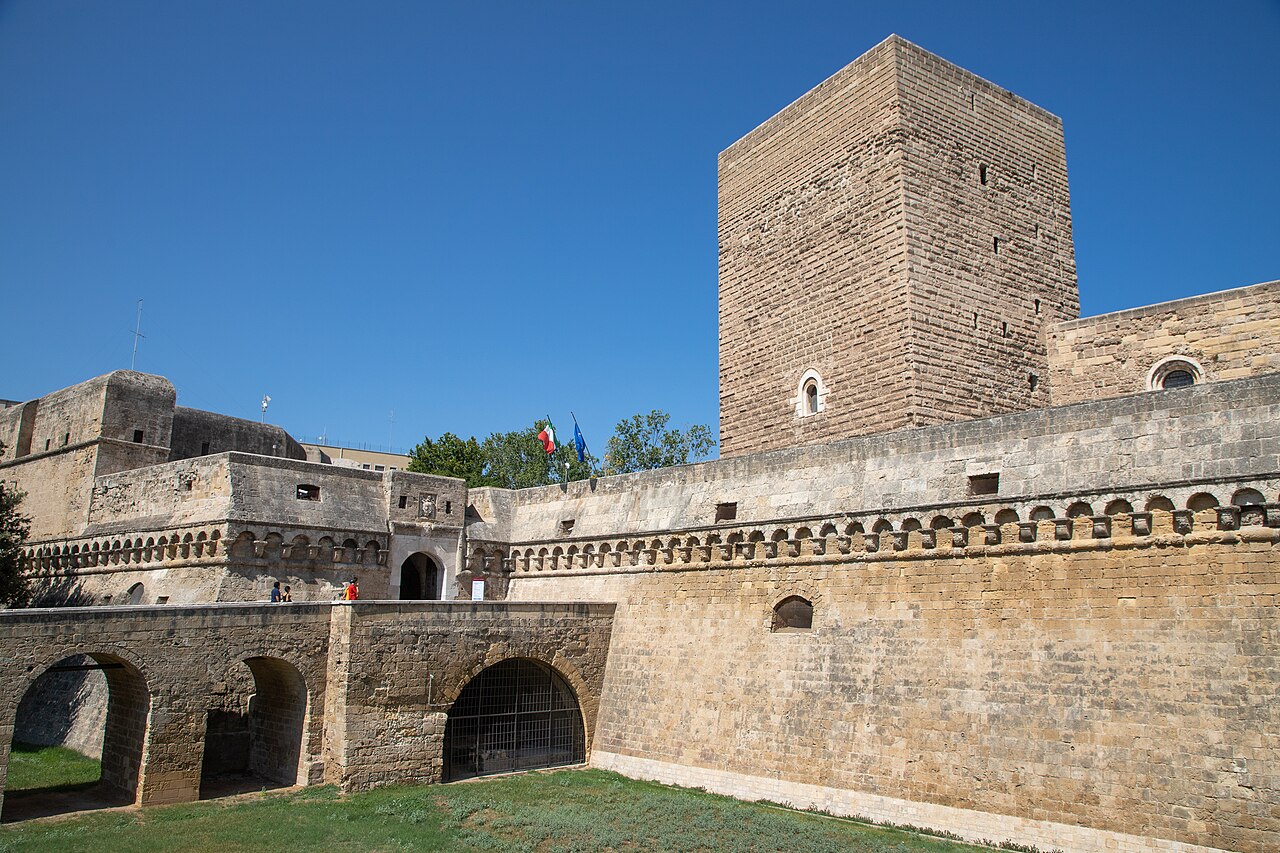
Sannicandro di Bari Castle
Sannicandro di Bari Castle stands as a remarkable example of layered medieval military architecture in the Apulia region of southern Italy. Its origins trace back to 916 AD, when the Byzantine general Niccolò Piccingli commissioned the fortress to defend the region against Saracen incursions. The castle's complex structure reflects its long history of modifications, combining Byzantine foundations with Norman and later Hohenstaufen enhancements.
Byzantine origins and early defensive design
The initial construction phase of the castle produced a robust fortress with a trapezoidal layout, characterized by a sturdy brick and stone wall. This wall was fortified with six four-sided towers positioned strategically at the four corners and the midpoints of the trapezoid’s bases. This design was typical of Byzantine military architecture aimed at maximizing defense and surveillance capabilities. The castle was part of a network of fortifications intended to protect Apulia from Saracen raids, which were a persistent threat during the early medieval period.
Norman conquest and architectural transformation
In 1071, after a prolonged siege, the Normans under Robert Guiscard, Duke of Apulia, captured Bari and asserted control over the region, including Sannicandro. The castle was declared a barony within the County of Montescaglioso. The Normans undertook significant reconstruction, incorporating their distinctive architectural style. They rebuilt the four corner towers atop the Byzantine ruins and added four central towers connected by a strong curtain wall, enhancing the castle's defensive capabilities.
To the east, a wide moat and drawbridge were constructed, isolating the castle and providing an additional layer of protection. Behind the northern curtain wall, the baronial palace was erected, featuring a secret tunnel leading to the nearby church of St. John, which the Normans themselves had built outside the walls. The castle also gained a chapel dedicated to St. Nicholas following the arrival of the saint's relics in Bari in 1087, underscoring the religious significance intertwined with the fortress.
Notable Norman barons and feudal administration
The last Norman baron of Sannicandro was William De Tot, who ruled approximately between 1150 and 1170. Prior to his tenure, the barony briefly passed to Count Guido da Venosa from 1131 to 1134. During this period, the castle functioned as a feudal stronghold and administrative center, overseeing the surrounding lands and asserting Norman authority in the region.
Hohenstaufen enhancements and imperial influence
The castle underwent further significant modifications under the Hohenstaufen dynasty, particularly during the reign of Emperor Frederick II. Although detailed records of events during this period are sparse, the emperor's centralization policies and his known intolerance for baronial autonomy suggest that the castle was likely retained under direct imperial control rather than granted to a feudal lord.
In 1242, the Hohenstaufens completed the Byzantine structure by adding an outer defensive wall approximately 1.58 meters thick, encircling the manor and protected by a new moat. This outer wall expanded the castle's footprint and reinforced its defensive posture. The demolition of the north central Norman tower made way for a grand baronial palace featuring three large mullioned windows, flanked by two massive towers.
Intriguingly, the castle incorporated hidden, lightless chambers designed for falconry, reflecting Emperor Frederick II's interest in hunting as detailed in his treatise De arte venandi cum avibus. A secret tunnel was also constructed, extending to the countryside near Bitetto, facilitating discreet movement in times of siege or emergency. By the end of the Hohenstaufen period, the castle comprised nine towers, blending military and residential functions.
Angevin period and ecclesiastical ownership
The arrival of the Angevin dynasty marked a turning point in the castle's history. According to tradition, Prince Charles I of Anjou, imprisoned in Sicily, prayed to St. Nicholas of Bari and credited the saint with his release. As king, Charles II of Anjou rewarded the shrine of St. Nicholas with generous endowments, and in 1304, the fief of Sannicandro was granted to the Basilica of Saint Nicholas of Bari.
During Angevin rule, the castle was administered by the Prior-Barons of the Basilica, who resided primarily at the royal court in Naples. The castle itself served as an agricultural and administrative center rather than a noble residence. Its ground floor rooms were adapted for practical uses, including a grain mill and an oil mill, reflecting a shift from military to economic functions.
This ecclesiastical ownership continued for five centuries until the abolition of feudalism in 1806 by King Joseph Bonaparte. Following this, the castle became private property, with the Basilica acting as a user rather than a feudal lord.
Modern transformations and preservation efforts
Between 1806 and 1875, the castle experienced significant deterioration. The loss of feudal rights created financial challenges for the Basilica, prompting alterations to the castle's structure to generate income. New doors and windows were added to the outer walls, converting parts of the fortress into workshops, residences, barns, and shops. The original tunnel was sealed, and the distinctive mullioned windows were modified into balconies, compromising some of the castle's historic architectural features.
In 1951, ownership transferred from the Prior of St. Nicholas to the Archbishop of Bari. Subsequently, in 1967, the castle was acquired by the Municipality of Sannicandro di Bari, marking a new phase focused on preservation and public use. Today, the castle is recognized as a valuable cultural and historical monument, illustrating centuries of military, feudal, and ecclesiastical history in Apulia.
Architectural features and layout
The castle's trapezoidal plan is a distinctive feature, with its combination of Byzantine, Norman, and Hohenstaufen elements. The original Byzantine walls and towers provide a foundation upon which later medieval fortifications were built. The Norman curtain walls and towers added robustness, while the Hohenstaufen expansions introduced residential palatial elements and improved defensive works such as moats and outer walls.
The presence of secret tunnels and hidden falconry chambers reflects the castle's multifunctional role as a military fortress, noble residence, and hunting lodge. The integration of religious spaces, including the chapel dedicated to St. Nicholas, highlights the castle's connection to local spiritual life and the significance of the saint's relics in Bari.
Defensive structures
- Moats and drawbridges: These were key defensive features constructed during the Norman period to isolate and protect the castle from attackers.
- Towers: The castle includes nine towers of varying size and function, strategically placed for surveillance and defense.
- Curtain walls: Thick, high walls connect the towers, forming a formidable barrier against siege weaponry.
Residential and functional areas
- Baronial palace: Built during the Norman and Hohenstaufen periods, it served as the noble residence with large mullioned windows and defensive towers.
- Chapel of St. Nicholas: A religious space within the castle, reflecting the importance of the saint's relics in Bari and the castle's ecclesiastical connections.
- Workshops and mills: Added during the Angevin period and later, these reflect the castle's role in local economy and administration.
Visiting Sannicandro di Bari Castle
Today, the castle is owned by the Municipality of Sannicandro di Bari and serves as a cultural landmark. Visitors can explore its layered architectural features and learn about its history through guided tours and exhibitions. The castle's location in Apulia makes it accessible for those interested in medieval architecture and southern Italian history.
Frequently asked questions (FAQ)
- What is the historical significance of Sannicandro di Bari Castle?
- Sannicandro di Bari Castle dates back to the 11th century and served as a vital defensive structure during various conflicts in southern Italy. Its architecture reflects a blend of Norman and Swabian styles, showcasing the rich history of the region and its strategic importance in medieval times.
- When was Sannicandro di Bari Castle built?
- The castle was initially constructed in the early 11th century, with significant modifications and additions made over the centuries. Its design and fortifications were influenced by the changing political landscape, making it a fascinating site for history enthusiasts.
- Can I visit Sannicandro di Bari Castle?
- Yes, visitors are welcome to explore Sannicandro di Bari Castle. The castle offers guided tours that provide insights into its history and architecture, making it an enriching experience for all ages.
- What are the opening hours for Sannicandro di Bari Castle?
- Sannicandro di Bari Castle is typically open to visitors from 9 AM to 6 PM, but it's advisable to check the official website for any seasonal changes or special events. Plan your visit accordingly to ensure you have enough time to explore the grounds and enjoy the views.
- Is it possible to access Sannicandro di Bari Castle with a wheelchair?
- While Sannicandro di Bari Castle has made efforts to improve accessibility, some areas may still pose challenges for wheelchair users due to uneven terrain and historic structures. It is recommended to contact the castle management in advance to inquire about specific accommodations.
- When is the best time to visit Sannicandro di Bari Castle?
- The best time to visit is during spring (April to June) and autumn (September to October) when the weather is mild and the crowds are smaller. These seasons enhance the overall experience, allowing you to enjoy the castle and its surroundings comfortably.
- What are the ticket prices for Sannicandro di Bari Castle?
- Ticket prices for Sannicandro di Bari Castle are generally affordable, with discounts available for students and seniors. It's best to check the official website for the most current pricing and any special offers that may be available during your visit.
- Are there any nearby attractions to visit after Sannicandro di Bari Castle?
- Yes, the area surrounding Sannicandro di Bari Castle is rich in attractions. You can explore the charming town of Sannicandro di Bari, visit local museums, or take a short drive to nearby Bari for additional historical sites and seaside views.
Information
Loading map...
Visitor reviews
No reviews yet. Been here? Write the first review and help other travelers!
Write the first reviewVisited this castle? Share your experience
Your review helps other travelers and adds first-hand knowledge to our encyclopedia.