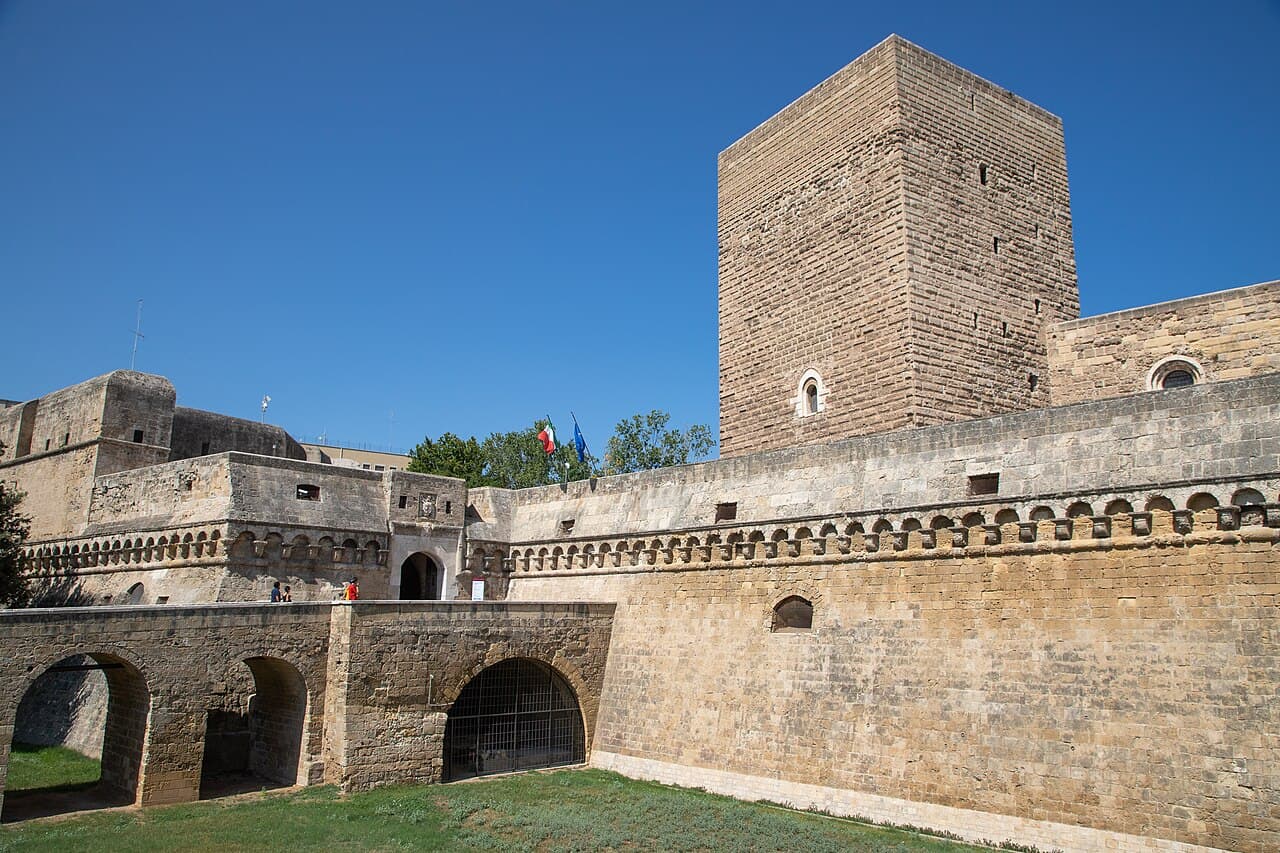
Bari Svevo Castle
Bari Svevo Castle, also known as the Castello Normanno-Svevo or Swabian Castle, is a monumental fortress located in the coastal city of Bari in the Puglia region of southern Italy. This castle stands as a remarkable testament to the region's complex medieval history, reflecting the architectural and political influences of the Normans, Hohenstaufens, Angevins, and Aragonese dynasties over several centuries.
The castle's origins date back to around 1132, when it was initially constructed by the Norman King Roger II atop the remnants of an earlier Byzantine fortification. Its strategic position near the Adriatic Sea made it a crucial military and administrative center designed to control the city of Bari and its surrounding territories. However, the castle's early Norman structure suffered significant damage in 1156 during the reign of King William I of Sicily, known as William the Bad, who ordered its partial destruction amid local unrest.
Reconstruction and expansion under emperor frederick ii
The castle was extensively rebuilt and fortified between 1233 and 1240 under the auspices of the Holy Roman Emperor Frederick II of the Hohenstaufen dynasty. This reconstruction transformed the fortress into a more imposing and architecturally sophisticated stronghold. Frederick II added a distinctive keep (bergfried) typical of German medieval castles, which served both defensive and residential purposes. The entrance of the castle prominently features an imperial eagle emblem, symbolizing Frederick's authority and the castle's elevated status within the empire.
According to local tradition, around 1221, Frederick II met St. Francis of Assisi within the castle walls. Although the story's historical accuracy is debated, it remains a cherished legend that highlights the castle's cultural significance. The tale recounts how Frederick, intrigued by Francis's principles, tested his resolve by sending a courtesan to his chambers, only to be impressed when Francis sent her away. This encounter is commemorated by a chapel dedicated to St. Francis and a 1635 inscription within the castle.
Changes during angevin and aragonese rule
Following the decline of Hohenstaufen power, the castle came under the control of the Angevin dynasty. King Charles I of Anjou ordered restorations and modifications, including the creation of a new northern entrance facing the sea to enhance the fortress's accessibility and defensive capabilities.
Later, during the Aragonese period, the castle was granted to the Sforza family. Notably, Bona Sforza, Queen of Poland and daughter of Isabella of Aragon, made significant enhancements in the early 16th century. She commissioned the addition of angular bastions designed to withstand emerging firearm technology and introduced elegant Renaissance-style staircases within the castle courtyard, blending military utility with refined aesthetics. Bona Sforza died in the castle in 1557, marking the end of an era of aristocratic residence.
Military use and later functions
In 1696, a lightning strike caused a catastrophic explosion in one of the castle's towers where gunpowder was stored, damaging nearby buildings and underscoring the risks of military storage within urban fortresses. During the Bourbon period spanning the 18th and 19th centuries, the castle was repurposed as a prison, notably housing juvenile offenders in the so-called "Tower of Minors." It also served as barracks for infantry and gendarmerie units, reflecting its continued strategic and administrative importance.
Architectural features and layout
Bari Svevo Castle has a nearly square, trapezoidal layout fortified by four prominent corner towers, each bearing historical names: the Tower of Minors (southwest), the Visconti Tower, the Semaphore or Sea Tower (southeast), the Monk's Tower or St. Francis Tower (northwest), and the Wind Tower (northeast). The castle is surrounded on three sides by a deep moat, while the northern side historically faced the sea, providing natural defense and access.
Access to the castle is gained via a southern bridge spanning the moat, leading to the main gate. This entrance is distinguished by a pointed arch adorned with the Bourbon coat of arms and the imperial eagle clutching prey, a symbol of Frederick II's enduring legacy. Beyond the gate lies a vestibule featuring high pointed vaults supported by columns and pilasters, with capitals decorated with intricate leaf patterns crafted by notable local sculptors such as Minerrus de Canusia and Melis de Stelliano.
Within the castle, a Renaissance-style courtyard houses a remarkable double-flight staircase from the Aragonese period. The left flight replaced an earlier medieval stair, while the right was uniquely designed to accommodate horse riders ascending, demonstrating innovative architectural adaptation to the needs of the era. The castle also contains a residential palace and the imposing keep added by Frederick II.
In response to evolving military technology, the outer defenses were reinforced in the 16th century with angular bastions shaped like spearheads, designed to resist cannon fire and other firearms. The castle's well-preserved condition allows visitors to appreciate the blend of medieval fortifications and Renaissance architectural elements, including decorated windows and ornate round openings on the towers.
Modern use and cultural significance
Today, Bari Svevo Castle serves as a cultural hub and museum complex. The lower floors accommodate the Museo della Gipsoteca, which exhibits plaster casts of Apulian sculptures dating from the 11th to the 17th centuries, offering insights into the region's artistic heritage. The upper floors host temporary exhibitions and collections of 16th- and 17th-century Apulian ceramics and majolica, enriching visitors' understanding of local craftsmanship.
The castle's rich history, architectural diversity, and cultural associations make it a prominent landmark in Bari and a significant attraction for those interested in medieval and Renaissance history, military architecture, and art. Its preservation and adaptive reuse underscore the importance of safeguarding historical monuments for educational and cultural enrichment.
Frequently asked questions (FAQ)
- What is the historical significance of Bari Svevo Castle?
- Bari Svevo Castle, originally built in the 12th century, played a crucial role in the defense of the city against invasions. Its strategic location and robust architecture reflect the various influences of the Norman, Swabian, and Aragonese periods, making it a significant monument of medieval history in Italy.
- When was Bari Svevo Castle built?
- Construction of Bari Svevo Castle began in the 12th century under the Normans, with significant modifications made during the Swabian period in the 13th century. The castle has undergone various restorations over the centuries, preserving its historical integrity while adapting to modern needs.
- What are the opening hours of Bari Svevo Castle?
- Bari Svevo Castle is typically open to visitors from 9:00 AM to 7:00 PM, with extended hours during the summer months. It is advisable to check the official website for any seasonal changes or special closure dates before planning your visit.
- Can I purchase tickets online for Bari Svevo Castle?
- Yes, tickets for Bari Svevo Castle can be purchased online through the official website or at the entrance. Buying tickets in advance is recommended, especially during peak tourist seasons, to avoid long queues.
- Is Bari Svevo Castle accessible for visitors with disabilities?
- Yes, Bari Svevo Castle is equipped with facilities to assist visitors with disabilities, including ramps and accessible restrooms. However, some areas may still pose challenges due to the castle's historical architecture, so it's best to inquire about specific accommodations upon arrival.
- What is the best time to visit Bari Svevo Castle?
- The best time to visit Bari Svevo Castle is during the spring (April to June) and fall (September to October) when the weather is pleasant and the tourist crowds are smaller. Visiting during these months allows for a more enjoyable exploration of the castle and its surroundings.
- Are there any nearby attractions to visit after Bari Svevo Castle?
- Yes, after visiting Bari Svevo Castle, you can explore the nearby Basilica di San Nicola and the picturesque Old Town of Bari. The area is rich in history and offers various dining options to enjoy local cuisine.
- How do I get to Bari Svevo Castle?
- Bari Svevo Castle is conveniently located in the city center, making it easily accessible by public transport. Visitors can take a bus, tram, or even walk from many central locations, as the castle is a prominent landmark in Bari.
- What is the ticket price for visiting Bari Svevo Castle?
- The ticket price for Bari Svevo Castle is typically around €5 for adults, with reduced prices for students and seniors. Children under a certain age may enter for free, but it's best to check current rates on the official website before your visit.
Photo gallery

Information
Website
Visit websiteSources & official resources
Verify the information above using these authoritative references.
Loading map...
Visitor reviews
No reviews yet. Been here? Write the first review and help other travelers!
Write the first reviewVisited this castle? Share your experience
Your review helps other travelers and adds first-hand knowledge to our encyclopedia.


