Sandsfoot Castle
Sandsfoot Castle stands as a significant example of Tudor military architecture, located in the coastal town of Weymouth, England. Constructed under the reign of King Henry VIII during the early 16th century, this fortress was part of a strategic network of artillery forts designed to protect England from the threat of invasion by European powers such as France and the Holy Roman Empire. Its position overlooking Weymouth Bay opposite Portland Castle made it a key defensive site along the southern English coast.
Historical context and construction
The castle was commissioned in 1539 as part of Henry VIII's extensive coastal defence program, often referred to as the 'Device Forts' or 'Henrician Castles'. The construction was completed around 1542, costing approximately £3,887, a considerable sum at the time. Sandsfoot was built primarily from Portland stone, a durable limestone prized for its strength and workability, with the visible surfaces finished in finely dressed ashlar stonework and the interior walls filled with rubble.
The design featured a compact two-storey blockhouse measuring roughly 42 by 32 feet, connected to a one-storey octagonal gun room about 36 by 28 feet in size. The blockhouse included a gate tower on the inland side, which likely housed a portcullis, a defensive sliding grille common in Tudor fortifications. The blockhouse contained four main rooms used for living quarters and cooking, as well as staircases providing access to upper and lower levels. Above the gate was a small chamber, possibly used for guard duties or storage.
The adjoining gun room was equipped with five embrasures—openings designed for mounting artillery—and featured a flat roof with protective parapets, intended to support additional cannons. This arrangement reflected the evolving military technology of the period, emphasizing artillery-based coastal defence rather than traditional medieval fortifications.
Military role and significance
Sandsfoot Castle served as a vital military outpost guarding the anchorage in Weymouth Bay. Its garrison was commanded by a captain appointed directly by the Crown, underscoring its strategic importance. The local community of Wyke Regis supported the castle's operations, receiving exemptions from taxes and militia service in exchange for their assistance.
During the English Civil War (1642–1651), Sandsfoot changed hands between Royalist and Parliamentarian forces. Notably, records indicate that between 1643 and 1644, the castle may have functioned as a Royalist mint, producing coins to finance the war effort. This use highlights the castle's continued military and economic significance during a turbulent period in English history.
Following the restoration of King Charles II, the castle was decommissioned in 1665 as advances in military technology and changing strategic priorities rendered it obsolete. Despite this, the structure remained intact and was repurposed as a storehouse throughout the late 17th century.
Decline and preservation challenges
By the early 18th century, Sandsfoot Castle had fallen into disrepair. The stonework was quarried for local building projects, and many original features were lost or relocated. For example, the Elizabethan coat of arms was moved to All Saints Church in Wyke Regis by 1825.
The castle's coastal position exposed it to relentless erosion, which gradually caused the collapse of the gun platform over the 18th and 19th centuries. Safety concerns led to the closure of the ruins to the public in 1930. The last remaining gun embrasure on the platform was lost during the 1950s, marking a significant loss of original fabric.
During World War II, Sandsfoot Castle briefly resumed military use as a site for an anti-aircraft battery, defending against aerial attacks. This reuse underscores the enduring strategic value of the location despite the castle's ruinous state.
Modern conservation and public access
In the early 21st century, concerted conservation efforts funded by the Heritage Lottery Fund aimed to stabilize and document the remaining structures. These efforts included advanced techniques such as three-dimensional laser scanning to record the castle's condition in detail.
Restoration work between 2009 and 2012 saw the construction of a viewing walkway, allowing visitors to safely explore the site and appreciate its historical significance. However, structural cracks detected in 2021 led to the closure of public access once again for safety reasons.
Today, Sandsfoot Castle is protected as a Grade II* listed building and a scheduled monument, recognizing its cultural and historical importance. Adjacent to the castle entrance are the Sandsfoot Gardens, established in the 1950s in a Tudor revival style, featuring an ornamental pond that complements the site's heritage atmosphere.
Architectural features and surviving remains
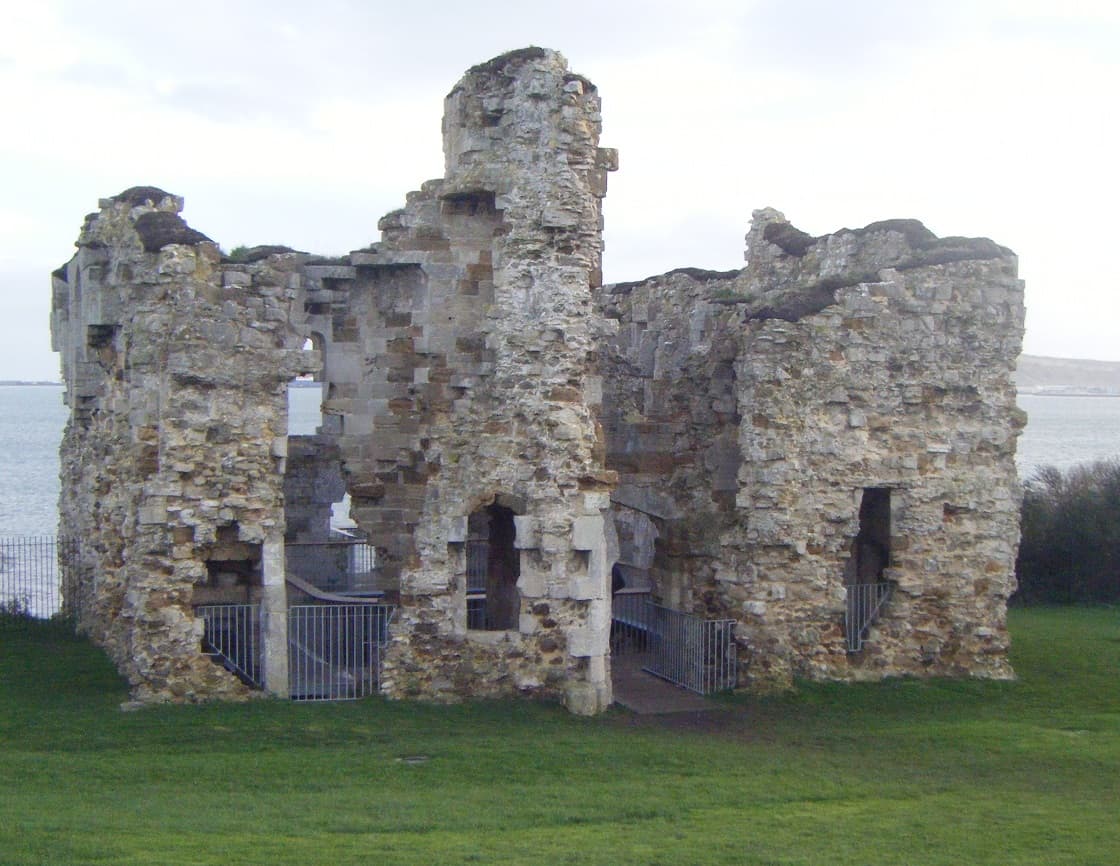
The castle's surviving ruins reveal much about Tudor military architecture. The main blockhouse, though roofless and missing floors, retains sections of its ashlar stone walls and structural elements. The gate tower, once protected by a portcullis, remains a prominent feature.
The original octagonal gun room has mostly been lost to coastal erosion, with only one southwest embrasure visible on the beach below the site. Surrounding the masonry structure was an outer defensive ward accessed by a bridge, with stables nearby, though these features no longer survive above ground.
In the early 17th century, additional earthwork defences were added, including a wide ditch and two bastions on the north and west sides. The north bastion is largely intact, while the west bastion has been mostly destroyed. These earthworks survive as a ditch and raised bank approximately 10 meters wide and 2.2 meters deep, providing visible evidence of the castle's extended defensive system.
The castle's strategic coastal location
Situated on a low hill overlooking the sea, Sandsfoot Castle's location was carefully chosen to command views of the anchorage and shipping lanes in Weymouth Bay. This vantage point allowed defenders to monitor and engage hostile vessels approaching the coast, demonstrating the tactical thinking behind Tudor coastal fortifications.
Construction materials and techniques
The use of Portland stone was typical for significant buildings in the region, prized for its durability and aesthetic qualities. The castle's ashlar facing provided a smooth, imposing exterior, while the rubble-filled interiors offered structural stability. The combination of stonework and earthworks reflected evolving military architectural practices aimed at resisting artillery fire.
Defensive innovations
The blockhouse's design incorporated features such as the portcullis and embrasures for cannon, marking a transition from medieval to early modern fortification styles. The flat roof of the gun room with parapets was intended to mount artillery, a relatively innovative approach in the mid-16th century, reflecting the increasing importance of gunpowder weapons in coastal defence.
Cultural heritage and visitor experience
Sandsfoot Castle today offers a tangible connection to England's Tudor past and its military history. The ruins and surrounding gardens provide a picturesque setting for visitors interested in coastal fortifications and historic landscapes.
Although public access is currently restricted due to safety concerns, the site remains a focus of heritage conservation efforts and local pride. The nearby town of Weymouth, with its maritime heritage and other historic sites, complements a visit to Sandsfoot Castle, offering a broader context for understanding the castle's role in England's coastal defence network.
Frequently asked questions (FAQ)
- When was Sandsfoot Castle built and by whom?
- Sandsfoot Castle was built between 1539 and 1542 under the direction of King Henry VIII as part of a coastal defence initiative.
- What is the architectural style of Sandsfoot Castle?
- The castle features mixed architectural styles typical of Tudor military fortifications, including ashlar stonework and embrasures for artillery.
- Can I visit Sandsfoot Castle today?
- Currently, Sandsfoot Castle is closed to the public due to structural safety concerns, but the surrounding Sandsfoot Gardens remain accessible.
- What caused the decline of Sandsfoot Castle?
- Coastal erosion and stone quarrying led to the castle's gradual decay, with significant parts collapsing into the sea over the 18th and 19th centuries.
- What role did Sandsfoot Castle play during the English Civil War?
- The castle changed hands between Royalist and Parliamentarian forces and may have served as a Royalist mint producing coins to fund the war effort.
Photo gallery

Information
Opening hours
Closed due to safety concerns
Ticket prices
Free
Current owner
Local authority
Website
Visit websiteSources & official resources
Verify the information above using these authoritative references.
Loading map...
Visitor reviews
No reviews yet. Been here? Write the first review and help other travelers!
Write the first reviewVisited this castle? Share your experience
Your review helps other travelers and adds first-hand knowledge to our encyclopedia.