Rufus Castle
Rufus Castle, perched on the Isle of Portland in Dorset, England, stands as a captivating example of medieval military architecture with a rich history spanning several centuries. Its strategic location overlooking Church Ope Cove and the treacherous Shambles sandbank highlights its role in coastal defense and maritime control. The castle’s name honors King William II (William Rufus), under whose reign the first fortifications were reportedly established in the 12th century.
The castle’s origins trace back to the turbulent High Medieval period, with early fortifications likely constructed during the reign of William Rufus in the late 11th or early 12th century. This initial stronghold formed part of a wider network of defenses intended to secure the southern coast against invasion and local unrest. Historical records confirm the castle’s significance during the civil war between King Stephen and Empress Matilda in 1142, when it was seized by Robert, Earl of Gloucester, underscoring its military value in regional power struggles.
Throughout the 13th century, fortification enhancements were authorized by royal license, including the granting of permission for crenellation to figures such as Aylmer de Lusignan and Robert, Earl of Gloucester. These improvements reflect the castle’s evolving defensive capabilities amid the shifting political landscape of medieval England.
Architectural evolution and late medieval reconstruction
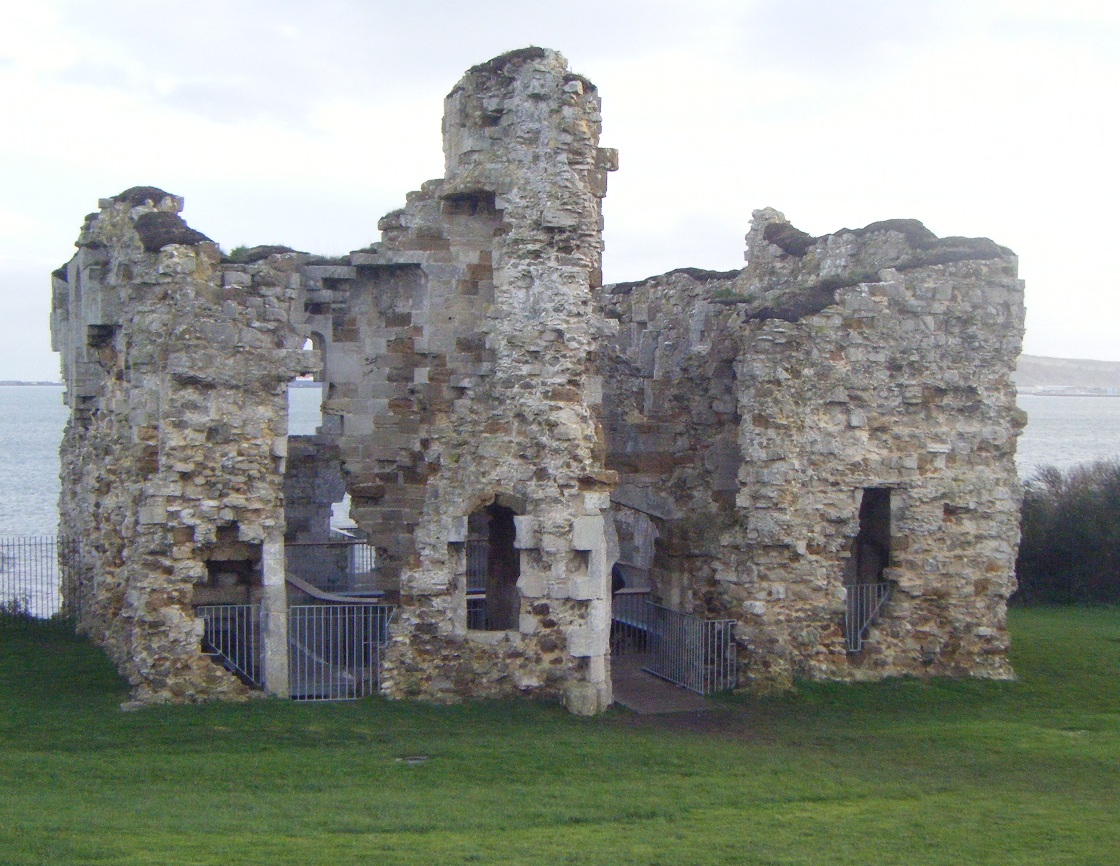
The current ruins predominantly date from the late 15th century, during which Richard, Duke of York, oversaw significant rebuilding efforts between 1432 and 1460. The castle’s pentagonal layout is distinctive, with walls constructed from locally quarried Portland stone. The landward walls are notably thick, measuring approximately seven feet, designed to withstand siege weaponry and assaults.
The castle’s defensive features include several medieval gun ports, often mistaken for arrow loops, which illustrate adaptations to the introduction of firearms in warfare. These circular openings, located mainly along the north and west walls at first-floor level, allowed defenders to operate small guns while remaining protected behind a projecting parapet supported by stone corbels arranged in groups of three.
The pentagonal tower rests upon earlier foundations, possibly incorporating elements of a 12th-century keep to the north and a stepped plinth to the west. This layering of construction phases reveals the castle’s continuous development and strategic importance over centuries.
Romantic era transformation and 19th-century modifications
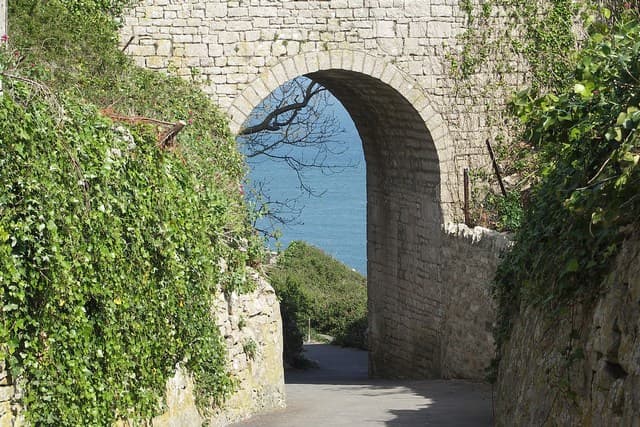
By the late 18th century, Rufus Castle’s military function diminished, and it became integrated into the landscape of the nearby Pennsylvania Castle estate owned by John Penn. Penn transformed the ruin into a picturesque folly, characteristic of the Romantic movement’s fascination with medieval ruins. He added a distinctive round-arched bridge over Church Ope Road, replacing original entrances with two large arches to enhance the castle’s aesthetic appeal rather than its defensive utility.
Preservation challenges and modern restoration efforts
Despite its romantic allure, Rufus Castle suffered from natural erosion and structural decline throughout the 20th century. It was designated a Grade I listed building in 1951 and later a scheduled monument in 1979, recognizing its national heritage importance. However, ongoing deterioration led to its inclusion on the Heritage at Risk Register in 2010.
Between 2010 and 2012, restoration work funded by English Heritage and directed by architect Russ Palmer focused on stabilizing vulnerable sections, particularly the north walls. Efforts included consolidating wall tops, repointing mortar joints, and filling gaps to prevent further decay, ensuring the castle’s survival as a significant historic ruin.
Architectural features and archaeological remains
The castle’s roughly squared Portland stone masonry displays medieval construction techniques, combining rough ashlar and rubble. The thick landward walls and irregular pentagonal plan reflect practical defensive design tailored to the site’s topography.
Medieval gun ports, often misidentified as arrow loops, are a key feature, revealing the castle’s adaptation to late medieval military technology. The presence of five embrasures with circular gunholes at first-floor level along the north and west walls allowed for effective defense using small firearms.
The pentagonal tower’s foundations incorporate earlier structures, highlighting the castle’s layered history. Archaeological investigations have uncovered stone footings outside the south gateway, although no visible remains survive of the historic "steppes of stone" that once linked the castle to the nearby Church of St Andrews.
Today, the castle remains a roofless ruin, with some parts lost to erosion, including the seaward arch that collapsed in 1989. Despite limited public access due to private ownership, Rufus Castle continues to inspire artists and visitors, embodying the enduring legacy of England’s medieval coastal fortifications.
Cultural significance and influence
Rufus Castle has long captured the imagination of artists and writers. Its dramatic silhouette and evocative ruins have been depicted by renowned painters such as J. M. W. Turner and referenced by literary figures including Thomas Hardy and Victor Hugo. The castle’s presence in cultural works underscores its importance beyond military history, contributing to England’s rich heritage of historic landmarks.
As a Grade I listed building and scheduled monument, Rufus Castle is recognized for its architectural and historical significance, representing a tangible connection to England’s medieval past and coastal defense heritage.
Frequently asked questions (FAQ)
- How do I visit Rufus Castle?
- Rufus Castle is privately owned and not regularly open to the public. Visitors can view the castle from nearby public footpaths and viewpoints around Church Ope Cove on the Isle of Portland.
- What is the historical significance of Rufus Castle?
- Rufus Castle played a strategic role in medieval coastal defense and was involved in key historical events such as the civil war between King Stephen and Empress Matilda in the 12th century.
- When was Rufus Castle built?
- The earliest fortifications at Rufus Castle date back to the 12th century, with significant reconstruction in the late 15th century under Richard, Duke of York.
- Can I explore the interior of Rufus Castle?
- Due to its ruined condition and private ownership, access to the interior of Rufus Castle is generally restricted. Visitors can appreciate the exterior ruins and architectural features from outside.
- Why is Rufus Castle also called Bow and Arrow Castle?
- The castle is sometimes referred to as Bow and Arrow Castle because of the circular gun ports in its walls, which were historically mistaken for arrow loops but actually accommodated small firearms.
- Is there parking available near Rufus Castle?
- Parking is available in nearby areas on the Isle of Portland. Visitors should use public car parks or street parking close to Church Ope Cove and walk to the castle viewpoint.
Photo gallery

Information
Address
Isle of Portland, Portland DT5 1JA, United Kingdom
Loading map...
Visitor reviews
No reviews yet. Been here? Write the first review and help other travelers!
Write the first reviewVisited this castle? Share your experience
Your review helps other travelers and adds first-hand knowledge to our encyclopedia.