Maiden Castle
Maiden Castle is a prominent Iron Age hillfort located approximately 1.6 miles (2.6 km) southwest of Dorchester in the county of Dorset, England. It stands as one of the largest and most complex hillforts in Britain, with origins that trace back to the 6th century BC. This fortified settlement occupies a commanding position atop a hill, characteristic of hill castles designed for defense and control of the surrounding landscape during the Early Medieval period and earlier.
The site of Maiden Castle reveals a long history of human activity, beginning in the Neolithic period with the presence of a causewayed enclosure and bank barrow. These early earthworks indicate ritual or communal use of the site long before the construction of the hillfort itself. By around 1800 BC, during the Bronze Age, the area was used for agricultural purposes, primarily crop growing, before being abandoned for a time.
Construction and expansion of the hillfort
Maiden Castle as it is known today was constructed around 600 BC. The initial phase of the hillfort was relatively modest, enclosing approximately 6.4 hectares (16 acres). Its design was typical of early Iron Age hillforts in Britain, featuring a single rampart and ditch system that provided basic defensive capabilities. This early fortification reflected the social and political climate of the time, when communities fortified their settlements against rival groups.
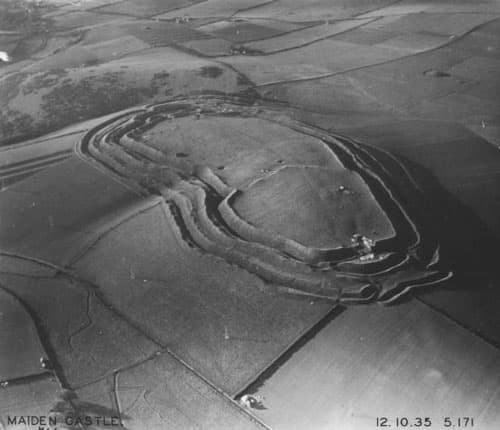
Significant changes occurred around 450 BC, when Maiden Castle underwent a major expansion. The enclosed area nearly tripled in size to about 19 hectares (47 acres), making it the largest hillfort in Britain and, by some measures, one of the largest in Europe. This enlargement included the construction of multiple ramparts and ditches, creating a complex system of defenses that enhanced the fort's security. The addition of these earthworks demonstrates advanced engineering skills and an increased need for protection, possibly due to rising tensions or growing population.
Defensive features and layout
The fortifications at Maiden Castle consist of several concentric ramparts and deep ditches, designed to deter attackers and control access. The multiple layers of earthworks would have made any assault difficult, forcing attackers to overcome successive barriers. The ramparts were constructed using local chalk and earth, shaped to form steep banks that were likely topped with wooden palisades or fences. The ditches served to impede enemy movement and may have been filled with water in certain sections.
The interior of the hillfort contained areas for habitation, storage, and communal activities. Archaeological evidence suggests that by around 100 BC, the population within Maiden Castle began to decline and became concentrated in the eastern part of the site. This contraction may reflect changes in social organization or external pressures.
Roman period and later use
Following the Roman conquest of Britain in the 1st century AD, Maiden Castle appears to have been largely abandoned as a settlement. However, the Romans may have maintained a military presence on the site, possibly using it as a strategic lookout or temporary camp. In the late 4th century AD, a temple and associated buildings were constructed within the hillfort, indicating continued religious or ceremonial significance during the Roman period.
By the 6th century AD, the hilltop was completely abandoned as a residential site and was subsequently used for agricultural purposes throughout the medieval period. The extensive earthworks remained visible in the landscape, serving as a reminder of the site's ancient past.
Archaeological investigations and cultural impact
The study of Maiden Castle has been influential in the understanding of Iron Age hillforts in Britain. Archaeological interest in the site was popularized in the 19th century by Augustus Pitt Rivers, a pioneering archaeologist who emphasized systematic excavation and recording techniques. In the 1930s, Mortimer Wheeler and Tessa Verney Wheeler conducted the first major archaeological excavations at Maiden Castle, uncovering significant details about its construction, use, and development.
More recent excavations led by Niall Sharples have further enhanced knowledge of the site, including conservation efforts to repair damage caused by erosion and visitor impact. These studies have helped to clarify the complex history of Maiden Castle and its role in the prehistoric and Roman eras.
Maiden Castle has also inspired cultural figures such as composer John Ireland and authors Thomas Hardy and John Cowper Powys, who drew upon its evocative landscape and historical resonance in their works.
Preservation and public access
Today, Maiden Castle is protected as a Scheduled Monument and is maintained by English Heritage. Its well-preserved earthworks and extensive ramparts offer visitors a tangible connection to Britain's ancient past. The site is open to the public, allowing exploration of the impressive defensive structures and panoramic views of the surrounding Dorset countryside.
Visitors can walk along the ramparts, observe the layout of the fortifications, and appreciate the scale of this remarkable Iron Age construction. Interpretive signage and guided tours provide context and enhance understanding of Maiden Castle's historical significance.
Frequently asked questions (FAQ)
- How do I get to Maiden Castle?
- Maiden Castle is located about 1.6 miles southwest of Dorchester in Dorset, England. It is accessible by car, with parking available nearby, and there are walking paths leading to the site from Dorchester.
- What is the historical significance of Maiden Castle?
- Maiden Castle is one of the largest Iron Age hillforts in Britain, notable for its extensive ramparts and ditches. It reflects the social and defensive strategies of prehistoric communities and has evidence of occupation from the Neolithic through the Roman periods.
- Can I explore the ramparts and earthworks at Maiden Castle?
- Yes, visitors can walk along the well-preserved ramparts and explore the earthworks. The site offers panoramic views and interpretive signs to help understand its historical context.
- When was Maiden Castle built and used?
- Maiden Castle was initially constructed around 600 BC in the Iron Age, expanded around 450 BC, and used until at least the Roman period. It saw decline and eventual abandonment by the 6th century AD.
- Are there any facilities or guided tours available at Maiden Castle?
- English Heritage manages the site and occasionally offers guided tours. Visitor facilities are limited, so it is advisable to check the English Heritage website for current information before visiting.
Photo gallery

Photo by Major George Allen (1891–1940)•Public domain
Information
Current owner
English Heritage
Loading map...
Visitor reviews
No reviews yet. Been here? Write the first review and help other travelers!
Write the first reviewVisited this castle? Share your experience
Your review helps other travelers and adds first-hand knowledge to our encyclopedia.