Sandomierz
Sandomierz Royal Castle stands as a significant historical and architectural monument in Sandomierz, Poland. Its origins trace back to the early medieval period, with the first stronghold likely established around the 11th century on a strategic hill overlooking the Vistula River valley. This elevated position, separated from the adjacent settlement by a deep ravine, offered natural defensive advantages that made it an ideal seat for feudal rulers. Mentioned by the chronicler Gall Anonim among the principal centers of the early Polish state alongside Kraków and Wrocław, Sandomierz held a prominent place in the region's medieval history.
Following the fragmentation of Poland in 1139, Sandomierz became the capital of a duchy, serving as the permanent residence of its prince. Although the earliest fortifications were likely wooden and earthworks, repeated Mongol invasions and attacks in 1241 and 1260 led to significant destruction, leaving little evidence of the original structures. The castle's role evolved after Poland's reunification, transitioning from a ducal seat to a royal castle and administrative center. A devastating fire in 1349 during a Lithuanian raid reshaped its layout, which has largely been preserved to the present day.
Medieval fortifications and kazimierz the great's contributions
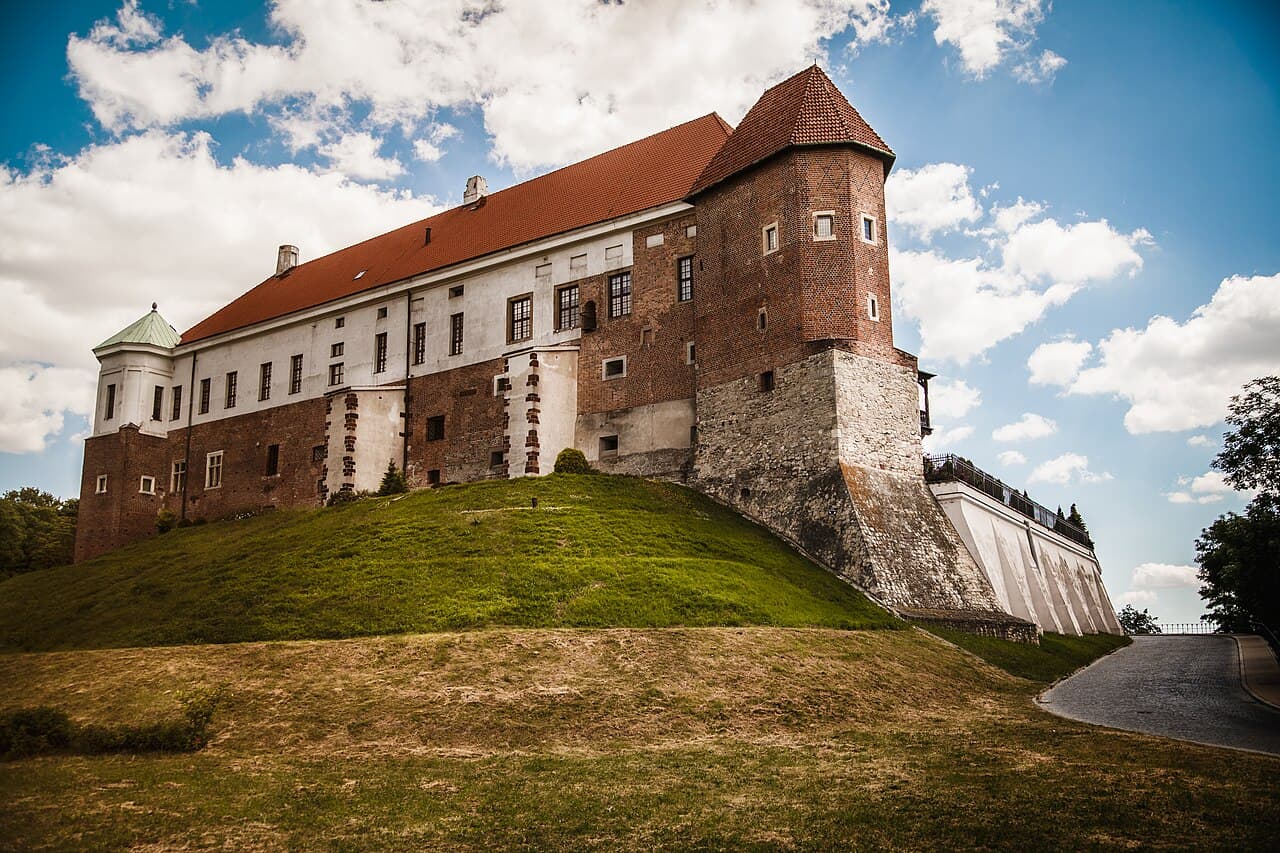
From 1362, under the reign of King Casimir III the Great, robust defensive walls were constructed to protect the castle and town. The mid-15th century saw a significant rebuilding phase, leaving behind architectural elements such as the southern tower known as 'kurza stopa' (hen's foot) and walls adorned with distinctive diamond-patterned zendrówka tiles. These features reflect the Gothic style prevalent at the time and underscore the castle's strategic and symbolic importance.
Renaissance transformation under the jagiellonian dynasty
The castle underwent a major transformation during the reign of King Sigismund I the Old, who initiated a Renaissance-style reconstruction of the medieval fortress. The project involved demolishing most of the old buildings except the southern residential house, and erecting new eastern and western wings. The western wing was crowned with a northern tower, and the courtyard was enclosed by a northern wall, resulting in a harmonious four-winged quadrangle typical of Renaissance palatial architecture. The work was overseen by the royal architect Benedyct Sandomierski, who also added two-storey arcaded cloisters around the courtyard, enhancing both the aesthetic and functional aspects of the castle.
Destruction and rebuilding in the 17th century
In 1656, during the Swedish Deluge, retreating Swedish troops left large quantities of ammunition in the castle's cellars, which exploded upon the arrival of Polish forces. This catastrophic blast destroyed the southern and eastern wings and severely damaged the northern section, sparing mainly the western wing. King John III Sobieski ordered the rebuilding of this surviving wing between 1680 and 1688, transforming it into a freestanding, palace-style residence. This reconstruction marked the end of the castle's role as a royal residence; it instead became an administrative and judicial center.
Later adaptations and current state
Following damage inflicted during the Bar Confederation conflicts in the late 18th century, further restoration was commissioned by King Stanisław August Poniatowski. Efforts included securing the southern tower with a large buttress to protect it from erosion by the Vistula River. In the 19th century, under the Congress Kingdom of Poland, the castle was repurposed as a prison, with the main building adapted for incarceration and other parts demolished. The eastern façade was remodeled in a monumental Neoclassical style, giving the castle its present-day appearance. Around 1894, a semicircular annex known as the "rogal" was added for staff accommodation.
The castle survived both World Wars and continued to function as a prison until 1959. In the 1980s, archaeological excavations uncovered remnants of earlier structures, including a Gothic octagonal tower from the era of Casimir the Great, and parts of the northern gate tower and outer walls. These findings have enriched the understanding of the castle's complex history and architectural evolution.
Today, Sandomierz Royal Castle operates as a museum, showcasing its layered history from early medieval fortifications through Renaissance grandeur to its later adaptations. The castle's preserved western wing, with its Renaissance cloisters and Gothic foundations, remains a testament to Poland's rich cultural heritage and the resilience of this historic site.
Architectural highlights and cultural significance
- Southern tower (kurza stopa): the oldest surviving part of the castle, with Gothic origins and later Renaissance modifications.
- Arcaded cloisters: two-storey Renaissance galleries surrounding the inner courtyard, designed by Benedyct Sandomierski.
- Diamond-patterned zendrówka tiles: distinctive decorative elements on the castle walls from the 15th century.
- Neoclassical eastern façade: 19th-century renovation giving the castle a monumental appearance.
- Archaeological remnants: foundations and towers revealing the castle's medieval past.
Sandomierz Royal Castle not only reflects the architectural transitions from the Gothic through the Renaissance to Neoclassical styles but also embodies the turbulent history of Poland, including invasions, royal ambitions, and administrative transformations. Its preservation and adaptation as a museum allow visitors to explore centuries of Polish history within its walls.
Frequently asked questions (FAQ)
- How do I get to Sandomierz Castle?
- Sandomierz Castle is easily accessible by car and public transportation. If you're traveling from Kraków, you can take a train or bus to Sandomierz, and from there, it's a short walk to the castle.
- What is the historical significance of Sandomierz Castle?
- Sandomierz Castle, built in the 14th century, played a crucial role in the defense of the region and served as a royal residence. Its strategic location on a hill overlooking the Vistula River made it an important site throughout Polish history.
- When was Sandomierz Castle built?
- Construction of Sandomierz Castle began in the late 14th century, with significant modifications and expansions occurring in subsequent centuries. The castle reflects various architectural styles due to these changes over time.
- Can I visit Sandomierz Castle year-round?
- Yes, Sandomierz Castle is open to visitors throughout the year, although opening hours may vary by season. It is advisable to check the official website for the latest information before planning your visit.
- Why is Sandomierz Castle a popular tourist destination?
- Sandomierz Castle attracts visitors due to its rich history, stunning architecture, and picturesque views of the surrounding landscape. The castle also hosts various cultural events and exhibitions, enhancing its appeal to tourists.
- Is it possible to access all areas of the castle?
- While many areas of Sandomierz Castle are accessible to visitors, some sections may have restricted access due to preservation efforts. Guided tours are available to help you explore the most significant parts of the castle.
- What are the ticket prices for visiting Sandomierz Castle?
- Ticket prices for Sandomierz Castle are generally affordable, with discounts available for students and seniors. It's best to check the castle's official website or visitor center for the most up-to-date pricing information.
- What are the opening hours of Sandomierz Castle?
- Sandomierz Castle typically opens at 9 AM and closes at 5 PM, but these hours may vary depending on the season. Always check the official website for current opening hours before your visit to avoid any inconvenience.
- When is the best time to visit Sandomierz Castle?
- The best time to visit Sandomierz Castle is during the spring and early autumn when the weather is mild, and the surrounding gardens are in full bloom. These seasons offer a pleasant experience and fewer crowds compared to the summer months.
- What nearby attractions can I visit while in Sandomierz?
- While visiting Sandomierz Castle, you can also explore the charming Old Town, the beautiful Cathedral, and the Opatów Gate. The region is rich in history, making it a great opportunity to discover additional cultural sites nearby.
Photo gallery

Information
Loading map...
Visitor reviews
No reviews yet. Been here? Write the first review and help other travelers!
Write the first reviewVisited this castle? Share your experience
Your review helps other travelers and adds first-hand knowledge to our encyclopedia.