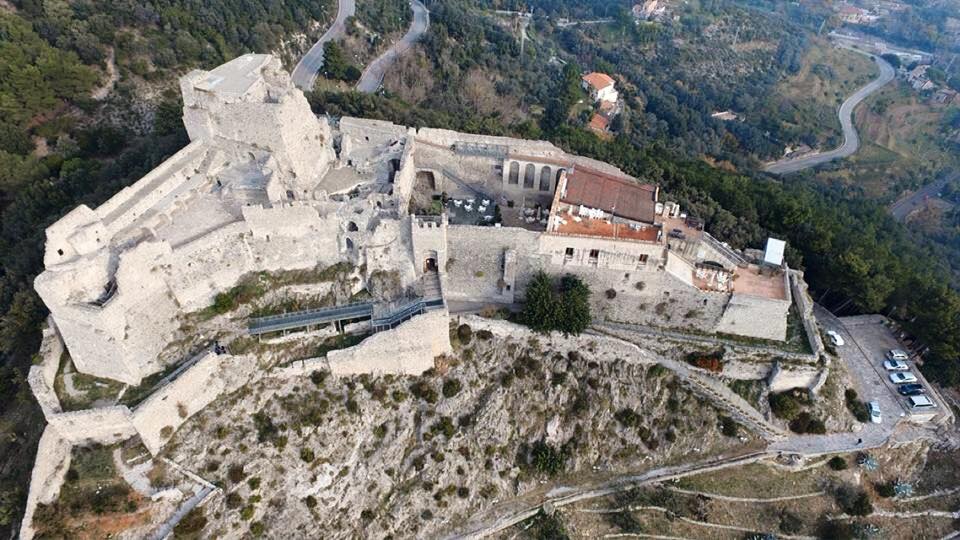
San Severino Castle
San Severino Castle, located in Mercato San Severino, Italy, is one of the largest and most historically significant hill castles in the country. Founded in the late 11th century by the Norman knight Turgisio Sanseverino after 1067, the castle occupies an extensive area of approximately 350 by 450 meters, roughly equivalent to three football fields. Its imposing scale and complex fortifications reflect its strategic importance in the medieval period, serving as a formidable stronghold in the region.
The castle's architecture reveals layers of construction and modification spanning several centuries, prominently influenced by the Norman origins and the later Angevin and Aragonese periods. The structure's defensive design evolved to meet changing military needs, incorporating multiple concentric walls, towers, and bastions that illustrate the transition from early medieval fortifications to more advanced late medieval military architecture.
Historical foundation and early development
The foundation of San Severino Castle dates back to the late 11th century when Duke Robert Guiscard granted the fief of Rota, the original name of the area now known as Mercato San Severino, to Turgisio Sanseverino. This grant marked the beginning of the castle's construction as a Norman fortress designed to consolidate control over the territory. The initial fortifications included a central nucleus with a palatium (lord's residence) and a piazza d'armi (army square), surrounded by a quadrangular donjon or keep, which formed the core defensive element.
The first enclosure, which includes the palatium and the piazza d'armi, was fortified with walls featuring corner towers and a postern gate. These walls also contained lower turrets possibly dating from the 12th century, which may have housed early war machines. The presence of battlements and crenellations along the patrol walkways highlights the castle's defensive capabilities during this period. A large cistern within this enclosure indicates the importance of water storage for sustaining the castle's inhabitants during sieges.
Architectural evolution during the angevin and aragonese periods
During the 13th and 14th centuries, the castle underwent significant modifications under the Angevin dynasty, which shaped much of its current appearance. The castle expanded to include a second enclosure with semicircular towers extending eastward, enclosing a Franciscan convent, a village, and a church. This integration of religious and civilian structures within the defensive perimeter reflects the castle's role as both a military fortress and a community center.
The third and outermost enclosure, dating to the Angevin-Aragonese era, features a distinctive triangular layout with a round tower at its apex. This tower is equipped with three characteristic gun ports typical of late medieval artillery defense. The southern curtain wall of this enclosure is reinforced with seven flanking towers designed to provide overlapping fields of fire, enhancing the castle's ability to repel attackers. This outer wall served a strictly military function, emphasizing the castle's strategic importance in regional defense.
Religious and social significance
San Severino Castle was not only a military bastion but also a site of religious and social importance. The castle grounds included a Franciscan convent and a church, highlighting the integration of spiritual life within the fortress. Notably, Saint Thomas Aquinas visited the castle to see his sister, Teodora, who was married to a member of the Sanseverino family. During his stay, he resided at a Dominican convent within the castle, underscoring the site's role as a place of religious refuge and intellectual activity.
Political turmoil and decline
The castle remained under the ownership of the Sanseverino family for centuries, maintaining its status as a regional power center. However, its fortunes changed during the Barons' Conspiracy against King Ferrante of Naples in the 15th century. A member of the Sanseverino family participated in this rebellion, leading to the confiscation of the castle by the crown. Although the castle was eventually returned to the family, it had lost much of its military significance by then and was partially abandoned.
Archaeological discoveries and preservation
Recent archaeological excavations conducted between 2003 and 2005 uncovered a metallurgical workshop within the castle precincts, active during the 13th and 14th centuries. Artifacts such as scissors and a specialized chaser's hammer were found, providing valuable insight into the economic activities and craftsmanship practiced at the site. Additionally, numerous coins, ceramics, and arrowheads have been recovered, some of which are exhibited at the local MIMU museum since 2018.
The castle's remains today include the three concentric walls with their respective towers and gates, the palatium with its donjon, the piazza d'armi, and religious buildings like the chapel and church. The preservation of original battlements, crenellations, and gun ports offers a tangible connection to the castle's military past. Although partially in ruins, the castle remains a prominent historical landmark that illustrates the evolution of medieval fortifications in southern Italy.
Strategic importance and regional network
San Severino Castle was strategically positioned to oversee and communicate with neighboring fortifications, including the castles of San Giorgio, Roccapiemonte, Solofra, and Monte Bastiglia. This network of castles formed a defensive system controlling the surrounding territory. The sightline from Monte Bastiglia to the castle of Salerno further emphasizes the interconnected nature of these medieval strongholds, facilitating rapid communication and coordinated defense.
In sum, San Severino Castle stands as a monumental example of medieval military architecture, reflecting Norman foundations, Angevin enhancements, and Aragonese adaptations. Its vast scale, complex fortifications, and integration of military, religious, and residential functions make it a unique site for studying the history and architecture of southern Italy's medieval period.
Frequently asked questions (FAQ)
- When was San Severino Castle built and by whom?
- San Severino Castle was built in the late 11th century by the Norman knight Turgisio Sanseverino after receiving the fief from Duke Robert Guiscard.
- What architectural styles are reflected in San Severino Castle?
- The castle reflects Norman military architecture initially, with significant modifications during the Angevin and Aragonese periods, including features like concentric walls, semicircular towers, and gun ports.
- Can visitors see the original defensive structures at San Severino Castle?
- Yes, visitors can observe the three concentric walls, battlements, crenellations, towers, and gun ports that illustrate the castle's medieval defensive design.
- What is the historical significance of Saint Thomas Aquinas in relation to the castle?
- Saint Thomas Aquinas visited the castle to see his sister Teodora, who was married to a Sanseverino family member, and stayed at the Dominican convent within the castle grounds.
- Are there any archaeological findings at San Severino Castle?
- Excavations revealed a 13th-14th century metallurgical workshop, coins, ceramics, and arrowheads, some of which are displayed at the local MIMU museum.
- Is San Severino Castle part of a larger defensive network?
- Yes, it was strategically linked with nearby castles such as San Giorgio, Roccapiemonte, Solofra, and Monte Bastiglia, forming a coordinated regional defense system.
Information
Website
Visit websiteSources & official resources
Verify the information above using these authoritative references.
Loading map...
Visitor reviews
No reviews yet. Been here? Write the first review and help other travelers!
Write the first reviewVisited this castle? Share your experience
Your review helps other travelers and adds first-hand knowledge to our encyclopedia.