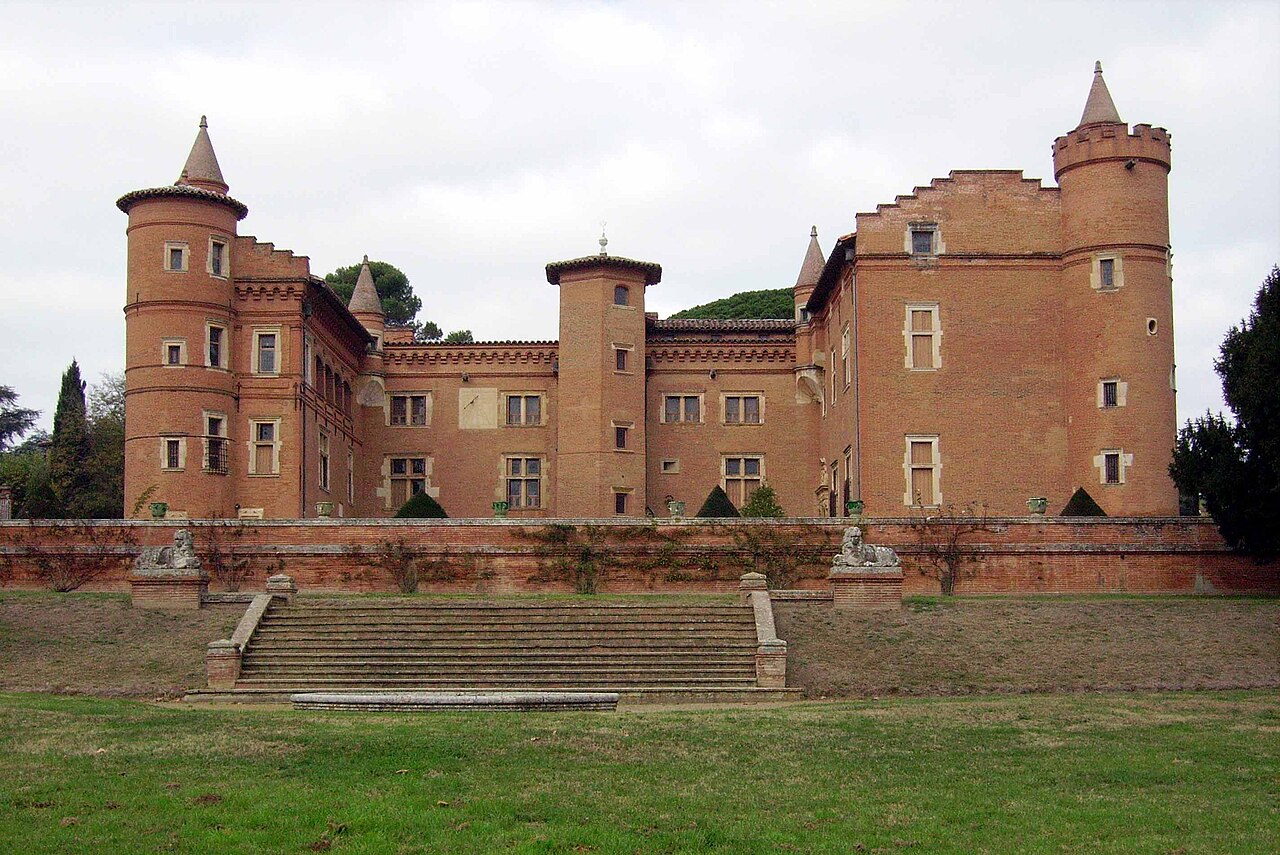
Salvetat-Saint-Gilles Castle
Salvetat-Saint-Gilles Castle stands as a remarkable example of a medieval hill castle that evolved into a refined Renaissance residence in southwestern France. Located in the town of La Salvetat-Saint-Gilles, this castle's history spans nearly a millennium, reflecting the shifting tides of military, political, and cultural change from the 11th century onward. Originally constructed as a strategic fortification by the Counts of Toulouse, the castle's commanding position atop a steep ridge overlooking the Aussonnelle river provided critical defense and surveillance capabilities. Over centuries, it was adapted and embellished, blending military architecture with Renaissance artistic flourishes, making it an important heritage site today.
The castle's earliest phase dates to between 1088 and 1096, commissioned by Raymond IV, Count of Toulouse, a notable figure also recognized for his role in the Crusades and the establishment of the County of Tripoli. This initial fortress, now no longer visible above ground, was a classic castrum—a fortified site designed to protect Toulouse from western threats. Its elevated location, approximately 90 meters above the riverbank, was chosen for maximum defensive advantage, allowing clear views across the surrounding landscape.
Medieval origins and strategic significance
The castle's foundation is deeply intertwined with the political and military ambitions of the Counts of Toulouse. Raymond IV's involvement in the Crusades, particularly his capture of Tripoli and construction of a namesake château there, underscores the broader geopolitical context in which Salvetat-Saint-Gilles was conceived. The fortress served as a western bulwark guarding Toulouse, a vital city in medieval southern France.
By the mid-12th century, around 1140, the nearby village of La Salvetat-Saint-Gilles was established by the Order of the Hospitallers. This settlement functioned as a sauveté, a protected refuge zone, and was named after Saint Gilles, reflecting the ecclesiastical influence of the Abbey of Saint-Gilles and the Counts' connection to this religious institution. The castle and village formed part of a network of military and religious sites that shaped the region's medieval landscape.
Refuge during epidemics
The castle also played a humanitarian role during times of crisis. Historical records note that in 1147, the local government of Toulouse, the Capitouls, sought shelter within its walls during a plague outbreak. Similarly, in 1481, a company associated with Lauret took refuge here during another epidemic, highlighting the castle's enduring function as a sanctuary beyond its military purpose.
Transition to renaissance residence
Following the extinction of the Toulouse counts' line around 1400, the château passed into the hands of the Tourneur family. In 1483, Antoine Tourneur sold the property to Nicolas Fesquet, a merchant from Toulouse who initiated significant renovations. These changes marked a shift from purely defensive architecture to a more comfortable and representative Renaissance-style residence.
The courtyard was redesigned with typical Renaissance elements, including open galleries or loggias featuring two-story arcades with ceilings decorated by intricate stenciled motifs of flowers, animals, castles, and landscapes. This artistic detail reflects the broader cultural movement of the Renaissance that emphasized beauty, symmetry, and the integration of art into architecture.
Architectural features and layout
The château's layout today centers around a courtyard defined by two wings oriented northeast and northwest. These wings contain L-shaped pavilions at their corners, enhancing the residential character. The courtyard includes a distinctive perron staircase supported by brickwork, providing elegant access between levels. Surrounding the courtyard, large semicircular niches in the façades exemplify Renaissance stylistic choices.
On the south façade, remnants of the original 13th-century fortress remain visible, preserving the castle's medieval defensive character. The west façade features mullioned windows, stone-framed openings divided by vertical bars, which balance structural integrity with aesthetic appeal. The main façade is flanked by turrets inspired by the Toulouse campanile, tall bell tower forms that blend military and regional architectural traditions.
Later modifications and preservation efforts
In the 17th and 18th centuries, the château underwent further modifications reflecting changing tastes and social functions. The addition of open galleries with elaborately decorated floral stencil ceilings and the raising of the keep (donjon) to 20 meters in height emphasized both elegance and prominence. The 18th century also saw the installation of tall gables topped with ornamental ridge finials, enhancing the château’s silhouette.
In 1924, the donjon's original roof was replaced with a crenellated terrace, creating a battlemented platform reminiscent of its military past. Structural challenges have affected the site, including the collapse of the south retaining wall in 1880 and roof damage caused by the storm Klaus in 2009. These events prompted restoration and strengthening works beginning in 2010, focusing on preserving historical authenticity.
Recognizing its cultural and historical importance, the castle was classified as a historic monument in 2007. The town of La Salvetat-Saint-Gilles acquired the property in 2016 and initiated restoration efforts in 2019. These projects involve local partners, including traditional tile manufacturers, to maintain the château's architectural integrity while adapting it for cultural and public use.
Current condition and visitor experience
Today, Salvetat-Saint-Gilles Castle offers a layered architectural narrative, showcasing its medieval origins alongside Renaissance enhancements and later stylistic adaptations. Visitors can explore the courtyard with its decorated galleries, mullioned windows, and turrets, gaining insight into the castle’s evolution over centuries. The restoration work ensures the château remains a valuable cultural asset, preserving its historical fabric for future generations.
The castle's hilltop location continues to provide commanding views of the surrounding Hauts-de-France region, linking the site’s strategic medieval purpose with its present-day role as a heritage landmark. Its combination of military and residential architecture, historical associations with the Counts of Toulouse, and ongoing preservation efforts make Salvetat-Saint-Gilles Castle a significant destination for those interested in French medieval and Renaissance history.
Frequently asked questions (FAQ)
- What is the historical significance of Salvetat-Saint-Gilles Castle?
- Salvetat-Saint-Gilles Castle, dating back to the 13th century, played a crucial role in the defense strategy of the region during the medieval period. Its architecture and historical artifacts provide valuable insights into the feudal society of France.
- When was Salvetat-Saint-Gilles Castle built?
- The castle was constructed in the 13th century, with significant renovations occurring in the 17th century. This timeline reflects the evolving architectural styles and the strategic importance of the castle throughout history.
- What are the opening hours for Salvetat-Saint-Gilles Castle?
- The castle is open to visitors from 10 AM to 5 PM, Tuesday through Sunday. It is advisable to check the official website for seasonal variations or special events that may affect these hours.
- Can I take guided tours of Salvetat-Saint-Gilles Castle?
- Yes, guided tours are available for visitors who wish to learn more about the castle's history and architecture. These tours often provide a deeper understanding of the castle's significance and are led by knowledgeable guides.
- Is it possible to access Salvetat-Saint-Gilles Castle with a wheelchair?
- The castle has made efforts to improve accessibility, but some areas may be challenging due to the historical architecture. It is recommended to contact the castle administration in advance to inquire about specific accessibility options.
- What is the best time to visit Salvetat-Saint-Gilles Castle?
- The best time to visit is during the spring and early fall when the weather is pleasant, and the surrounding gardens are in bloom. Additionally, these seasons typically see fewer crowds, allowing for a more enjoyable experience.
- Are there any nearby attractions to visit after touring the castle?
- Yes, nearby attractions include the charming town of La Salvetat-Saint-Gilles, where visitors can explore local shops and cafes, as well as other historical sites in the region. The scenic countryside also offers opportunities for hiking and outdoor activities.
- What are the ticket prices for Salvetat-Saint-Gilles Castle?
- Ticket prices for adults are approximately €8, while reduced prices are available for students and seniors. Children under 12 can often enter for free, making it a family-friendly destination.
Information
Website
Visit websiteSources & official resources
Verify the information above using these authoritative references.
Loading map...
Visitor reviews
No reviews yet. Been here? Write the first review and help other travelers!
Write the first reviewVisited this castle? Share your experience
Your review helps other travelers and adds first-hand knowledge to our encyclopedia.