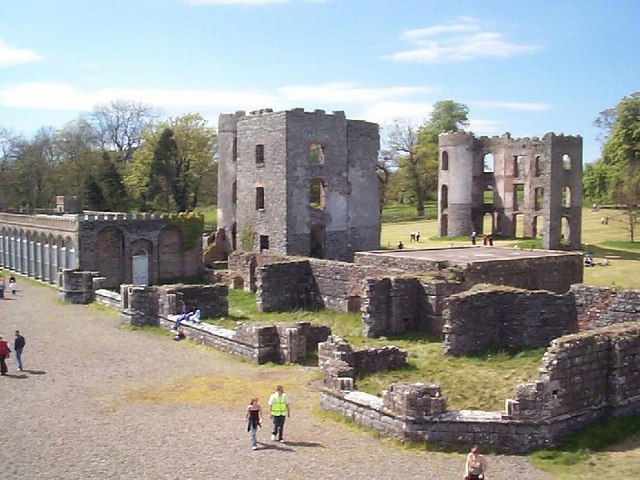
Salterstown Castle
Salterstown Castle is a historic ruin located near the western shore of Lough Neagh, south of the village of Ballyronan in County Derry, Northern Ireland. This castle dates back to the early 17th century and is a notable example of the fortified houses constructed during the Plantation of Ulster, a period when English and Scottish settlers were granted lands in Ireland to establish control and colonization.
Historical context and construction
Constructed in 1613 by the Worshipful Company of Salters, a London-based trade guild, Salterstown Castle was part of the broader efforts of the Plantation to secure and develop the region. The castle was built as a two-storey fortified house, a common architectural form for plantation houses, designed to serve both as a residence and a defensive structure.
The castle featured a bawn, a fortified enclosure wall typical of Irish plantation houses, intended to protect the occupants and livestock. The bawn was equipped with two circular flankers, which are small round towers positioned at the corners of the enclosure to provide defensive coverage. These features reflect the turbulent times and the need for security against local resistance.
Destruction and later ownership
Salterstown Castle's strategic importance made it a target during the Irish Rebellion of 1641, when it was captured and destroyed by Phelim O'Neill, a prominent Irish leader of the uprising. This event marked a significant episode in the castle's history, contributing to its decline as a fortified residence.
By the mid-18th century, around 1740, the property came into the possession of the McMaster family. The castle itself had fallen into ruin by this time, and the surrounding lands were likely used for agricultural purposes.
Architectural features and current condition
Originally, Salterstown Castle was characterized by its two-storey structure and the defensive bawn with circular flankers. However, today the castle remains are incorporated into a complex of farm buildings, and visible traces of the bawn and flankers have vanished. The ruin is limited to remnants of the main house, and the overall condition is classified as ruins.
As the site is located on private farmland, public access to the castle is restricted. Visitors can view the ruins only from the adjacent public road, which provides a distant perspective of the historic site.
Significance and preservation
Salterstown Castle is an important example of the plantation castles built in Ulster during the early 17th century. These castles illustrate the intersection of military architecture and colonial settlement strategies. Although much of the original structure has been lost, the castle's remains contribute valuable insight into the defensive and residential architecture of the period.
Preservation efforts have been limited, and the castle remains in a ruinous state. Its inclusion within farm buildings has helped prevent total destruction, but also complicates archaeological study and conservation.
Visiting information
Since Salterstown Castle is situated on private property, there are no formal visiting hours or facilities for tourists. The site can be observed from the public road, offering a glimpse into Northern Ireland's plantation heritage. Visitors interested in the broader history of the Plantation of Ulster and its castles may explore other nearby sites with better preservation and public access.
Nearby historical sites
County Derry and the surrounding region host several other castles and plantation houses that provide context for Salterstown Castle's history. These include Springhill House, a well-preserved plantation mansion, and various medieval castles that illustrate the evolution of fortifications in the area.
Frequently asked questions (FAQ)
- When was Salterstown Castle built and by whom?
- Salterstown Castle was built in 1613 by the Worshipful Company of Salters, a London-based trade guild, as part of the Plantation of Ulster.
- What architectural features did Salterstown Castle originally have?
- The castle was a two-storey fortified house with a bawn and two circular flankers for defense, typical of plantation houses of the early 17th century.
- Can visitors enter Salterstown Castle?
- No, Salterstown Castle is on private farmland and cannot be visited inside. It can only be viewed from the public road nearby.
- What happened to Salterstown Castle during the Irish Rebellion of 1641?
- The castle was captured and destroyed by Phelim O'Neill during the 1641 rebellion, leading to its decline and ruin.
- Are there other plantation castles to visit near Salterstown Castle?
- Yes, nearby sites such as Springhill House offer well-preserved examples of plantation architecture and are open to the public.
Information
Current owner
Private owner
Address
50 Salterstown Road, United Kingdom of Great Britain and Northern Ireland
Loading map...
Visitor reviews
No reviews yet. Been here? Write the first review and help other travelers!
Write the first reviewVisited this castle? Share your experience
Your review helps other travelers and adds first-hand knowledge to our encyclopedia.