
Saissac Castle
Saissac Castle, located in the commune of Saissac in the Occitanie region of southern France, stands as a remarkable example of a high medieval hill castle with deep historical roots reaching back to the early medieval period. Perched on a rocky promontory overlooking the Vernassonne ravine, it commands a strategic position at the gateway to the Montagne Noire mountains. This imposing fortress, now in ruins, is renowned as one of the so-called Cathar castles due to its historical association with the Cathar heresy and the turbulent events of the Albigensian Crusade.
Archaeological evidence, including Carbon-14 dating of charcoal fragments embedded in the masonry of the castle's tower, suggests that the original fortification dates back to approximately 900 AD, making it one of the oldest fortresses in the region. The earliest documentary mention of Saissac Castle appears in 960, when it was bequeathed by Hugh, Bishop of Toulouse, to the Count of Carcassonne. This early connection highlights the castle's importance within the feudal landscape of medieval Languedoc.
Medieval origins and feudal lineage
During the 11th century, the castle became a fiefdom under the powerful lords of Carcassonne, who granted it to vassals in the surrounding region. This led to the establishment of the Saissac lineage, a junior branch of the counts of Foix. The castle and its associated lordship played a significant role in the complex network of feudal allegiances that characterized the region. Beneath the current ruins lies evidence of an earlier fortified settlement or castrum, possibly dating to the 11th century or even earlier Visigothic times, indicating the site's long-standing military and administrative significance.
One of the most notable figures associated with Saissac Castle was Bertrand de Saissac (1140–1202), a patron of troubadours and a sympathizer of the Cathar faith. He served as the guardian and tutor of Raymond Roger Trencavel, the viscount of Carcassonne, during a period marked by religious and political upheaval. Bertrand's allegiance to the Cathar cause ultimately placed Saissac Castle at the heart of the conflict that erupted during the Albigensian Crusade (1209–1229).
Impact of the albigensian crusade and subsequent ownership changes
The outbreak of the Albigensian Crusade dramatically altered the castle's fate. In 1209, fearing reprisals from the Crusader armies led by Simon de Montfort, the lords of Saissac aligned themselves with the northern Crusaders. The castle was seized by Bouchard de Marly and later restored by Lambert de Thursey after 1234. The lordship was divided between northern barons and local heirs who pledged loyalty to the French crown and renounced Catharism.
Throughout the late 13th and early 14th centuries, Saissac Castle passed through the hands of several noble families, including the Lévis family, the Isle-Jourdain family, and the Caraman family. Each transition reflected the shifting political landscape of Languedoc following the Crusade and the integration of the region into the French royal domain.
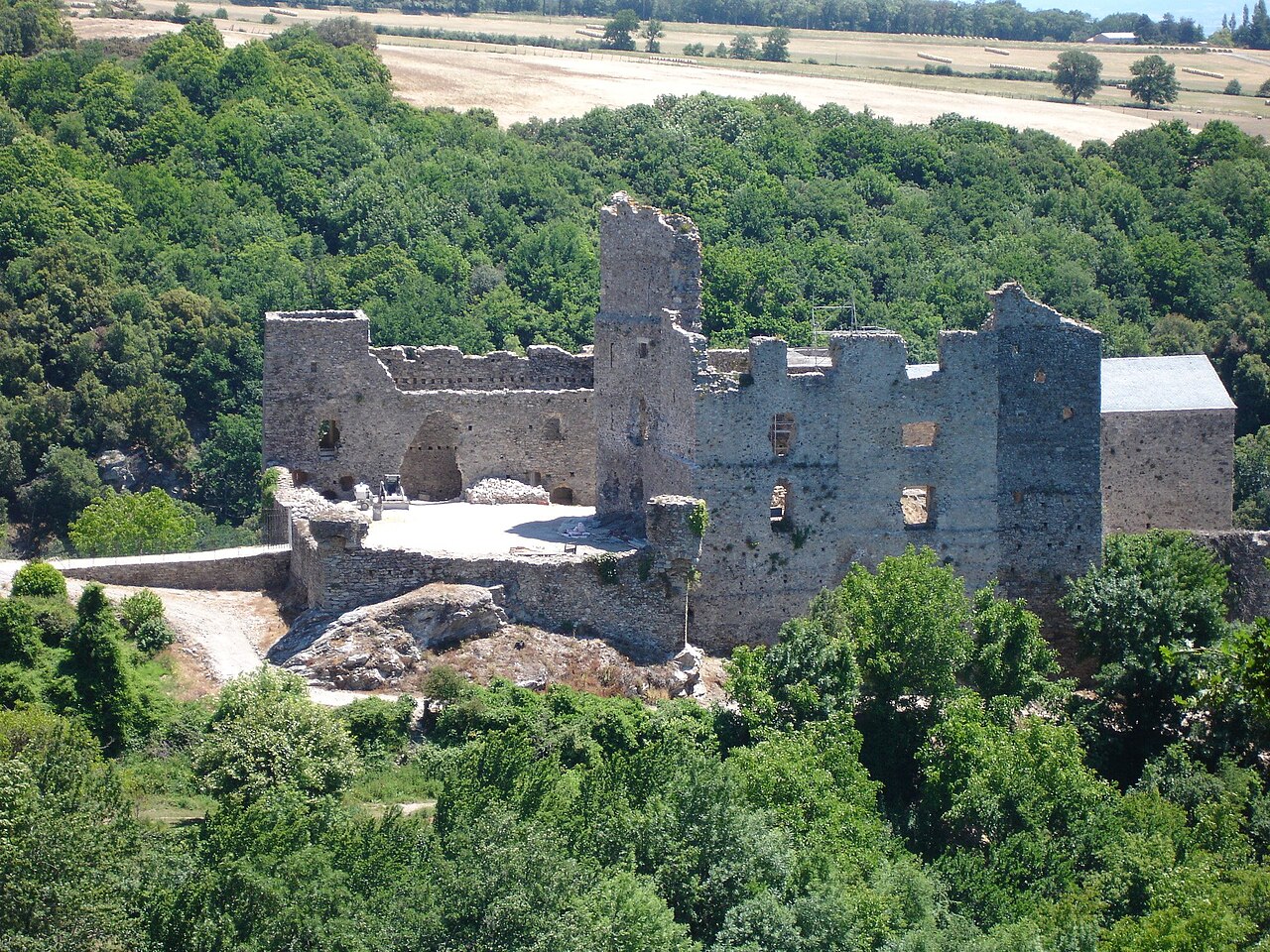
Photo by --Pinpin 12:32, 1 July 2006 (UTC) • CC BY-SA 3.0
Architectural evolution and defensive features
The castle's architecture evolved significantly over the centuries. The fortress is arranged on three terraces adapted to the natural slope of the rocky outcrop. The main defensive features include a large polygonal keep approximately 20 meters high, flanked by round watchtowers and enclosed by an irregular quadrangular curtain wall with battlements and square towers. These defensive elements date primarily to the early 14th century, reflecting royal military engineering efforts to fortify the region after the Crusade.
Access to the castle was originally protected by a moat and a drawbridge, now filled in, with remnants visible in the form of a two-arched stone bridge leading into the curtain wall. The residential quarters, including the Aldonce residence built in the 16th century, feature Renaissance-style mullioned windows and architectural details added by the wealthy Bernuy family, who acquired the castle in 1518.
During the French Wars of Religion in the late 16th century, the castle was adapted to withstand artillery attacks, with the addition of cannon openings and reinforced circular towers. Despite the surrounding village being destroyed by Protestant troops in 1568 and 1580, Saissac Castle itself remained impregnable, a testament to its robust fortifications.
Decline, restoration, and current status
Following the French Revolution, Saissac Castle was confiscated and sold as national property. Neglect and treasure hunting, including destructive excavations in the 19th century, led to significant deterioration. Notably, a treasure of approximately 2,000 deniers dating to the late 13th century was discovered nearby in 1979, highlighting the site's historical wealth.
In 1994, the municipality acquired the castle and initiated extensive restoration efforts. From 1996 to 2000, consolidation work made the site safe and accessible to the public. Further restoration between 2004 and 2006 focused on the Aldonce residence, reconstructing two rooms in the spirit of the 16th century, complete with a timber framework resembling the hull of a ship. Today, visitors can explore the castle's ruins, including the accessible cellars beneath the keep and a small museum interpreting its rich medieval history.
Notable nearby structures and archaeological significance
Close to the castle ruins stand the remains of the 13th-century Saint-Michel church, originally built in the Romanesque style. Although damaged during the Crusade and later by fire, fragments of its walls and doorway remain, providing insight into the religious and communal life surrounding the fortress. Additionally, traces of an ancient castral villa at the base of the promontory testify to early habitation and the site's long-term strategic importance.
Saissac Castle remains a powerful symbol of the region's medieval history, Cathar heritage, and architectural evolution. Its dramatic setting, layered history, and ongoing restoration efforts make it a compelling destination for those interested in medieval fortifications, religious history, and the cultural landscape of Occitanie.
Frequently asked questions (FAQ)
- How do I get to Saissac Castle?
- Saissac Castle is located in the village of Saissac in the Occitanie region of France. It can be reached by car via local roads from Carcassonne or other nearby towns. Parking is available near the village center, and the castle is accessible by a short walk uphill.
- What are the opening hours for visiting Saissac Castle?
- The castle is open daily from 10:00 to 18:00. It is advisable to check seasonal variations before planning your visit, especially in winter months when hours may be reduced.
- Is there an admission fee to enter Saissac Castle?
- Yes, the admission fee is €5 for adults and €3 for children. Tickets can be purchased at the entrance or online in advance during peak tourist seasons.
- What is the historical significance of Saissac Castle?
- Saissac Castle is historically significant as a medieval hill castle associated with the Cathar movement and the Albigensian Crusade. It was a residence of the Saissac family, vassals of the Trencavel lords, and played a strategic role in regional conflicts during the 12th to 16th centuries.
- Can I explore the interior and cellars of Saissac Castle?
- Visitors can explore the accessible ruins, including the restored Aldonce residence and the cellars beneath the keep. A small museum on-site offers insights into the castle's medieval history and architecture.
- Are there any guided tours available at Saissac Castle?
- Guided tours are often available during the tourist season, providing detailed historical and architectural information. It is recommended to check with the local visitor center or the castle's official website for tour schedules.
- What is the best time of year to visit Saissac Castle?
- The best time to visit is during spring and summer when the weather is pleasant, and the castle is fully accessible. Autumn offers beautiful scenery, but some facilities may have limited hours. Winter visits are possible but may have reduced opening times.
Photo gallery

Information
Opening hours
10:00-18:00, daily
Ticket prices
€5 adult, €3 child
Current owner
Municipality of Saissac
Website
Visit websiteSources & official resources
Verify the information above using these authoritative references.
Loading map...
Visitor reviews
No reviews yet. Been here? Write the first review and help other travelers!
Write the first reviewVisited this castle? Share your experience
Your review helps other travelers and adds first-hand knowledge to our encyclopedia.