Lastours Castles
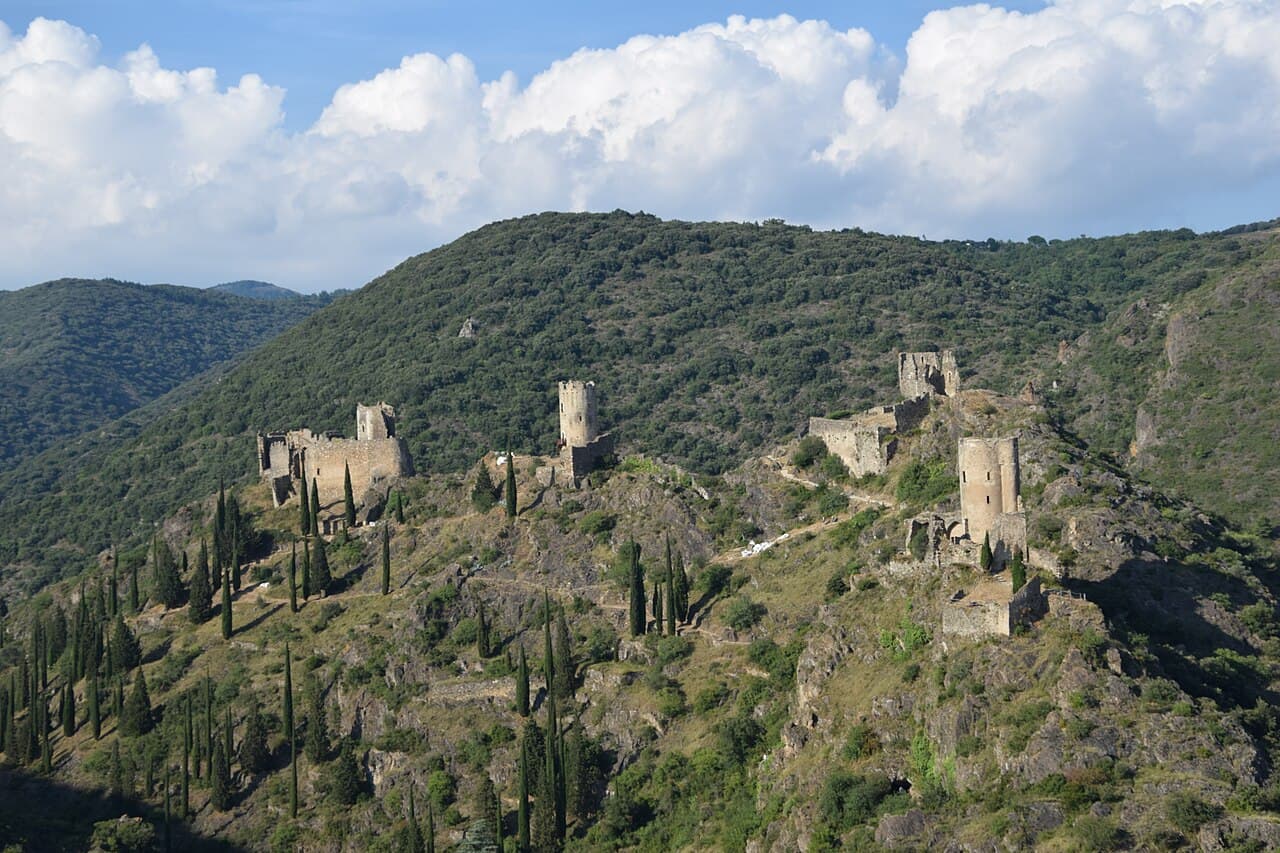
The Lastours castles, also known as the Châteaux de Lastours, are a remarkable ensemble of four medieval fortresses perched on a dramatic rocky spur above the village of Lastours in the Occitanie region of southern France. These castles are intimately linked to the history of the Cathars and the Albigensian Crusade, representing a significant chapter in the medieval conflicts and religious struggles of the 12th and 13th centuries. The site is uniquely defined by its natural geography, isolated by the deep valleys carved by the Orbeil and Grésilhou rivers, which provided a formidable natural defense and allowed the construction of a fortress complex of great height and strategic importance.
Unlike a single castle, the Lastours site comprises four distinct castles that functioned as a cohesive defensive system. Their architecture adapts ingeniously to the rocky terrain, with each castle exhibiting different construction techniques and modifications that reflect the evolving military needs and architectural styles over several centuries. The castles are primarily classified as hill castles, built during the High Medieval period around the 11th century, with subsequent alterations and additions extending into the 13th century and beyond.
Historical context and the cabaret lineage
The lords of Cabaret were the original owners of the Lastours castles, first mentioned in historical records dating back to 1067. The site initially consisted of three castles, with the fourth added later. The lords of Cabaret were notable supporters of the Cathar faith, a Christian dualist movement considered heretical by the Catholic Church. The surrounding villages were known to harbor many Cathars, making the site a focal point during the Albigensian Crusade.
Pierre-Roger de Cabaret, a prominent figure and staunch Cathar sympathizer, allied himself with Raymond Roger Trencavel, the Viscount of Carcassonne, during the defense of Carcassonne in 1209 against the crusading forces led by Simon de Montfort. The Lastours castles notably resisted Simon de Montfort's siege in 1209, showcasing their strategic resilience.
In a significant episode of the crusade, Bouchard de Marly, the crusader lord of Château de Saissac, was captured by Pierre-Roger de Cabaret. His release was negotiated in exchange for the surrender of the Cabaret fortress in 1211. Despite this setback, the lords of Cabaret regained control in 1223, and the site became the seat of the Cathar bishop of Carcassès.
The castles endured further sieges, including one in 1227 by Humbert de Beaujeu, a royal commander, and eventually capitulated in 1229. Following the crusade, the castles and surrounding villages were plundered and then rebuilt as royal fortresses to assert the authority of the French crown. The Tour Régine was constructed during this period as a symbol of royal supremacy.
Architectural features of the four castles
Cabaret castle
The Cabaret castle is the main citadel of the group, characterized by its sophisticated barbican defense system. It features a north tower, a distinctive polygonal keep to the south, and a cluster of residential buildings centrally located within the fortress. The entire complex is enclosed by ramparts with a round walk for patrols. The crenellated walls are constructed from irregular stones, with large blocks reinforcing corners and openings, demonstrating typical medieval masonry techniques adapted to the rugged terrain.
Tour régine
The Tour Régine, also known as Fleur-Espine (Thornflower), is the smallest and most recent castle in the ensemble. It consists of a round tower surrounded by a small curtain wall, much of which has collapsed over time. Notably, it contains the largest cistern among the four castles, located underground. The tower rises to three stories and is accessed via a spiral staircase. The white limestone used in its construction matches that of Cabaret, indicating continuity in material sourcing. This tower is believed to have been built after the Albigensian Crusade, with its name "Régine" (meaning "Royal") reflecting its function as a royal stronghold. There is no documentary evidence of its existence before 1260.
The castle on the highest point
Situated on the highest part of the site, this castle is notable for its square tower, an adjacent house, and a cistern. It is protected by a rectangular curtain wall. Architecturally, it is distinguished by the rarity of its murder holes and the presence of four semicircular arched windows, which are uncommon features in military architecture of the period.
Quertinheux castle
The Quertinheux castle lies furthest south along the ridge, perched on an isolated rocky outcrop. It comprises a circular tower and a polygonal curtain wall. The entrance is defended by a chicane, a defensive feature designed to slow attackers. The castle overlooks the ruins of a destroyed Romanesque church, adding to its historical and architectural interest.
Later history and preservation
During the 16th century, the Lastours castles were occupied by Protestant forces during the French Wars of Religion. They were eventually expelled by the maréchal de Joyeuse in 1591. Over the centuries, the castles fell into ruin but remain a powerful symbol of the Cathar heritage and medieval military architecture in southern France.
Today, the Lastours castles are classified as ruins but are well-studied and protected as a cultural heritage site. Their dramatic location, complex history, and distinctive architectural features make them a significant destination for visitors interested in medieval history, the Cathar legacy, and fortification architecture.
Visitor information and significance
The Lastours castles offer visitors a unique opportunity to explore a multi-fortress complex that played a crucial role in the religious and military conflicts of the Middle Ages. The site’s natural defenses and strategic position provide panoramic views of the surrounding Occitanie landscape. Walking trails connect the four castles, allowing visitors to appreciate the varied architectural styles and historical layers present at the site.
The castles are accessible from the village of Lastours, which serves as a gateway to this historic ensemble. Interpretive signage and guided tours help visitors understand the complex history of the Cathars, the Albigensian Crusade, and the subsequent royal control of the region.
Frequently asked questions (FAQ)
- What is the historical significance of Lastours Castles?
- Lastours Castles, a group of four medieval fortifications, played a crucial role during the Cathar Crusade in the 13th century. These castles exemplify the architectural style of the time and provide insight into the feudal system and the conflicts that shaped the region.
- When was Lastours Castles built?
- The construction of Lastours Castles began in the 11th century, with significant developments occurring throughout the medieval period. The castles were strategically built to defend against invasions and to control the surrounding territory, making them vital military strongholds.
- What are the opening hours for Lastours Castles?
- Lastours Castles are typically open to visitors from 10 AM to 6 PM from April to October. During the off-peak months, the hours may vary, so it's advisable to check the official website for the latest information before your visit.
- Can I access the castles with limited mobility?
- The site has some accessibility features; however, due to the uneven terrain and steep paths, accessing all areas of the castles may be challenging for those with limited mobility. It's recommended to contact the visitor center for specific accessibility options before your visit.
- What is the best time to visit Lastours Castles?
- The best time to visit Lastours Castles is during the spring and early autumn months, when the weather is generally mild and pleasant. This allows for a more enjoyable exploration of the site and its stunning views of the surrounding landscape.
- Are there any nearby attractions to Lastours Castles?
- Yes, the area around Lastours is rich in history and natural beauty. Visitors can explore the charming village of Lastours, enjoy hiking trails, or visit the nearby city of Carcassonne, famous for its well-preserved medieval fortress.
- What are the ticket prices for Lastours Castles?
- Ticket prices for Lastours Castles typically vary depending on the season and age of the visitor. As of the latest information, adult tickets are around €8, with reduced rates for children and families, making it an affordable outing for history enthusiasts.
Photo gallery

Information
Loading map...
Visitor reviews
No reviews yet. Been here? Write the first review and help other travelers!
Write the first reviewVisited this castle? Share your experience
Your review helps other travelers and adds first-hand knowledge to our encyclopedia.