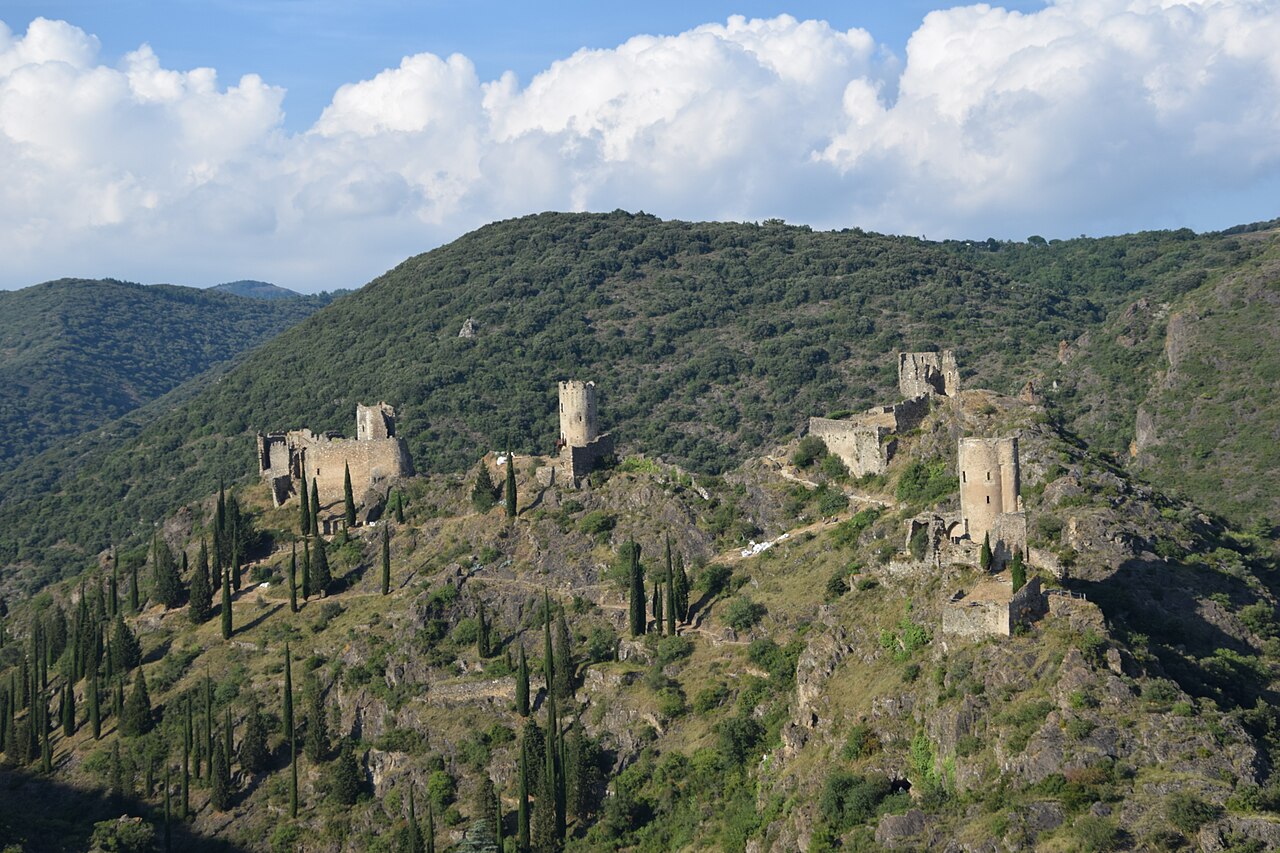
Château de Hautpoul
Château de Hautpoul stands prominently on a rocky spur overlooking the town of Mazamet in southern France. This medieval fortress is strategically perched on the side of a mountain, defended naturally by nearly inaccessible cliffs. The castle's location allowed it to control the Arnette and Thoré valleys, overseeing the plain where Mazamet now lies. Its commanding view and natural defenses made it a key stronghold throughout the High Medieval period.
Early origins and medieval significance
The site of Château de Hautpoul has a long history of fortification. According to tradition, the first fortification was established by the Visigoths in 413, marking it as an early defensive position in the region. Although no substantial remains from this period survive, the location’s defensive advantages were recognized early on.
The castle as it is known today began to take shape in the 11th century when Pierre-Raymond de Hautpoul, the earliest documented lord of Hautpoul (mentioned in 1084), undertook significant rebuilding efforts. He not only reconstructed the castle but also fortified the surrounding town with walls and built the fortified church of Saint-Pierre d'Hautpoul. This church served both religious and defensive purposes, a common feature in medieval strongholds.
Pierre-Raymond de Hautpoul is notable for his participation in the First Crusade alongside his suzerain, Raymond IV of Toulouse, in 1098. This connection highlights the castle’s importance within the feudal network of southern France during the Crusades.
The cathar period and the albigensian crusade
In the 13th century, the castle was under the lordship of Izarn d'Hautpoul, who is reputed to have adopted the Cathar faith. The Cathars were a religious group considered heretical by the Catholic Church, and their presence in the Languedoc region led to the Albigensian Crusade, a military campaign initiated by the Church to eliminate Catharism.
In 1212, Château de Hautpoul and the adjacent town were besieged by Simon de Montfort, a leading commander of the Crusade. The siege resulted in the town being occupied and burned, with its fortifications destroyed. Despite this, the Cathar faith apparently persisted among the survivors after the Crusaders withdrew, reflecting the deep roots of Catharism in the area.
Wars of religion and later history
By the mid-16th century, the region saw the emergence of the Huguenots, French Protestants who were involved in the French Wars of Religion. Château de Hautpoul was again a site of conflict during this turbulent period. The castle endured another siege as Catholic and Protestant forces vied for control in the area.
Over time, the castle fell into decline but significant vestiges of both the upper and lower castles remain visible today. The village of Hautpoul, which winds down the hillside from the castle, still retains its medieval character with old houses and restored structures.
Architectural features and preservation
The castle’s architecture reflects its defensive purpose and the turbulent history of the region. The fortified church of Saint-Pierre d'Hautpoul is a notable feature, combining religious function with military architecture. The original town walls constructed by Pierre-Raymond de Hautpoul provided a strong defensive perimeter.
Today, visitors can see the restored lower town gate complete with its meurtrière (arrow slit), a typical medieval defensive element. The village itself is undergoing rejuvenation, with craftsmen occupying the historic houses and workshops, preserving the cultural heritage of the site.
At the foot of the castle, the Arnette river continues to flow, historically important for the wool industry in Mazamet. The natural landscape around the castle, combined with its medieval fortifications, offers a vivid glimpse into the region’s past.
Visiting château de hautpoul
Château de Hautpoul is accessible to visitors interested in medieval history and architecture. The site offers a combination of natural beauty and historical intrigue, with its rugged cliffs and well-preserved ruins. The village of Hautpoul provides additional context with its medieval streets and artisan workshops.
While the castle itself is partially preserved, the surrounding landscape and village contribute to understanding the castle’s role in regional defense and local life over centuries. Visitors can explore the remains of the fortifications, the fortified church, and the village’s historic buildings.
Frequently asked questions (FAQ)
- How do I get to Château de Hautpoul from Mazamet?
- Château de Hautpoul is located just above the town of Mazamet. Visitors can reach the castle by a short hike from the town center, following marked trails that lead up the hillside to the fortress.
- What is the historical significance of Château de Hautpoul?
- Château de Hautpoul was a strategic medieval fortress controlling the Arnette and Thoré valleys. It played a role during the Cathar period, the Albigensian Crusade, and the French Wars of Religion, reflecting the region's turbulent history.
- Can I visit the fortified church of Saint-Pierre d'Hautpoul?
- Yes, the fortified church of Saint-Pierre d'Hautpoul is part of the castle complex and can be visited. It is notable for its combination of religious and defensive architectural features.
- Is Château de Hautpoul suitable for families with children?
- The castle ruins and hillside trails are suitable for families with children who can manage moderate hikes. Visitors should wear appropriate footwear and supervise children near steep areas and ruins.
- When is the best time to visit Château de Hautpoul?
- The best time to visit Château de Hautpoul is during the spring and autumn months when the weather is mild and the natural surroundings are particularly scenic.
Information
Loading map...
Visitor reviews
No reviews yet. Been here? Write the first review and help other travelers!
Write the first reviewVisited this castle? Share your experience
Your review helps other travelers and adds first-hand knowledge to our encyclopedia.