Rydzyna
Rydzyna Castle stands as a remarkable example of Polish baroque architecture layered upon a foundation of medieval fortification. Located in the town of Rydzyna, Poland, this castle's history spans over six centuries, beginning with its origins as a Gothic fortress built in the early 15th century. Over time, it evolved into a grand noble residence, reflecting the tastes and ambitions of successive owners, notably the Leszczyński and Sułkowski families.
The castle's initial construction dates back to around 1403-1422, when Komes Jan of Czernina established a fortified stronghold on an artificially created island surrounded by a defensive moat. This late medieval fortress featured massive walls up to five meters thick, a rectangular layout with a main residential building on the south side, an economic wing to the east, and a northern gate tower providing controlled access. Its strategic position on a small island in the valley of the Wyrycz River, amidst marshlands, enhanced its defensive capabilities.
Despite its formidable design, the original Gothic castle was destroyed during the Swedish invasion of Poland in the mid-17th century, a conflict that devastated many Polish strongholds. The ruins lay dormant until the late 17th century, when the property was acquired by Rafał Leszczyński, a powerful magnate and voivode of Łęczyca. Between 1685 and 1695, Leszczyński undertook an ambitious project to transform the medieval fortress into a luxurious baroque manor house.
Architectural transformation in the baroque era
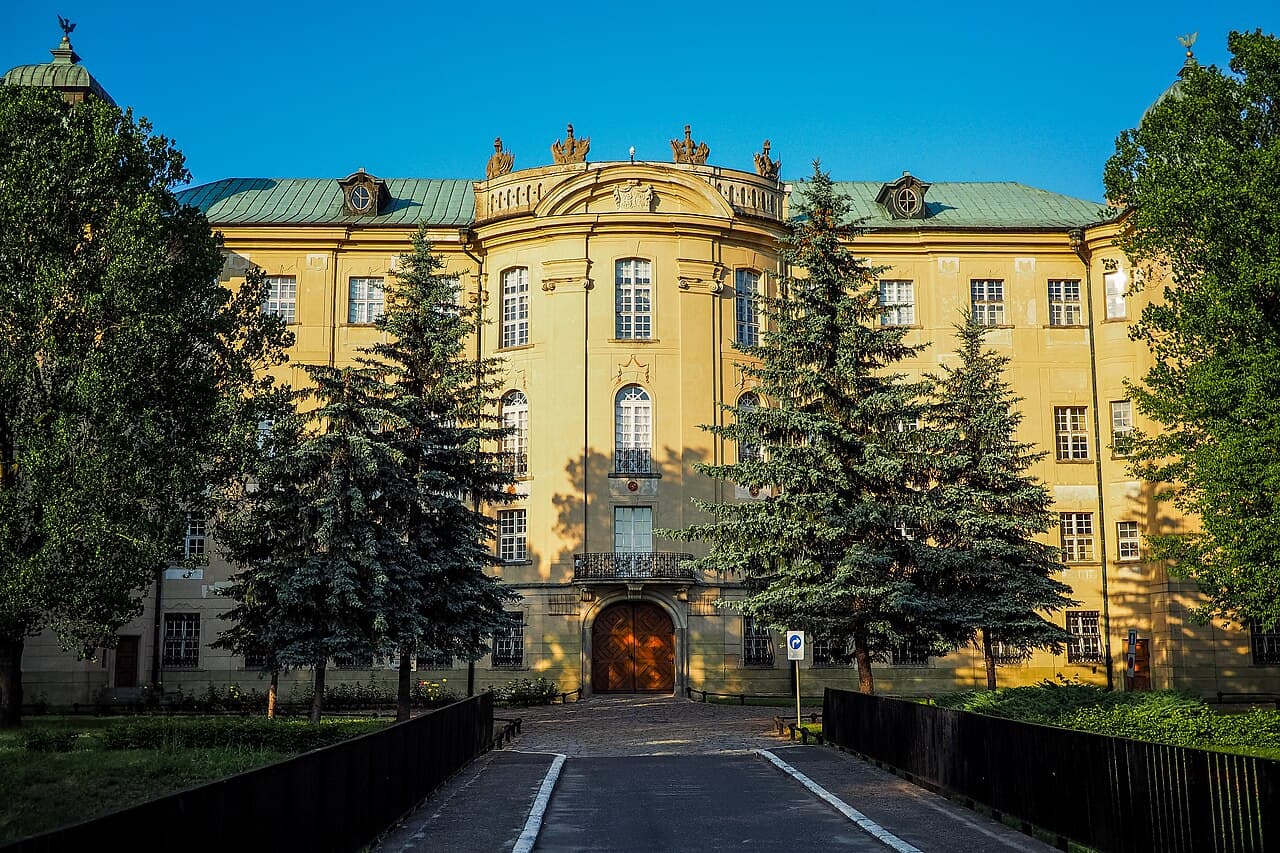
The conversion of Rydzyna Castle into a baroque residence was led by the royal architect Giuseppe Józef Szymon Belotti, with later contributions by Pompeo Ferrari. The new design replaced the defensive medieval structure with a four-winged palace arranged around a spacious internal courtyard. Each wing rose four stories high and was anchored by alcove towers at the corners, creating a harmonious and imposing silhouette.
The western wing was remodeled to include a grand two-story ballroom over an elliptical vestibule, emphasizing the castle's shift from military fortress to noble residence and cultural venue. The interiors featured elegant private apartments on the first floor and lavishly decorated reception rooms on the second floor, showcasing the refined tastes of the Leszczyński family.
The castle's park was also developed during this period, with gardens replacing the former defensive moats. The integration of the residence and the urban fabric of Rydzyna reflected the baroque ideal of harmonious town planning combined with aristocratic grandeur.
Historical significance and royal connections
In 1703, Stanisław Leszczyński, son of Rafał Leszczyński, became the owner of Rydzyna Castle. His reign as King of Poland from 1704 brought further prestige to the estate. However, the turbulent political climate led to the castle's partial destruction in 1707 when Russian troops set fire to Rydzyna during the Saxon Wars. The fire severely damaged the western and southern wings, leaving the residence partially ruined for several decades.
After Stanisław Leszczyński's abdication in 1736, the castle changed hands to Aleksander Józef Sułkowski, minister at the court of Augustus III. Under Sułkowski's ownership, extensive reconstruction and enlargement took place between 1742 and 1745, guided by the Silesian architect Karol Marcin Frantz. This work introduced rococo decorative elements, new roofs, and ornamental tower tops, enhancing the castle's elegance.
The grand staircase in the northern wing, a monumental architectural feature connecting all floors via a stately vestibule, was added during this period. The ballroom was further embellished with stucco decorations by Jan Chrystian Grünewald and a remarkable polychrome ceiling painted by Georg Wilhelm Neunhertz, depicting the Apotheosis of the Sułkowski family.
Expansion of the estate and urban integration
The mid-18th century also saw the expansion of the castle's service areas. A semi-circular courtyard was created in front of the northern elevation, enclosed by annexes including stables, a coach house, and a dressage arena connected by galleries. The castle island was extended, and new moats were excavated to enhance the estate's grandeur and functionality.
Landscape architect Ignacy Graff contributed to the estate's refinement by designing garden pavilions, including an orangery and a Turkish pavilion. He also installed a semi-circular pool surrounded by stone sculptures crafted by Jan Rimpler, notably sphinx figures added in 1752, reflecting the period's fascination with classical motifs.
The castle and town were aligned along a compositional axis, embodying the baroque principles of order and symmetry. This urban planning effort underscored Rydzyna's status as a significant magnate seat and cultural center in the region.
20th-century history and preservation efforts
Following the death of the last Sułkowski ordynat in 1909, the estate was acquired by the Prussian School Board and converted into a collegiate school. After Poland regained independence in 1918, the Ministry of Education took over the property, establishing a gymnasium with a dormitory. During World War II, the castle was used by the Hitlerjugend as a youth school, a period marked by further damage.
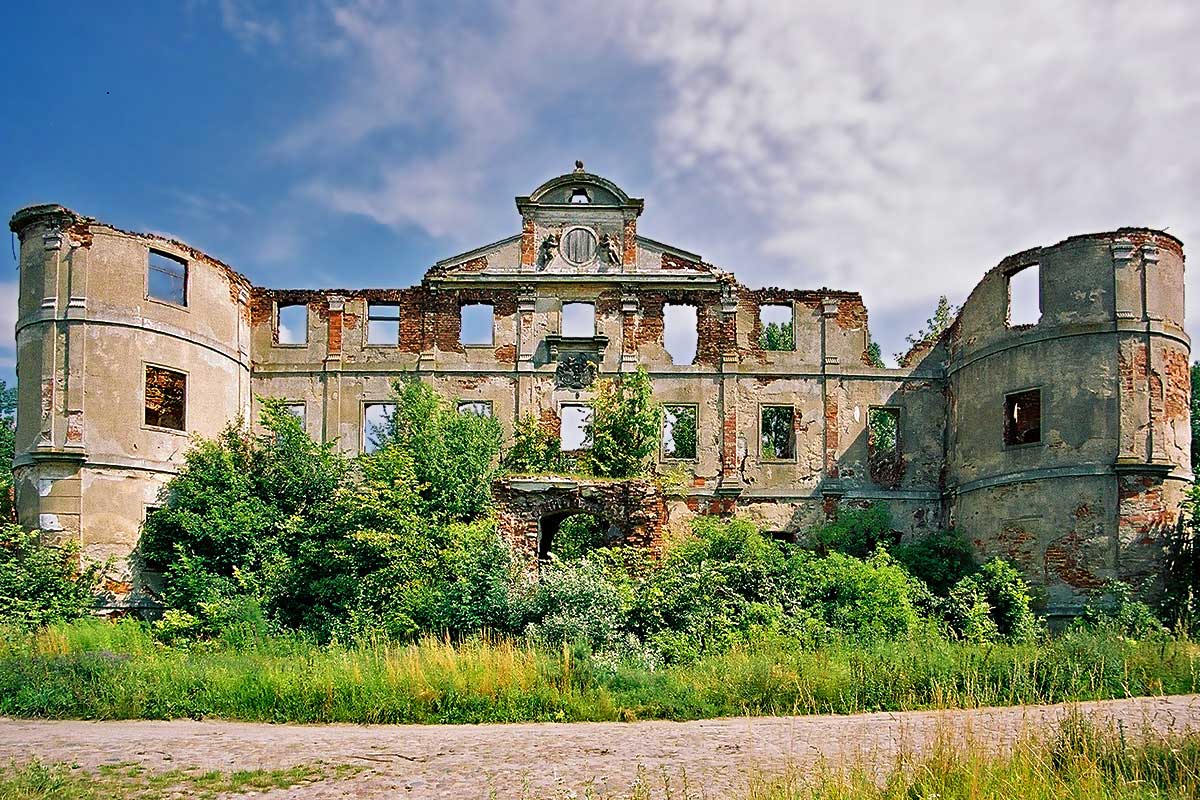
In 1945, the advancing Soviet forces caused a devastating fire that destroyed the castle's interiors, leaving only its structural shell intact. Restoration and conservation efforts began in the 1950s and continued through the 1970s and 1980s under the stewardship of the Association of Polish Engineers and Mechanical Technicians. These efforts stabilized the ruins and adapted the castle for use as a training center and hotel, preserving its cultural heritage.
Architectural features and cultural legacy
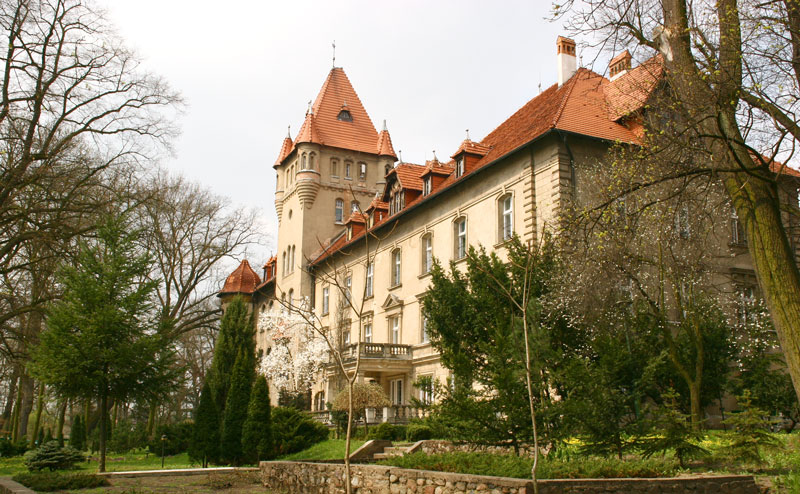
Today, Rydzyna Castle is recognized as one of the finest examples of Polish baroque magnate residences. Its four-winged layout with corner alcove towers encloses a spacious courtyard, reflecting the aristocratic lifestyle of its former inhabitants. The castle's ballroom remains a highlight, with its two-story height, Corinthian columns, and richly decorated ceiling.
The castle's park, covering over six hectares, showcases a transition from formal baroque gardens to an English landscape style by the early 19th century. While many original pavilions have been lost, the restored shooting pavilion from 1772 survives as a testament to the estate's historical leisure functions.
Rydzyna Castle's layered history, from its medieval defensive origins to its baroque splendor and modern restoration, marks it as a significant cultural monument in Poland. Its preservation and adaptive reuse ensure that it continues to serve as a symbol of the region's rich architectural and historical heritage.
Frequently asked questions (FAQ)
- How do I get to Rydzyna Castle?
- Rydzyna Castle is located in the town of Rydzyna in Greater Poland Voivodeship, accessible by regional roads and public transport from nearby cities like Leszno and Poznań.
- What is the historical significance of Rydzyna Castle?
- Rydzyna Castle is a prime example of Polish baroque architecture built upon a medieval fortress, associated with notable noble families such as the Leszczyńskis and Sułkowskis, and linked to King Stanisław Leszczyński.
- Can I visit the interior of Rydzyna Castle?
- Yes, parts of the castle have been restored and adapted for use as a hotel and training center, allowing visitors to explore some of the interiors and the grand ballroom during guided tours or events.
- When is the best time to visit Rydzyna Castle?
- The castle and its park are best visited in spring through early autumn when the gardens are in bloom and the weather is favorable for walking tours.
- Are there any special events held at Rydzyna Castle?
- Rydzyna Castle hosts cultural events, concerts, and historical reenactments, especially during the summer months, celebrating its baroque heritage and community significance.
Photo gallery

Information
Opening hours
Typically 10:00-16:00, daily
Ticket prices
Varies, check local listings
Current owner
Association of Polish Engineers and Mechanical Technicians
Website
Visit websiteSources & official resources
Verify the information above using these authoritative references.
Loading map...
Visitor reviews
No reviews yet. Been here? Write the first review and help other travelers!
Write the first reviewVisited this castle? Share your experience
Your review helps other travelers and adds first-hand knowledge to our encyclopedia.