Osieczna
Osieczna Castle stands as a remarkable example of a bastioned fortress located in the town of Osieczna, Poland. Its origins trace back to the medieval period, with the earliest historical records referencing the site in the 14th century. The castle's evolution reflects centuries of architectural development, noble ownership, and strategic adaptations, culminating in its current well-preserved state following significant renovations in the late 19th and early 20th centuries.
Early history and medieval origins
The first documented owner of the Osieczna estate was Wojsław Borek, castellan of Santok, mentioned between 1365 and 1385. This period marks the likely foundation of the initial fortifications, although no definitive archaeological evidence confirms the existence of a fortress before the town's official charter in 1370. The name Osieczna itself, formerly Oszeczno, suggests a settlement of strategic or defensive importance.
The earliest explicit mention of a castle at Osieczna dates to 1472, but it is plausible that a fortified structure existed by the late 14th or early 15th century. The castle was probably constructed or significantly developed by Maciej Borek during his active years from 1418 to 1453. Initially, the castle featured a square defensive wall roughly 25 meters per side, built on an artificial mound beside a lake, with wooden buildings within the enclosure.
In the 15th century, the castle was expanded with the addition of three masonry wings and a corner tower on the northeast side. This development marked a transition from purely defensive architecture to a more complex residential stronghold. The Borkowie family held the castle until 1512, when it was sold to Łukasz Górka, a member of one of the wealthiest noble families in Greater Poland, who owned extensive estates but rarely resided at Osieczna, leading to the castle's gradual decline.
Renaissance enhancements and noble ownership
In 1592, the castle passed as inheritance to Andrzej Czarnkowski, nephew of Stanisław Górka. Although his tenure was brief, lasting less than a decade, Czarnkowski undertook significant reconstruction and enlargement efforts around the turn of the 17th century. This period introduced Renaissance architectural elements, including the well-preserved knights' hall with its distinctive barrel-vaulted ceiling and cross-ribbed vaulting.
The mannerist sandstone portal leading to the knights' hall is a notable artistic feature dating from this era, adorned with the Czarnkowski-Nałęcz coat of arms, grotesque ornamentation, and symbolic figures such as genii holding horns of plenty. This portal exemplifies the fusion of defensive and decorative architecture characteristic of Polish Renaissance castles.
Subsequent owners included the Przyjemski and Opaliński families. In 1665, a devastating fire severely damaged the castle. Jan Opaliński of Bnin led the reconstruction, as commemorated by an ornamental plaque. The castle then passed to the Mycieliński family in 1694 and later to the Skoroszewski family in 1750. The last Polish owner was Mikołaj Skoroszewski, whose indebted estate was sold in 1797 to a Berlin bank.
19th and early 20th-century transformations
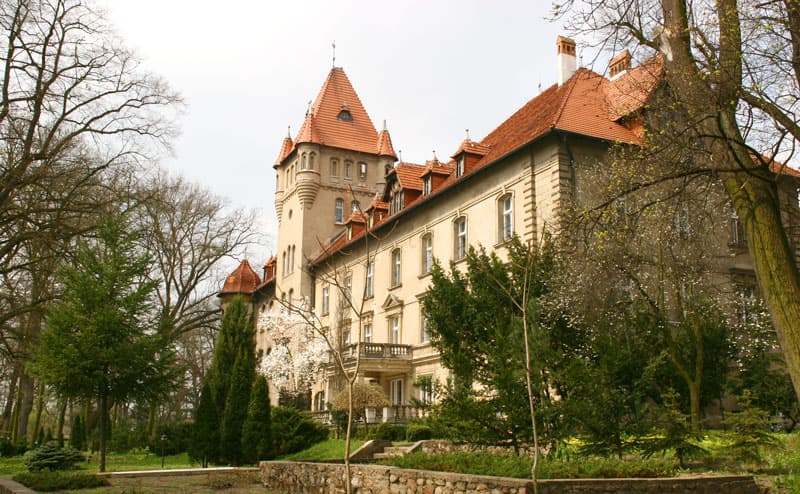
The castle suffered neglect and partial ruin during the early 19th century due to frequent changes of ownership. Between 1895 and 1906, under the ownership of Henryk Hedebrand, the castle underwent a comprehensive reconstruction. This renovation introduced a prominent 26-meter-high tower around 1900, built atop a connector linking the two remaining wings. The architectural style of this period is an eclectic blend with Renaissance Revival influences, reflecting contemporary tastes while respecting the castle's historic fabric.
The current layout is an irregular triangular plan with three main wings enclosing an open courtyard. The northern wing preserves medieval walls at the ground floor, including the knights' hall with its Renaissance vaulting. The southern wing contains thick walls constructed from large field stones bound with lime mortar and clay, likely remnants of the original Górka castle.
Exterior features include bay windows, balconies, terraces, and stucco decorations bearing historic coats of arms such as Abdank and Zbiświcz. The main entrance on the west side is marked by masonry pillars supporting a floral balcony and a protective canopy, highlighting the castle's blend of defensive and residential character.
Modern use and cultural significance
Since 1959, Osieczna Castle has served a public function, initially adapted as a sanatorium specializing in rheumatism, diabetes, and obesity treatment. Today, it operates as the Rehabilitation and Treatment Hospital for Children and Youth, continuing its role in community health care. The castle is surrounded by a 2.2-hectare park featuring mature trees such as lindens, plane trees, red-leafed beech, oaks, maples, and sycamores, along with historic plantings including a notable magnolia near the lake shore.
The park's late 19th-century three-section gatehouse marks the entrance, complementing the castle's historic ambiance. The site also holds cultural significance due to its association with Tassilo von Heydebrand und der Lasa, a renowned chess master who kept his chess library at Osieczna during his final year.
Architectural and archaeological research
Extensive studies, including those by Jerzy Romanow in 1982, have documented the layered history of Osieczna Castle, revealing its medieval foundations, Renaissance modifications, and modern reconstructions. These investigations have helped preserve the castle's heritage and inform ongoing conservation efforts.
Notable features
- Knights' hall with barrel vault and cross ribs from the Renaissance period
- Mannerist sandstone portal with Czarnkowski-Nałęcz coat of arms and grotesque decorations
- 26-meter tower built in 1900 as a prominent architectural focal point
- Medieval walls preserved in the northern wing
- Stucco decorations bearing historic coats of arms on courtyard facades
- Historic park with mature trees and a late 19th-century gatehouse
Osieczna Castle remains a significant monument of Polish history, architecture, and cultural heritage. Its combination of medieval origins, Renaissance artistry, and modern restoration makes it a unique site that reflects the complex layers of Poland's noble past and architectural evolution.
Frequently asked questions (FAQ)
- How do I get to Castle Osieczna?
- Castle Osieczna is located in the charming village of Osieczna, Poland. You can reach it by car or public transport, with several bus services operating from nearby cities. For those driving, ample parking is available near the castle.
- What is the historical significance of Castle Osieczna?
- Castle Osieczna dates back to the 14th century and has played a vital role in the region's history. It served as a defensive stronghold and residence for local nobility, reflecting the architectural styles and historical events of its time. Today, it stands as a testament to Poland’s rich heritage.
- When was Castle Osieczna constructed?
- The construction of Castle Osieczna began in the 14th century, with significant renovations occurring in subsequent centuries. The castle has undergone various modifications, showcasing different architectural styles that are representative of its long history. Its enduring presence offers a glimpse into the past.
- Can I take guided tours of Castle Osieczna?
- Yes, guided tours of Castle Osieczna are available for visitors. These tours provide insightful information about the castle's history, architecture, and significant events. It is recommended to check the castle’s official website for tour schedules and availability.
- Why is Castle Osieczna considered an architectural gem?
- Castle Osieczna is renowned for its unique blend of Gothic and Renaissance architectural styles. Its well-preserved structures, including impressive towers and intricate stonework, highlight the craftsmanship of the era. Visitors often admire its picturesque setting and historical ambiance.
- Is it possible to host events at Castle Osieczna?
- Yes, Castle Osieczna offers facilities for hosting various events, including weddings and corporate gatherings. The stunning backdrop of the castle enhances the experience, making it a popular choice for special occasions. Interested parties should contact the castle's management for more details and booking information.
- What are the opening hours for Castle Osieczna?
- Castle Osieczna is typically open to visitors from 10 AM to 6 PM, with extended hours during the summer months. It's advisable to check the official website for any seasonal changes or special events that may affect operating hours. Planning your visit ahead of time will ensure a smooth experience.
- What are the ticket prices for visiting Castle Osieczna?
- Ticket prices for Castle Osieczna vary depending on age and the type of tour chosen. Generally, adult tickets are priced modestly, with discounts available for students and seniors. Always check the castle's website for the most up-to-date pricing and any special offers.
- When is the best time to visit Castle Osieczna?
- The best time to visit Castle Osieczna is during the late spring and early autumn months when the weather is pleasant. This period allows visitors to enjoy the surrounding gardens and scenic views fully. Additionally, special events and festivals often occur during these seasons, enhancing the overall experience.
- Are there any nearby attractions to visit while at Castle Osieczna?
- Yes, several attractions are located near Castle Osieczna, including beautiful parks, local museums, and scenic walking trails. Exploring the surrounding area can provide a fuller experience of the region's history and natural beauty. Be sure to plan extra time to discover these nearby gems.

Information
Loading map...
Visitor reviews
No reviews yet. Been here? Write the first review and help other travelers!
Write the first reviewVisited this castle? Share your experience
Your review helps other travelers and adds first-hand knowledge to our encyclopedia.