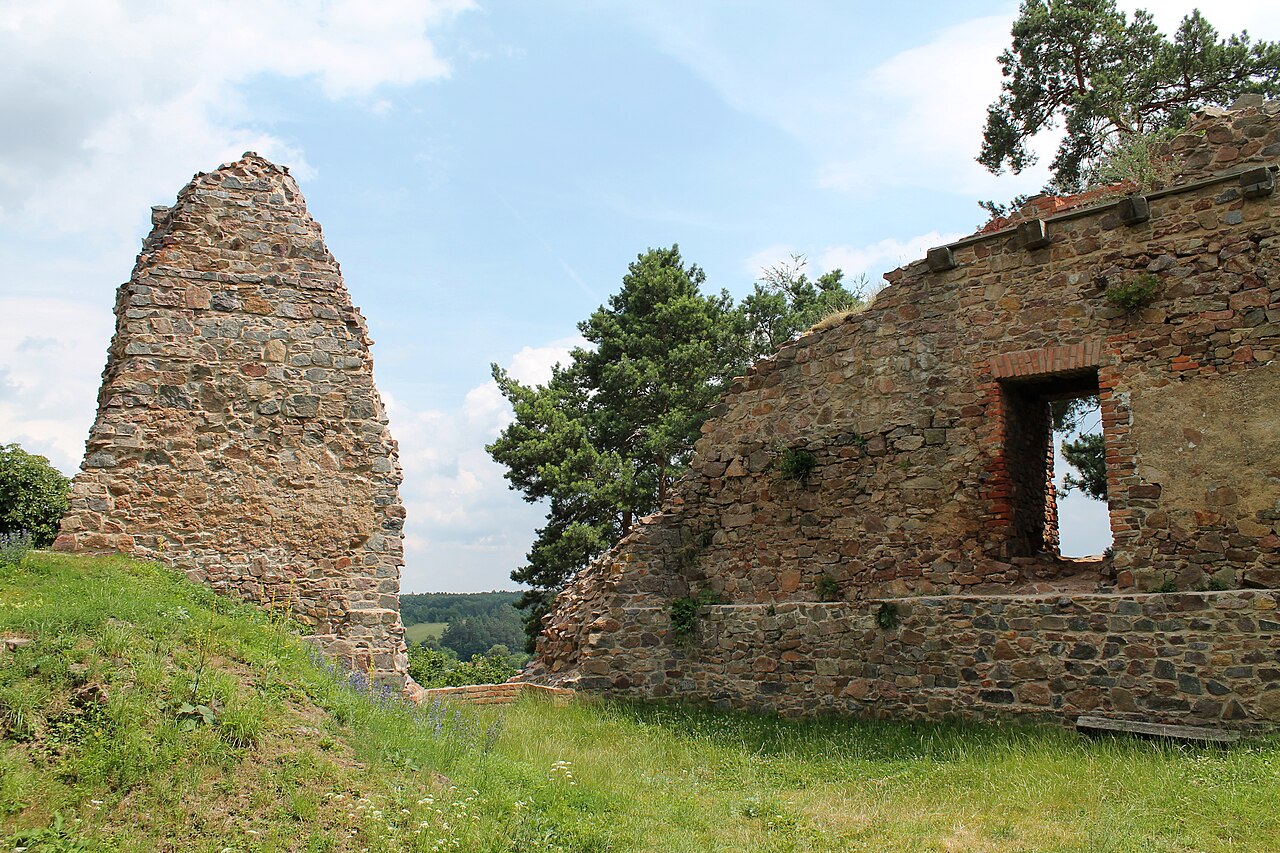
Rychmburk Castle
Rychmburk Castle stands as a monumental example of medieval architecture in the Czech Republic, with origins tracing back to the 13th century. Perched strategically on a steep hill overlooking the confluence of the Lešanský stream and the Krounka river, this hill castle was originally constructed by the noble Tas of Rychmburk. Over the centuries, it evolved from a fortified stronghold into a grand residence that reflects layers of architectural styles including Gothic, Renaissance, and Baroque. Its enduring presence offers a vivid window into the region's turbulent history and noble lineage.
Early history and medieval significance
The castle's earliest recorded owner, Tas of Mrdice, established Rychmburk as a powerful seat of the Mrdice family around 1325. This fortified complex was part of an extensive estate comprising several villages and towns, underscoring its importance in the feudal landscape of Bohemia. In the late 14th century, the castle gained cultural prominence as the residence of Smil Flaška of Pardubice, a notable poet and nobleman whose stewardship marked a flourishing period for the castle.
Throughout the High Medieval period, Rychmburk experienced typical aristocratic transitions, passing through the hands of influential families such as the Vartenberks and Pardubices. These transfers illustrate the castle's role as a valuable asset within the Czech nobility's network of power and landholdings.
The impact of the hussite wars
The 15th century was a time of upheaval for Rychmburk due to the Hussite Wars, a series of religious conflicts that reshaped Bohemia. Initially a refuge for Catholic nobles opposing the Hussite movement, the castle was seized by Hussite forces in 1425 without a battle, highlighting the shifting allegiances and political tensions of the era. This event marked a critical turning point, reflecting the castle's strategic and symbolic significance during the conflict.
Renaissance transformations and baroque renovations
In the first half of the 16th century, under the ownership of Jindřich Šťastný of Valdštejn, Rychmburk Castle underwent a significant transformation into a Late Gothic palace. This period introduced Renaissance architectural elements, notably the elegant stone-framed gate at the southern entrance and the Renaissance gallery in the northern wing. The castle's defensive structures were complemented by aesthetic enhancements, blending fortification with noble comfort.
Later, in the late 18th century, the Kinský family commissioned extensive Baroque renovations between 1793 and 1798. These modifications reflected contemporary tastes and the evolving function of the castle as a noble residence rather than purely a military fortress. The Baroque influence is evident in the castle's refined interiors and structural adjustments that prioritized elegance and status.
Architectural features and layout
Fortifications and towers
Rychmburk Castle's layout is characterized by a rectangular two-story structure with a large fortified outer bailey added around 1500. This bailey not only enhanced the castle's defenses but also gave rise to the adjacent settlement of Předhradí, which remains one of the best-preserved examples of such medieval urban development in the Czech Republic. The castle is separated from Předhradí by a man-made moat, emphasizing its defensive design.
A prominent feature is the round tower on the western corner of the courtyard, dating from the 14th century. Rising approximately 30 meters, this tower boasts a conical roof and retains traces of sgraffito decoration. Its walls include partly preserved Gothic embrasures and corbels that once supported small oriel windows, illustrating medieval defensive architecture combined with decorative elements.
The northern corner of the castle is anchored by a smaller four-sided tower, complementing the larger round tower and reinforcing the castle's defensive perimeter. The curtain walls and a broad ditch, once guarding the southwestern approach, are key components of the castle's fortifications, with a stone bridge now spanning the ditch as a later adaptation.
Interior spaces and religious elements
Inside the castle, the vaulted cellar beneath the courtyard, supported by a central pillar, is a surviving element from the original Gothic construction. The castle also retains Gothic vaulted cellars and Renaissance vaulting on the first and second floors, showcasing the architectural evolution over centuries.
The Chapel of the Holy Cross on the second floor of the round tower is a highlight of the castle's religious heritage. Dating to the latter half of the 17th century, the chapel features distinctive vaulting and two panel paintings, reflecting the Baroque period's artistic influences and the castle's role as a noble residence with spiritual functions.
Later history and preservation
Following the Berka family's tenure, the castle passed to the Kinský family in 1706 through marriage, who maintained and enhanced the property. In 1823, ownership transferred to the princely Thurn-Taxis family, who retained it until the end of World War II. Post-1945, the castle was nationalized and repurposed as a care home, serving elderly and mentally ill adults until 2021.
Today, Rychmburk Castle is under the stewardship of the Regional Museum in Chrudim and has been reopened to the public, allowing visitors to explore its rich architectural heritage and historical significance. Its condition is well preserved, with many original features intact, making it a valuable cultural monument and a testament to the layered history of Czech castles.
Frequently asked questions (FAQ)
- When was Rychmburk Castle originally built?
- Rychmburk Castle was originally built in the 13th century, with its earliest known owner recorded around 1325.
- What architectural styles are represented in Rychmburk Castle?
- The castle features a mix of Gothic, Renaissance, and Baroque architectural styles, reflecting its long history and various renovations.
- Can visitors explore the interior of Rychmburk Castle?
- Yes, the castle is open to the public under the care of the Regional Museum in Chrudim, offering access to its historic interiors and chapel.
- What is the significance of the round tower at Rychmburk Castle?
- The 14th-century round tower is a key defensive feature, notable for its height, conical roof, Gothic embrasures, and decorative sgraffito.
- How did the Hussite Wars affect Rychmburk Castle?
- In 1425, during the Hussite Wars, the castle was seized by Hussite forces without a battle, marking a significant moment in its history.
- What was the castle's function after World War II?
- After World War II, Rychmburk Castle was nationalized and used as a care home for the elderly and adults with mental illness until 2021.
Information
Sources & official resources
Verify the information above using these authoritative references.
Loading map...
Visitor reviews
No reviews yet. Been here? Write the first review and help other travelers!
Write the first reviewVisited this castle? Share your experience
Your review helps other travelers and adds first-hand knowledge to our encyclopedia.