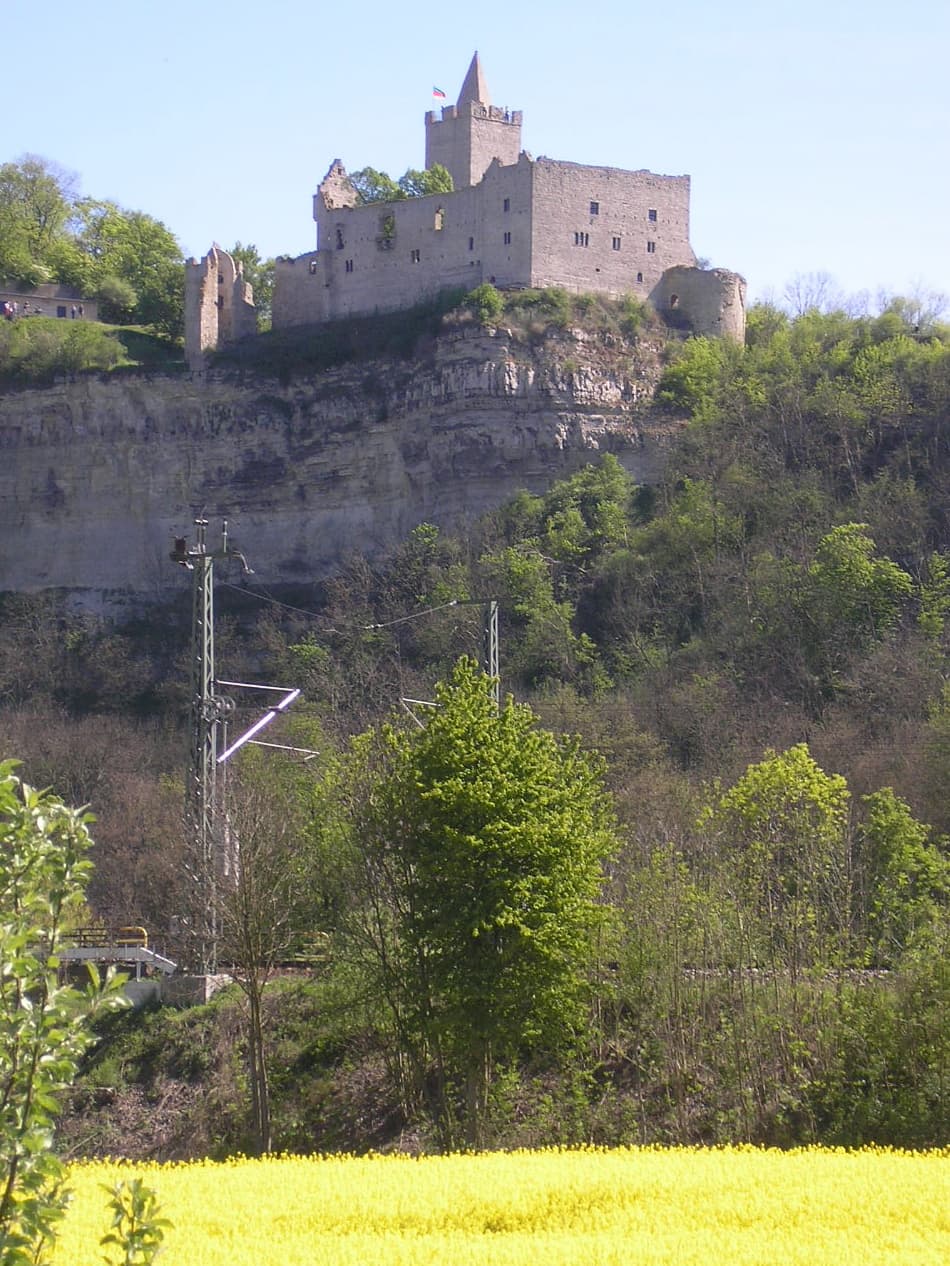
Rudelsburg
Rudelsburg Castle is a prominent high medieval hill castle situated on the east bank of the river Saale, perched atop a rocky shell limestone ridge approximately 85 metres above the river level. Located near Saaleck, a suburb of the town of Bad Kosen in Germany, the castle commands a strategic vantage point overlooking the Saale Valley. This elevated position allowed it to control and secure vital medieval trade routes, most notably the Via Regia, which was one of the most important east-west trade corridors in Europe during the Middle Ages.
Historical significance and origins
The construction of Rudelsburg Castle dates back to the 11th century, a period marked by the consolidation of territorial power through fortified structures. It was originally built under the auspices of the Bishop of Naumburg, a powerful ecclesiastical figure whose influence extended across the region. The castle's primary function was to serve as a military and administrative stronghold to protect the bishopric's interests and to monitor the bustling trade routes passing through the Saale Valley.
Throughout the high medieval period, Rudelsburg played a pivotal role in regional defense and governance. Its position enabled control over river traffic and overland commerce, which were critical to the economic prosperity of the bishopric and surrounding territories. The castle's fortifications were designed to withstand sieges and assaults typical of the era, reflecting the turbulent political landscape of medieval Germany.
Architectural features and layout
The castle is a classic example of a hill castle built to exploit natural topography for defense. The rocky ridge foundation provided a naturally elevated platform, making direct assaults difficult. The castle complex includes robust curtain walls, towers, and a gatehouse that controlled access to the inner bailey. These defensive elements were complemented by a deep moat and strategically placed battlements, allowing defenders to repel attackers effectively.
Inside the castle, the keep or donjon served as the last line of defense and the residence of the castle's lord or the bishop's appointed representative. The castle also contained various halls, chapels, and service buildings necessary for sustaining a garrison and administrative functions. The use of shell limestone in construction not only provided durability but also contributed to the castle's distinctive appearance.
The romantic era and cultural importance
By the early 19th century, Rudelsburg Castle had fallen into disuse as a military fortification but gained new life as a symbol of romantic nationalism and the burgeoning interest in medieval heritage. The rise of hiking and the romanticization of natural landscapes made the castle a favored destination for tourists and artists alike. Its dramatic setting above the Saale River and the evocative ruins inspired numerous paintings, poems, and literary works celebrating the medieval past.
From 1855 onwards, the castle's fame extended beyond regional boundaries, becoming one of the most celebrated castles along the Saale River. It became an integral part of the Romanesque Road, a cultural and tourist route in Saxony-Anhalt that highlights significant medieval architecture and heritage sites. The castle's restoration efforts in the 19th and 20th centuries have preserved its structure, allowing visitors to experience its historical ambiance and panoramic views.
Restoration and current status
Today, Rudelsburg Castle is classified as a restored monument, having undergone extensive preservation to maintain its architectural integrity. The restoration has focused on stabilizing the castle walls, refurbishing key structures such as the gatehouse and , and enhancing visitor access without compromising historical authenticity.
The castle remains a popular tourist attraction, offering visitors not only a glimpse into medieval fortification architecture but also spectacular views over the Saale Valley. Its inclusion on the Romanesque Road continues to attract cultural tourists interested in the rich medieval history of the region.
Visiting Rudelsburg Castle
Visitors to Rudelsburg Castle can explore the well-preserved ruins and enjoy hiking trails that lead through the scenic Saale Valley. The castle's elevated position provides excellent opportunities for photography and nature appreciation. Interpretive signage and guided tours offer insights into the castle's history, architecture, and role in medieval trade and politics.
Frequently asked questions (FAQ)
- When was Rudelsburg Castle built and by whom?
- Rudelsburg Castle was built in the 11th century by the Bishop of Naumburg to secure important trade routes through the Saale Valley.
- What architectural features define Rudelsburg Castle?
- Rudelsburg is a hill castle featuring robust curtain walls, towers, a gatehouse, a keep, and a deep moat, all built on a rocky limestone ridge for strategic defense.
- Why did Rudelsburg Castle become popular in the 19th century?
- In the 19th century, Rudelsburg gained popularity due to the romantic movement, which celebrated medieval ruins and natural landscapes, making it a favored hiking destination.
- Is Rudelsburg Castle part of any cultural route?
- Yes, Rudelsburg Castle lies on the Romanesque Road, a cultural and tourist route in Saxony-Anhalt that highlights medieval architecture and heritage sites.
- What is the current condition of Rudelsburg Castle?
- Rudelsburg Castle is currently restored and maintained as a cultural monument, allowing visitors to explore its historic structures and enjoy panoramic views.
Photo gallery

Information
Website
Visit websiteSources & official resources
Verify the information above using these authoritative references.
Loading map...
Visitor reviews
No reviews yet. Been here? Write the first review and help other travelers!
Write the first reviewVisited this castle? Share your experience
Your review helps other travelers and adds first-hand knowledge to our encyclopedia.



