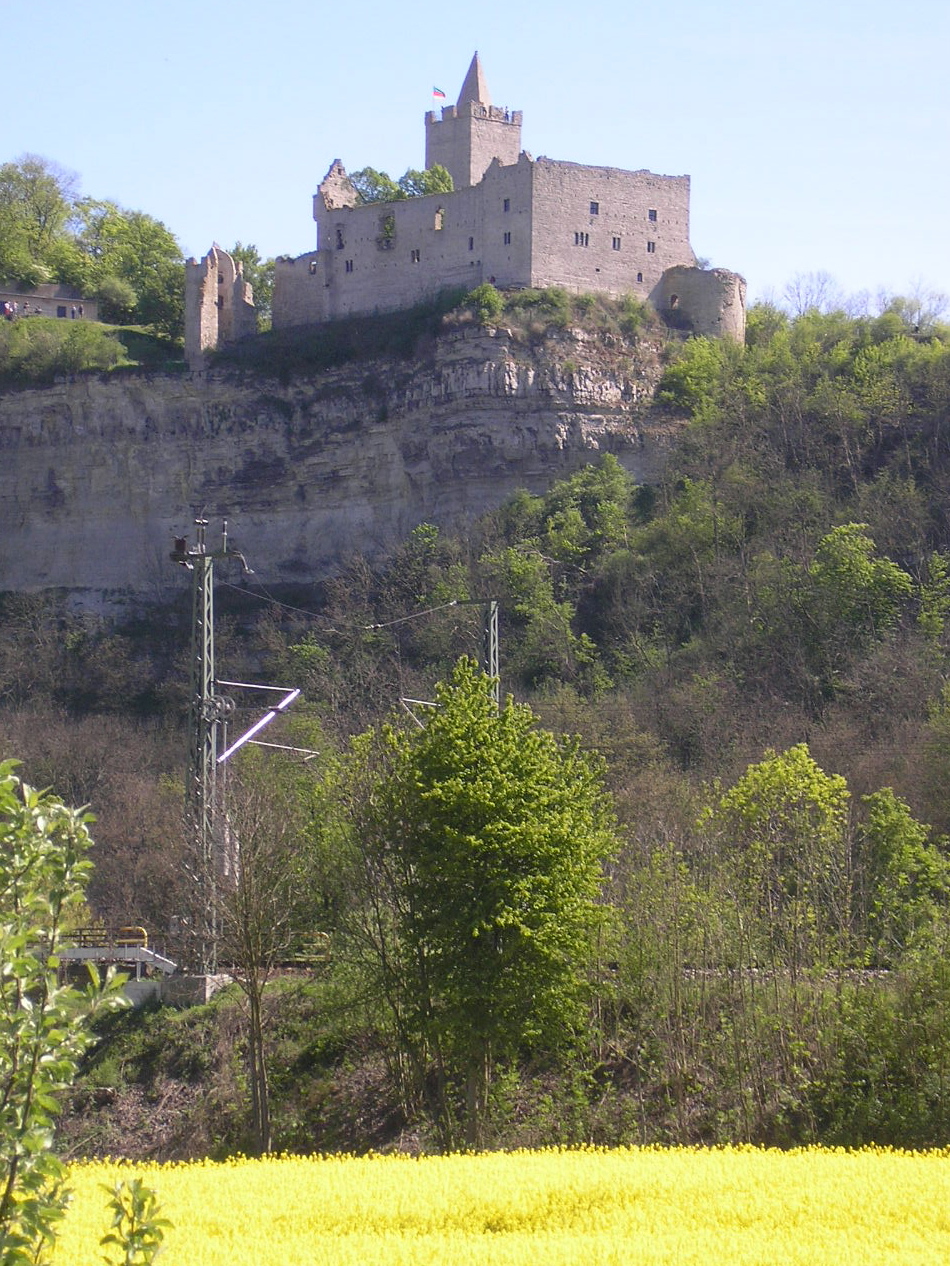
Burg Camburg
Burg Camburg stands as a significant medieval hill castle ruin located in the municipality of Dornburg-Camburg in Thuringia, Germany. Constructed during the second half of the 11th century, this castle played a pivotal role in the regional power dynamics of central Germany. Its strategic position above the Saale River allowed control over an important medieval trade route, the Salzstraße, which was crucial for the salt trade.
The earliest documented figure connected to the castle is Count Wilhelm of Camburg, mentioned in 1088, though it remains uncertain if he directly owned the castle at that time. By the mid-12th century, the castle was firmly linked to the influential Wettin dynasty, a prominent noble family that shaped much of the region's history. The first explicit mention of a margravial fortress at Camburg dates to 1166, underscoring its importance as a fortified site during the High Medieval period.
Historical significance and ownership
Throughout the 12th and 13th centuries, Burg Camburg was under the influence of various local noble families, including the ministeriales, who were unfree knights serving the Wettins. There are possible connections to the Reginbodonen lineage, a noble family active in the region. The castle also had a religious function, as indicated by the presence of a castle chapel recorded from 1213.
The castle endured military conflicts reflecting the turbulent political landscape of medieval Thuringia and Saxony. In 1191, it withstood a siege by Landgrave Hermann I of Thuringia. Later, in 1280, Count Günther of Kevernburg attempted to capture the fortress but failed. The castle's decline was marked by its partial destruction during the Saxon Brother War in the mid-15th century when Elector Frederick II of Saxony ordered its destruction, sparing only the main tower, known as the bergfried.
After its devastation, Burg Camburg was not rebuilt as a full fortress but remained under the control of the Wettin family and later passed through various branches of the Ernestine duchies. In the late 19th and early 20th centuries, a guesthouse was constructed on the ruins but was removed in 1935 when the lower castle area was repurposed as a Jugendburg for Nazi youth organizations. Since 2006, restoration efforts have focused on the bergfried, which now serves as a museum and observation point. Additionally, a building on the site functions as a civil registry office today.
Architectural layout and defensive features
Burg Camburg is situated on a narrow, elongated spur approximately 285 meters long and 25 to 75 meters wide, elevated at 179 meters above sea level. This naturally defensible hill was further fortified by a deep and broad neck ditch that artificially divided the site into two main sections: the upper castle and the lower castle.
Lower castle and bergfried
The lower castle, often called the Turmberg, is roughly quadrilateral and dominated by the bergfried, a tall main tower standing about 37 meters high with an external diameter of 11 meters. This tower, dating from the late 12th or early 13th century, is one of the best-preserved medieval towers in the region and remains largely intact following restoration. Surrounding the bergfried are remnants of a curved curtain wall constructed of stone, parts of which still extend from the tower, outlining the original defensive perimeter.
Upper castle and earthworks
The upper castle, known as the Matzberg, is located at the southern end of the spur and is characterized by a substantial earthen rampart measuring roughly 45 meters long, 25 meters wide, and rising 15 meters high. This earthwork served as a formidable defensive barrier, controlling access to the spur from the south and complementing the natural topography to enhance the castle's defenses. The upper castle sits several meters higher than the lower castle, emphasizing a layered defense strategy common in medieval fortifications.
Archaeological findings and material culture
Excavations conducted in 1935 around the lower castle uncovered significant structural remains, including sections of outer walls and foundations of what was likely a major residential or representative building south of the bergfried. Cellar remains shaped in a trapezoid approximately 5 by 6 meters were found, alongside evidence of destruction by fire consistent with historical accounts of the castle's violent end in the mid-15th century.
The archaeological layer yielded a rich assemblage of artifacts, including ceramics such as gray and blue-gray earthenware from the 13th to 15th centuries and 14th-century stoneware pieces like a Jacobakanne jug from Waldenburg. Unique ceramic fragments included parts shaped as a horse's head and a rider's torso, which formed an aquamanile — a vessel used for ritual hand washing — as well as a lion-head mask.
Glass artifacts include a ribbed cup dating to the mid-15th century. Coins discovered comprised a Prague groschen and a container lid for Meissen groschen, both silver medieval currencies used in the region. Metal finds included copper fittings inscribed with letters, various strap fasteners, a gilded wire, a bone comb with eight teeth, and weapon fragments such as crossbow nuts, bolt tips, and a spur dating broadly to the 10th or 11th century.
These findings corroborate the castle's establishment in the late 11th century and its destruction during the 1450 Saxon Brother War. While stratigraphic data is limited, the artifacts provide valuable insights into the castle's material culture and daily life during its occupation.
Modern preservation and usage
Today, the most prominent surviving structure at Burg Camburg is the bergfried, which has been restored to house a museum and an observation platform offering panoramic views of the surrounding landscape. Portions of the original curtain walls remain visible as stone ruins, while much of the rest of the castle has been reduced to earthworks and ramparts.
The site has been adapted for contemporary use, including event spaces and municipal functions, integrating the historical heritage with community activities. The transformation of the lower castle area into a Jugendburg during the 20th century reflects the site's varied history and changing social roles.
Burg Camburg remains an important cultural landmark in Thuringia, attracting visitors interested in medieval architecture, regional history, and archaeological heritage. Its combination of natural defensive features, layered fortifications, and rich historical narrative make it a compelling subject for study and tourism.
Frequently asked questions (FAQ)
- How do I get to Burg Camburg?
- Burg Camburg is located in Dornburg-Camburg, Germany, easily accessible by car or public transportation. If you are traveling by train, the nearest station is Camburg, from which you can take a short taxi ride or walk to the castle.
- What is the historical significance of Burg Camburg?
- Burg Camburg dates back to the 10th century and played a crucial role in the region's defense and governance throughout the Middle Ages. It has witnessed numerous historical events and changes in power, making it an important site for understanding local history.
- When was Burg Camburg built?
- Construction of Burg Camburg began in the 10th century, with significant expansions and renovations occurring over the centuries. The castle reflects various architectural styles that evolved during its long history.
- Can I visit Burg Camburg year-round?
- Yes, Burg Camburg is open to visitors throughout the year, although specific opening hours may vary by season. It is advisable to check the official website or contact the visitor center for the most up-to-date information before planning your visit.
- Why is Burg Camburg considered an architectural gem?
- Burg Camburg showcases a blend of Romanesque and Gothic architectural styles, featuring impressive towers and well-preserved fortifications. Its unique design and historical elements make it a fascinating site for architecture enthusiasts and historians alike.
- Is it possible to access all areas of Burg Camburg?
- While many areas of Burg Camburg are accessible to the public, some sections may be restricted for safety reasons. Guided tours are available, providing in-depth information and access to parts of the castle that are not open to general visitors.
- What are the ticket prices for visiting Burg Camburg?
- Ticket prices for Burg Camburg are typically affordable, with discounts available for students, seniors, and families. Check the castle's official website for current pricing and any special promotions that may be offered.
- What are the opening hours for Burg Camburg?
- Burg Camburg generally opens at 10 AM and closes at 6 PM, but hours may vary by season or special events. It's recommended to verify the opening hours on the official website before your visit.
- When is the best time to visit Burg Camburg?
- The best time to visit Burg Camburg is during the spring and early fall when the weather is pleasant, and the surrounding landscape is beautiful. These seasons also tend to attract fewer crowds, allowing for a more enjoyable experience.
- What nearby attractions can I explore after visiting Burg Camburg?
- After visiting Burg Camburg, you can explore other nearby attractions like the Dornburg Castle and the picturesque town of Camburg. The region is also known for its beautiful hiking trails and scenic views along the Saale River.
Information
Website
Visit websiteSources & official resources
Verify the information above using these authoritative references.
Loading map...
Visitor reviews
No reviews yet. Been here? Write the first review and help other travelers!
Write the first reviewVisited this castle? Share your experience
Your review helps other travelers and adds first-hand knowledge to our encyclopedia.