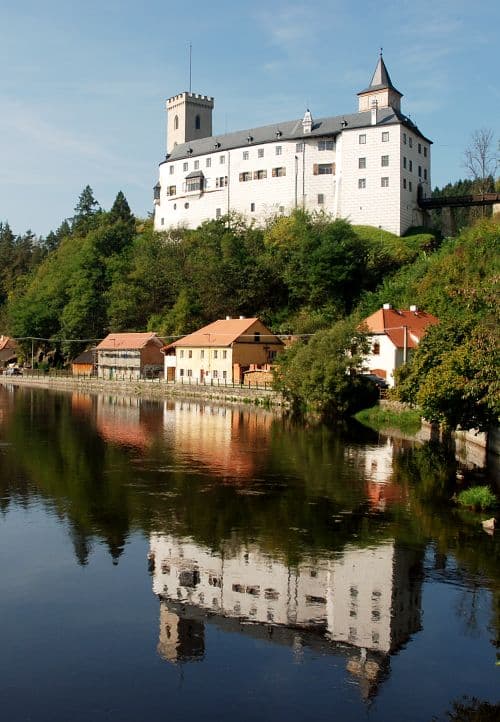
Rožmberk Castle
Rožmberk Castle stands as a remarkable example of a hill castle with a rich history spanning over eight centuries in the Czech Republic. Located in the municipality of Rožmberk nad Vltavou, this castle was originally established in the early 13th century by Vok I of Rožmberk, a member of the influential Vítkovci family. The castle's name became synonymous with the noble family who adopted the surname Rožmberk, first documented in written records around 1250. As a significant stronghold and administrative center, Rožmberk Castle played a vital role in the region's medieval political and military affairs.
Medieval origins and historical significance
The castle's strategic location on a promontory bordered by the Vltava River on three sides provided natural defense advantages, complemented by man-made fortifications such as ramparts and moats. Initially, Rožmberk Castle served as the ancestral seat of the Rožmberk family, a lineage that wielded considerable influence in Bohemia. Although after 1302 the family's primary residence shifted to the nearby Český Krumlov Castle, Rožmberk remained a crucial military and administrative site.
During the turbulent 15th century, the castle was embroiled in regional conflicts, including the Hussite Wars. It was seized twice by opposing forces before being reclaimed by the Rožmberk family. Oldřich II of Rožmberk, a key figure during this period, initially sympathized with the Hussite movement but later aligned with Catholic forces supporting King Sigismund. Under his command, Rožmberk Castle was used to imprison Hussite priests, reflecting its role in the religious and political struggles of the time.
Financial difficulties during the Hussite period led Oldřich II to pledge the castle to Reinprecht II of Walsee in 1420, but the Rožmberk heirs regained ownership in 1456. The castle's ownership changed hands multiple times in the late 15th and early 16th centuries due to political disputes and monetary troubles, including pledges to the Lobkowicz family and involvement in conflicts linked to supporters of King George of Poděbrady. A significant fire in 1522 devastated the upper section of the castle, which was never rebuilt, marking a turning point in its architectural evolution.
Renaissance transformation and architectural evolution
At the turn of the 16th and 17th centuries, Rožmberk Castle underwent a substantial transformation from a medieval fortress into a Renaissance-style chateau. This reconstruction reflected contemporary architectural trends emphasizing residential comfort alongside defensive capabilities. In 1600, Peter Vok of Rožmberk passed the estate to his nephew, Count Jan Zrinský of Seryn, who spearheaded renovations of the lower castle, incorporating Renaissance design elements.
Following the extinction of the Rožmberk family line in 1611 and the death of Jan Zrinský in 1612, the castle passed to the Švamberk family. However, during the upheavals of the Bohemian Revolt, imperial forces led by Count Charles Bonaventure Buquoy captured Rožmberk Castle in 1619. Emperor Ferdinand II subsequently awarded the castle to Count Buquoy in 1620 as a reward for his military service. The Buquoy family maintained ownership until 1945, treating Rožmberk as a secondary residence to their main seat in Nové Hrady.
In the mid-19th century, Jiří Jan Jindřich Buquoy initiated Neo-Gothic remodeling of parts of the castle, expanding the surviving upper castle structures and adding decorative battlements. This period saw the integration of historicist architectural elements, blending the castle's medieval and Renaissance heritage with 19th-century stylistic trends.
Architectural features and castle layout
Upper and lower castle complexes
Rožmberk Castle comprises two originally independent fortifications: the Upper Castle (Horní hrad) and the Lower Castle (Dolní hrad). Positioned on a promontory with natural defenses provided by the Vltava River, the complex is further protected by earthworks, including ramparts and moats.
The Upper Castle, dating likely to the 14th century, featured a prominent round tower known as Jakobínka, measuring 9.6 meters in diameter. This tower, enclosed by protective walls and a moat, had a separate entrance, indicating it operated independently from the Lower Castle. The Jakobínka tower remains a dominant surviving feature because the rest of the Upper Castle was largely destroyed by fire in 1522 and never rebuilt. The wooden roof components of Jakobínka have been dendrochronologically dated to 1523, confirming repairs or reconstruction shortly after the fire.
The Lower Castle was constructed with Renaissance-style residential and defensive functions in mind. It includes an earlier square tower on the southern side called the English Tower, notable for containing a rare Romanesque window. This architectural detail suggests historical connections to regions along the Danube River. Later modifications added a smaller tower on the northern end of the Lower Castle.
Palace and courtyard features
Along the eastern wall of the Lower Castle stands a palace with a complex architectural history. Its Renaissance reconstruction began in 1556, revitalizing the deteriorated structure with interior reorganization and ornamental plasterwork using the sgraffito technique, which involves layering plaster to create decorative patterns. The palace complex also includes low buildings such as a gatehouse situated in the forecourt.
The main entrance to the castle is approached from the north, crossing a defensive ditch before passing through a Renaissance rusticated semicircular stone portal. This portal still bears traces of Mannerist painted decoration, an artistic style characterized by elaborate and stylized elements. Beyond the gate lies a vaulted passage with lunettes, semicircular wall spaces often containing windows or decorative features.
The castle's inner courtyard presents relatively plain facades. The principal residential wing extends along the eastern side and culminates in a rectangular tower crowned with Neo-Gothic battlements added during 19th-century renovations. Opposite the palace stands the Crusader Gallery, also enhanced with Neo-Gothic features and an open roof truss richly carved in the 19th century.
Interior spaces and artistic heritage
Inside Rožmberk Castle, significant rooms have been preserved that showcase the castle's layered history. The Armory on the first floor has a distinctive trapezoidal plan with a ceiling made of Renaissance-style wooden panels featuring coffered (sunken square) decorations supported by central pillars. The Knight’s Hall, a rectangular chamber, contains a coffered ceiling embellished with carved pine cones and Mannerist frescoes dating to 1607. These paintings draw inspiration from designs by artists such as L. Kilian, J. Vredeman de Vries, Marten de Vos, and R. Sadeler. The hall's walls display early 17th-century coats of arms belonging to Jan Zrinský and Marie Magdalena of Kolovrat.
The 19th-century Neo-Gothic remodeling by the Buquoy family preserved valuable furnishings and assembled art collections including works by prominent painters like Karel Škréta, Jan Kupecký, and Norbert Grund. The castle also houses a collection of edged weapons, firearms, military artifacts, and heraldic symbols, reflecting its martial heritage.
Modern additions and visitor experience
A notable decorative feature in the castle courtyard is a bronze elephant sculpture, a modern replica made in 2003. This statue replaces the original created in 1916, which was lost during World War II and subsequently returned to Switzerland. The elephant has become a distinctive symbol associated with Rožmberk Castle.
Visitors to Rožmberk Castle can explore the English Tower through guided tours, offering insight into the castle’s early medieval defensive architecture within the broader Renaissance and Neo-Gothic complex. The castle's blend of architectural styles, historical layers, and preserved interiors provide a comprehensive glimpse into the evolution of Bohemian noble residences from the medieval period through the 19th century.
Overall, Rožmberk Castle remains a well-preserved example of a hill castle that has adapted through centuries of political change, architectural trends, and ownership, embodying the rich cultural heritage of Czechia.
Frequently asked questions (FAQ)
- How do I get to Rožmberk Castle?
- Rožmberk Castle is located in Rožmberk nad Vltavou, Czechia, and is accessible by car or public transport. If you are traveling by train, the nearest station is in Český Krumlov, from where you can take a bus or taxi to the castle. Additionally, the castle is well-signposted, making it easy to find.
- What is the historical significance of Rožmberk Castle?
- Rožmberk Castle dates back to the 13th century and is one of the oldest preserved castles in the Czech Republic. It played a significant role in the political and cultural life of the region, serving as a residence for the influential Rožmberk family. The castle is a testament to the Gothic architecture and the historical heritage of Czech nobility.
- When was Rožmberk Castle built?
- Rožmberk Castle was founded in the second half of the 13th century, specifically around 1250. Initially constructed for defense purposes, it has undergone various renovations and expansions over the centuries, reflecting the architectural styles of different periods. Today, it stands as a well-preserved example of medieval fortification.
- Can I take guided tours of Rožmberk Castle?
- Yes, guided tours are available at Rožmberk Castle, providing visitors with an in-depth look at its history and architecture. Tours typically include access to the castle's main attractions, such as the chapel, tower, and various exhibition halls. It is recommended to check the castle's official website for tour schedules and languages offered.
- Why is Rožmberk Castle considered an architectural gem?
- Rožmberk Castle is renowned for its striking Gothic architecture, characterized by its tall towers, fortified walls, and intricate stonework. The castle complex features a blend of styles, including Renaissance and Baroque elements added during various renovations. Its picturesque setting above the Vltava River enhances its charm and historical allure.
- Is it possible to host events at Rožmberk Castle?
- Yes, Rožmberk Castle offers facilities for hosting special events, including weddings, corporate gatherings, and cultural activities. The stunning backdrop and unique atmosphere make it an attractive venue for various occasions. For more details, interested parties should contact the castle administration to discuss availability and arrangements.
- What are the opening hours for Rožmberk Castle?
- Rožmberk Castle is generally open to visitors from April to October, with extended hours during the peak summer months. Exact opening hours may vary, so it's advisable to check the official website or contact the castle directly for the most current information. Off-season visits may be limited, so planning ahead is recommended.
- What are the ticket prices for Rožmberk Castle?
- Ticket prices for Rožmberk Castle vary depending on the type of tour and age of the visitor, with discounts available for children, students, and seniors. Typically, a standard adult ticket provides access to the main attractions and guided tours. For the most accurate pricing and any available special offers, please refer to the castle's official website.
- When is the best time to visit Rožmberk Castle?
- The best time to visit Rožmberk Castle is during the spring and early autumn months when the weather is pleasant, and the surrounding landscape is particularly beautiful. Summer is also popular, but it can be crowded with tourists. Visiting during weekdays may offer a more relaxed experience.
- Are there any nearby attractions to Rožmberk Castle?
- Yes, there are several nearby attractions to explore, including the charming town of Český Krumlov, which is a UNESCO World Heritage site. Other local points of interest include the picturesque Vltava River, hiking trails, and various historical sites in the region. These attractions make for a great day trip in conjunction with your visit to Rožmberk Castle.
Photo gallery

Information
Website
Visit websiteSources & official resources
Verify the information above using these authoritative references.
Loading map...
Visitor reviews
No reviews yet. Been here? Write the first review and help other travelers!
Write the first reviewVisited this castle? Share your experience
Your review helps other travelers and adds first-hand knowledge to our encyclopedia.



