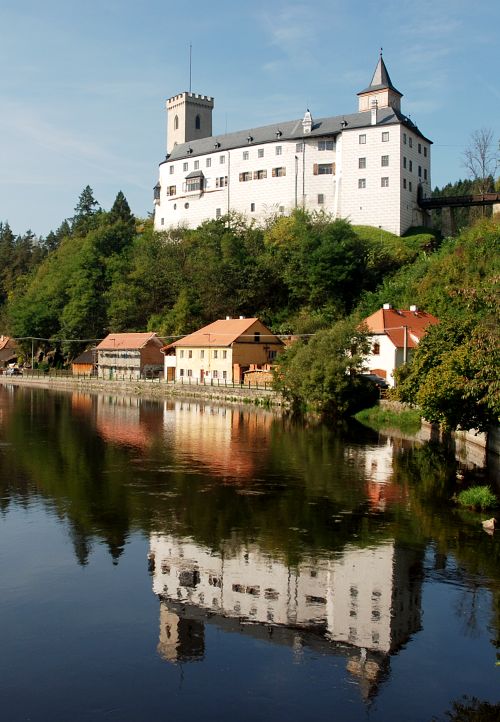
Waldenfels Castle
Waldenfels Castle, located in the Mühlviertel region of Upper Austria, stands as a significant example of a medieval castle complex that has evolved architecturally through the centuries. Situated just 500 meters south of the town of Reichenthal, this castle's origins date back to around 1290, when it was reportedly constructed by the brothers Heinrich and Eberhard von Wallsee. Though the first documentary mention of Waldenfels comes from 1380, when it was recorded as a fief under Duke Albert III, the castle's foundations reach deeper into the High Medieval period.
Historical development and ownership
The castle's ownership history reflects the complex feudal relationships of medieval Austria. After its initial mention in 1380, Waldenfels was purchased outright by Duke Albert III in 1390. Shortly thereafter, in 1396, the estate was pawned to the influential Starhemberg family, a prominent noble house in the region. The castle changed hands several times in the 15th century, passing to the Lower Austrian Plankensteiner family between 1449 and 1461. In 1461, Hans von Plankenstein transferred the property to Reinprecht von Polheim. A notable event occurred in 1474 when Waldenfels endured a siege led by Jaroslav Lev of Rosental, the Chief Steward of the Kingdom of Bohemia, alongside the outlawed Freistadt patrician Zinispan.
By the late 16th century, the castle was under the control of Joachim Stangel, who purchased it in 1584 from Emperor Rudolf II. The Stangel family maintained ownership until 1636, when Konstantin Grundemann von Falkenberg acquired the estate. Remarkably, the castle has remained in the Grundemann-Falkenberg family ever since. In the aftermath of World War II, Waldenfels served as a billet for approximately 700 Soviet soldiers, which inflicted considerable damage that required extensive repairs over the subsequent 12 years. The current owner is Dominik Grundemann-Falkenberg.
Architectural features and styles
Waldenfels Castle is a sprawling complex set on a gentle slope, featuring an irregular arrangement of buildings that blend medieval, Renaissance, and Baroque architectural elements. The castle's present-day appearance largely reflects renovations and additions from the early 17th century.
Courtyard and defensive structures
The castle is organized around a central courtyard which contains a well dated to 1702. This courtyard is bordered by two-story wings that feature arcaded galleries dating from the 16th century. Part of the courtyard's enclosure is a massive, square tower topped with a distinctive Baroque onion dome. Surrounding the courtyard is a crenellated wall that hints at the castle's defensive origins.
Residential and ceremonial spaces
The residential buildings are predominantly two stories high, with the main entrance marked by a stone portal that includes a smaller door alongside a larger gate. Above this portal, the coat of arms of the Counts Grundemann is prominently displayed, symbolizing the family's long-standing association with the castle. The medieval core of the castle was incorporated into these later expansions, preserving its original structure within the evolving complex.
Garden and ornamental features
On the southwestern side, the castle features a terrace known historically as the 'Tournament Court', dating from the 17th century. This area has been transformed into a garden enclosed by an arched wall, offering a peaceful contrast to the fortified sections of the castle. One of the castle's unique ornamental features is an artificial grotto located within one of the wings. This grotto contains stalactites and a carved female figure, showcasing the Baroque era's fondness for decorative and naturalistic elements.
Historical significance and cultural heritage
Waldenfels Castle is a valuable cultural landmark that illustrates the evolution of castle architecture in Upper Austria. Its layered construction reveals the transition from medieval fortifications to Renaissance residential comforts and Baroque stylistic flourishes. The castle's long history of ownership by notable noble families and its survival through sieges and wartime occupation contribute to its historical importance.
The castle's post-World War II use by Soviet troops and the subsequent restoration efforts underscore the challenges faced by heritage sites in maintaining structural integrity and historical authenticity. Today, Waldenfels Castle remains a private residence but stands as a testament to the region's medieval and early modern history.
Visiting waldenfels castle
While Waldenfels Castle is privately owned and not regularly open to the public, its exterior and surrounding grounds can be appreciated from nearby public areas. The castle's position on a gentle slope offers scenic views of the Mühlviertel landscape. Visitors interested in castle architecture and Austrian history will find Waldenfels a notable example of a complex that integrates multiple architectural periods.
Information
Loading map...
Visitor reviews
No reviews yet. Been here? Write the first review and help other travelers!
Write the first reviewVisited this castle? Share your experience
Your review helps other travelers and adds first-hand knowledge to our encyclopedia.