Rouelbeau Castle Ruins
Rouelbeau Castle ruins stand as a remarkable testament to medieval fortification and regional power struggles in the Swiss municipality of Meinier. Originally constructed in 1318 as a wooden stronghold by knight Humbert de Choulex, the castle was strategically positioned to secure the route of the lords of Faucigny toward the settlement of Hermance and to counter the influence of the expanding House of Savoy. Over the course of the 14th century, Rouelbeau evolved from its initial wooden form into a formidable stone castle, reflecting the shifting military and political realities of the late medieval period.
The castle's location on marshy terrain near the source of the Seymaz river necessitated innovative construction techniques, including the creation of an artificial earth mound to provide a stable foundation. This mound was formed using clay excavated from the site itself, demonstrating medieval engineering adapted to challenging landscapes. Surrounding the castle was a complex double moat system, parts of which still retain water today, offering a glimpse into the castle's original water defenses designed to repel attackers.
Historical context and strategic significance
Rouelbeau Castle's foundation in 1318 by the lords of Faucigny was part of a broader effort to fortify the region against the ambitions of the House of Savoy. The castle served as a key defensive outpost in the borderlands, with a small garrison manning the site during peacetime and a larger force during periods of conflict. Early records indicate that the castle was initially a wooden fortified house, which was typical for the period but vulnerable to siege and attack.
Between 1334 and 1339, the castle's defenses were significantly enhanced with the addition of an artificial mound and two moats. Subsequently, stone fortifications replaced or reinforced the wooden structures, likely under the ownership of Nicod de Ferney after 1345. This transition to stone construction marked a critical evolution in the castle's architecture, aligning with contemporary trends in military fortification during the late medieval period.
The castle's military role diminished after its conquest by Amadeus VI of Savoy in 1355, which integrated the castle firmly into the County of Savoy. Following this, Rouelbeau was repurposed as a prison and later, from the early 15th century, served as a hunting lodge for the Genève-Lullin family. The castle sustained damage during the religious conflicts of the 16th century, particularly in 1536 amid the Protestant Reformation and Geneva's struggle for independence. Despite this, the site remained under the control of baronial owners after being reclaimed from the city of Geneva in 1564.
Architectural features and layout
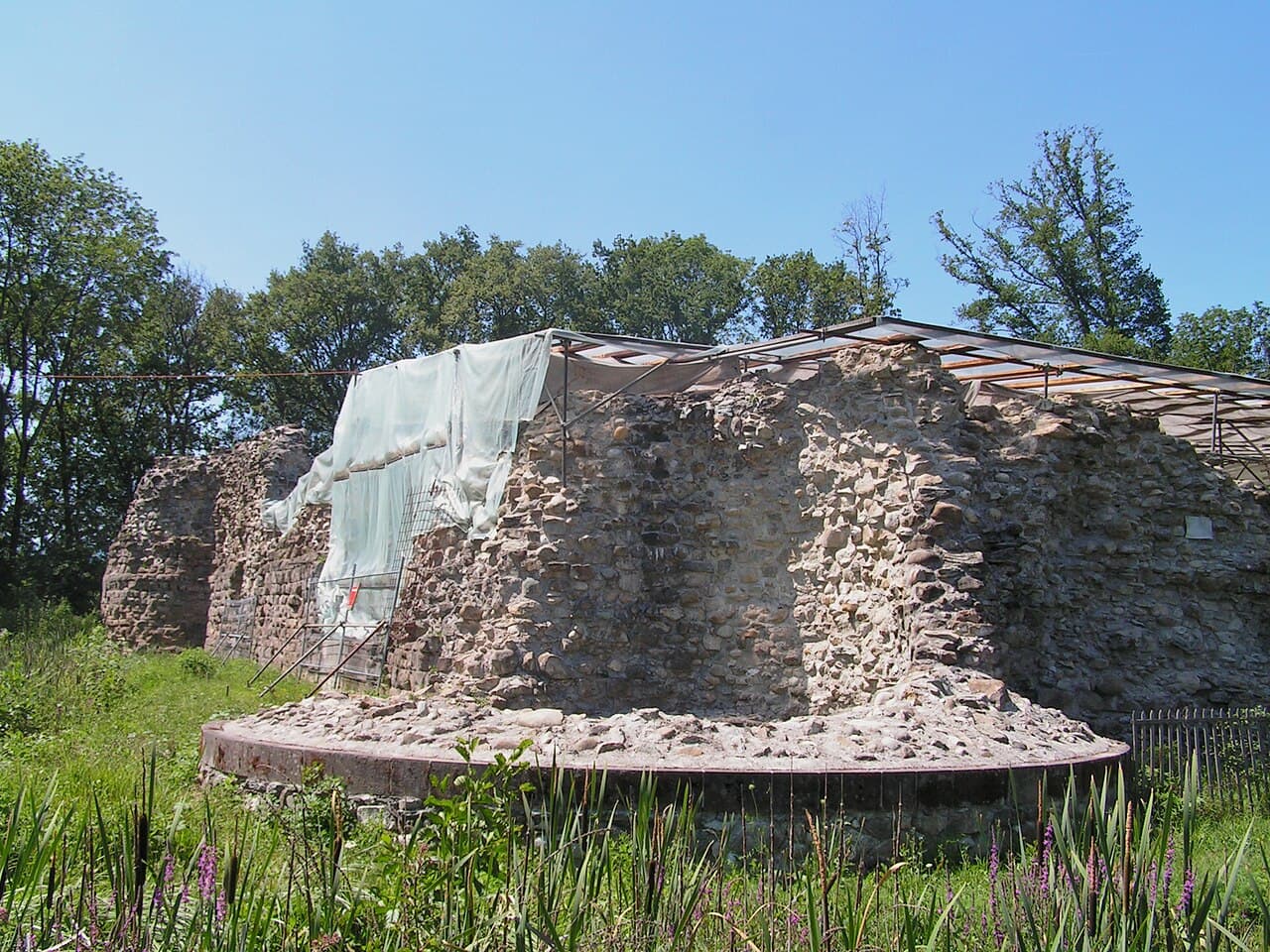
The castle's ruins reveal a roughly rectangular footprint measuring approximately 52 by 39 meters. The defensive perimeter was defined by four circular corner towers, each about nine meters in diameter with walls approximately 2.3 meters thick, designed to withstand assaults and provide vantage points for defenders. The main entrance was guarded by a rectangular gate tower, controlling access to the interior courtyard.
The transition from wood to stone construction between 1339 and 1355 involved the use of molasse sandstone, a soft regional stone, for the walls. Interestingly, some of the masonry incorporates embedded cannonballs, which may have been repurposed from military engagements or served as additional defensive reinforcement. Large sections of these stone walls remain visible, including parts of the main gate and foundations of two corner towers, offering valuable insights into medieval construction techniques and defensive design.
Moats and earthworks
The castle's double moat system was a critical defensive feature. The moats, fed by the nearby Seymaz river source, created a formidable barrier against attackers. Remnants of these moats persist, with some areas still holding water, allowing visitors to appreciate the castle's original strategic use of natural and artificial water defenses.
Interior structures and archaeological findings
Within the castle's enclosure, the earliest structure was a wooden fortified house surrounded by wooden palisades. Archaeological excavations conducted between 2001 and 2014 uncovered a wealth of artifacts that illuminate the castle's varied history. Among the finds was a lead-sealed papal bull issued by Pope Innocent IV, underscoring the site's connection to broader medieval ecclesiastical networks.
Other notable artifacts include fragments of lead-glazed ceramic jugs decorated with chevron patterns, coins, and a ceramic hunting horn, which testify to the castle's later use as a noble residence and hunting lodge. These discoveries provide a tangible link to the daily life and social status of the castle's inhabitants across centuries.
Cultural significance and preservation
Beyond its historical and architectural importance, Rouelbeau Castle is embedded in local folklore. Legends of a "White Lady" ghost and a mysterious "Black Cat" apparition linked to witchcraft accusations from 1567 enrich the cultural heritage of the site, attracting visitors interested in both history and legend.
Recognized as a monument of national importance in 1921, the ruins have been carefully preserved and protected. Excavations have been covered with layers of sand and earth to safeguard the delicate remains. Modern technologies, including drone surveys and 3D virtual reconstructions, have enhanced understanding and public engagement with the site.
Visitors today can explore the ruins via a designated trail that guides them through the castle's defensive architecture and historical phases. Interpretive materials help contextualize the castle within the broader narrative of medieval fortifications and regional power dynamics in Switzerland.
Frequently asked questions (FAQ)
- When was Rouelbeau Castle originally built and by whom?
- Rouelbeau Castle was originally built in 1318 by knight Humbert de Choulex, a vassal of the lords of Faucigny, as a wooden fortified house.
- What architectural features characterize Rouelbeau Castle?
- The castle featured four circular corner towers, a rectangular gate tower, a double moat system, and stone walls constructed from molasse sandstone, reflecting late medieval defensive design.
- What is the historical significance of Rouelbeau Castle?
- Rouelbeau played a strategic role in the border conflicts between the lords of Faucigny and the House of Savoy, later serving as a prison and hunting lodge after its conquest by Savoy in 1355.
- Are there any legends associated with Rouelbeau Castle?
- Local folklore includes tales of a 'White Lady' ghost and a 'Black Cat' apparition linked to witchcraft accusations from the 16th century, adding cultural intrigue to the site.
- Can visitors explore the ruins today?
- Yes, visitors can follow a designated trail around the ruins, which highlights the castle's defensive structures and provides educational insights into its history and architecture.
Photo gallery

Information
Website
Visit websiteSources & official resources
Verify the information above using these authoritative references.
Loading map...
Visitor reviews
No reviews yet. Been here? Write the first review and help other travelers!
Write the first reviewVisited this castle? Share your experience
Your review helps other travelers and adds first-hand knowledge to our encyclopedia.