Rotštejn Castle
Rotštejn Castle stands as a remarkable example of a medieval rock castle in the Czech Republic, located near the village of Rotštejn-Turnov. Established in the mid-13th century, this fortress uniquely blends natural sandstone formations with traditional masonry, reflecting the architectural ingenuity of Bohemian noble families during the High Medieval period. Founded by Jaroslav of Hrutwice for his son Vok of Rotštejn shortly after 1250, the castle exemplifies the strategic use of the region's distinctive geology to create defensible living spaces.
The origins and historical significance of Rotštejn Castle
The castle's foundation by the Markvartic family situates it within the broader context of Bohemian noble power structures in the 13th century. Jaroslav's role as a prominent nobleman and the construction of Rotštejn for his son highlight the familial strategies of territorial control and defense. The connection to the nearby Valdštejn Castle, established by Jaroslav's other son Zdeněk, underscores the intertwined heritage of these fortresses and their importance in regional governance.
Throughout the early 14th century, Rotštejn remained under the stewardship of the Rotštejn family, notably under Vok II. This era was characterized by frequent local conflicts, with the castle and its estates enduring raids by neighboring nobles. The significant assault in 1318 by a coalition of 152 nobles marks a turbulent chapter in the castle's history, evidencing its strategic and symbolic importance. Despite such attacks, the Rotštejn family maintained possession well into the mid-14th century, with Ješek of Rotštejn securing imperial privileges from Emperor Charles IV in 1360, including the right to hold weekly markets in Klokočí, which enhanced the castle's economic and administrative role.
Rotštejn Castle during the Hussite Wars and decline
The early 15th century brought profound changes as ownership shifted to Ondřej or Vaněk Paldra of Vařin around 1415, coinciding with the Hussite Wars. Conflicting accounts suggest the castle may have been captured or damaged by Hussite forces circa 1426, but evidence indicates it remained partially intact, with Vaněk residing nearby in Klokočí after 1430. This resilience amid conflict illustrates the castle's enduring strategic value despite the era's upheavals.
Following the wars, natural erosion of the sandstone formations began to undermine the castle's structural integrity. By 1514, contemporary records describe Rotštejn as deserted and dilapidated, with walls collapsed and stones scattered, a state confirmed in 1540. The castle ceased to function as a noble residence or military stronghold, transitioning from a center of feudal power to a ruin shaped by natural forces.
Architectural features and the unique rock castle design
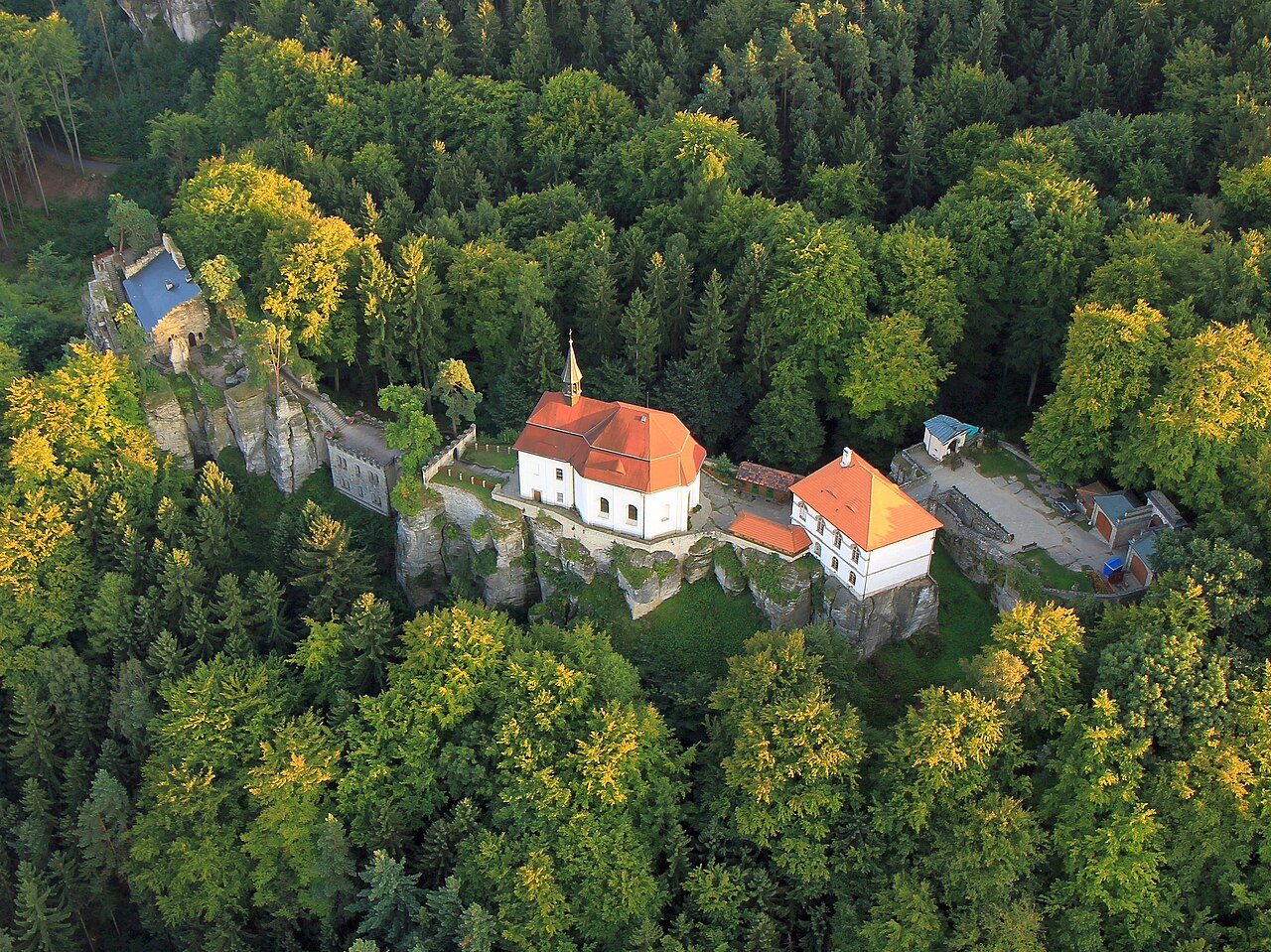
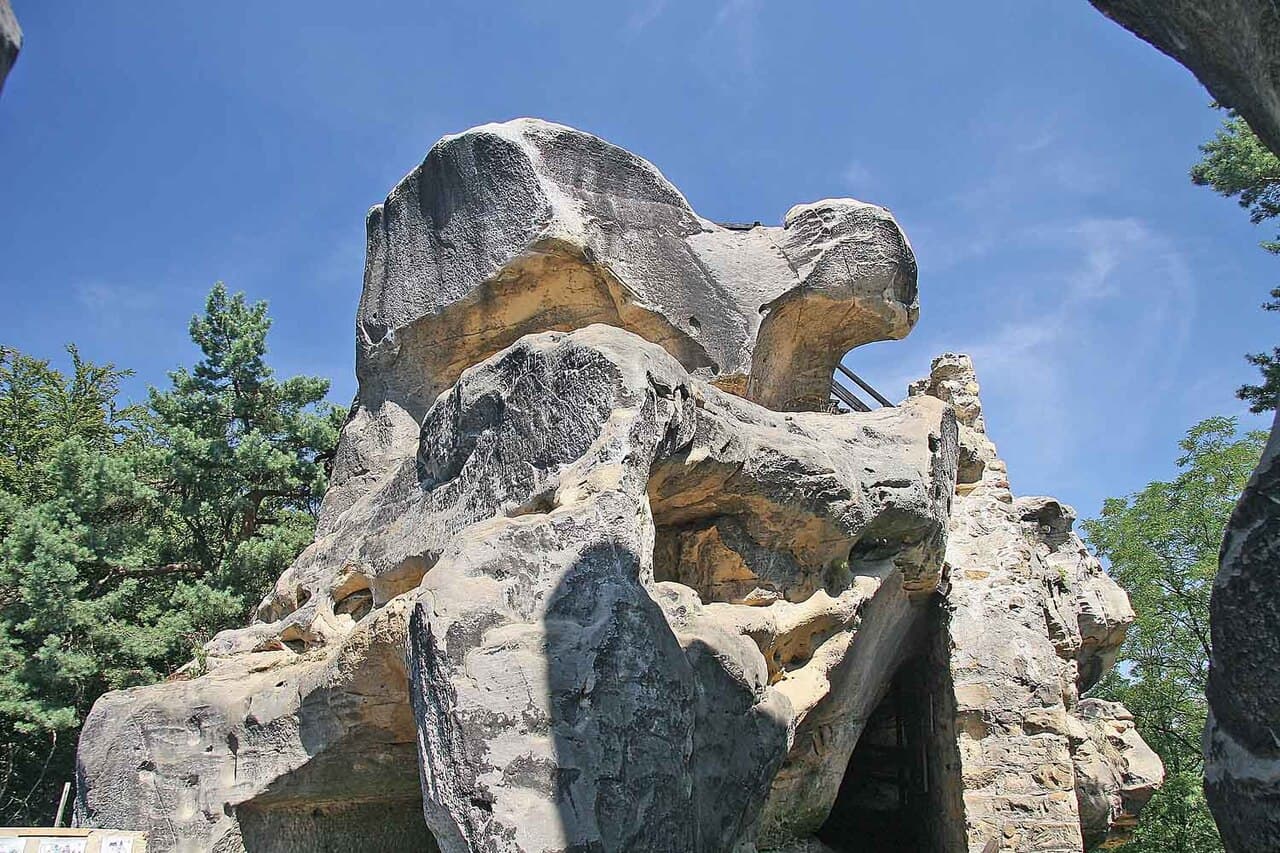
Rotštejn Castle's construction typifies the rock castle style prevalent in Bohemia, where builders integrated natural sandstone outcrops into the defensive and residential structures. The castle's layout combined carved rock chambers and stone masonry, with defensive elements such as gates, bridges, and bastions harmoniously incorporated into the landscape. Although no complete buildings survive, the remaining fragments of walls and sandstone formations reveal the castle's original spatial configuration.
One prominent sandstone rock opposite the accessible area once supported the castle's tower, a critical feature for defense and observation. Nearby, a rock with a natural window formed by erosion likely served as a vantage point or provided light and ventilation to adjacent structures. The presence of a half-timbered guardhouse is inferred from the site layout, though wooden elements have long since disappeared.
Preservation efforts and current status
Since 1988, a voluntary group named Protection of Klokočské Rocks, led by castellan H. T. Hlubučková, has spearheaded preservation activities to protect the castle ruins and the surrounding natural environment. Wooden walkways and paths have been sensitively installed to allow visitors safe access to the castle summit without damaging the fragile sandstone formations or remaining masonry.
Today, Rotštejn Castle serves not only as a historical monument but also as an educational site within the Klokočské Rocks nature reserve. Its evocative ruins and rock formations offer insight into medieval Bohemian fortification techniques and the interplay between human construction and natural geology. Despite the absence of significant archaeological artifacts, the site remains a compelling testament to the region's medieval heritage and architectural adaptation.
The castle’s role in local history and economy
The castle's historical role extended beyond military defense to include administrative and economic functions. The market rights granted by Emperor Charles IV in 1360 to Ješek of Rotštejn emphasized the castle's importance in local governance and commerce. The nearby village of Klokočí, benefiting from these market privileges, likely grew in tandem with the castle’s influence.
During the 17th century and the Thirty Years’ War, the castle's ruins and exposed rock cavities became shelters for local inhabitants, marking a shift from feudal fortress to community refuge. This adaptive reuse illustrates the dynamic relationship between the castle site and the surrounding population over centuries.
Exploring the site today
Visitors to Rotštejn Castle can explore the rugged sandstone formations and partial ruins that define the site. The wooden walkways facilitate safe passage through the rocky terrain, allowing close observation of the castle's unique integration with its natural environment. Interpretive signage and educational programs provide context about the castle’s history, architecture, and the ecological significance of the Klokočské Rocks.
While the castle no longer stands as a complete structure, its remains offer a vivid glimpse into medieval castle construction adapted to challenging geological conditions. The site attracts historians, architects, and nature enthusiasts interested in the intersection of cultural heritage and natural landscapes.
Frequently asked questions (FAQ)
- When was Rotštejn Castle built and by whom?
- Rotštejn Castle was built shortly after 1250 by Jaroslav of Hrutwice for his son Vok of Rotštejn, members of the noble Markvartic family.
- What is unique about Rotštejn Castle's architecture?
- Rotštejn Castle is a rock castle that integrates natural sandstone formations into its defensive and residential structures, a typical medieval Bohemian design.
- Is Rotštejn Castle accessible to visitors today?
- Yes, wooden walkways and paths have been installed since 1988 to allow safe visitor access to the castle ruins within the Klokočské Rocks nature reserve.
- What happened to Rotštejn Castle during the Hussite Wars?
- The castle may have been captured or damaged by Hussite forces around 1426, but it remained partially intact and was still usable after 1430.
- Why is Rotštejn Castle historically significant?
- Rotštejn Castle played a key role in local medieval administration and defense, with its owners securing market rights and enduring significant conflicts in Bohemia's history.

Information
Sources & official resources
Verify the information above using these authoritative references.
Loading map...
Visitor reviews
No reviews yet. Been here? Write the first review and help other travelers!
Write the first reviewVisited this castle? Share your experience
Your review helps other travelers and adds first-hand knowledge to our encyclopedia.