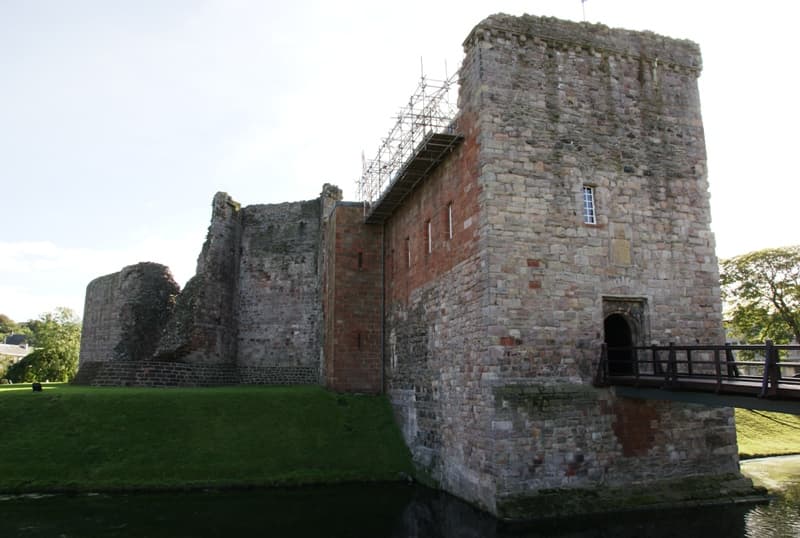
Rothesay Castle ruins stand as one of Scotland's most remarkable medieval fortifications, renowned for their unusual circular design and extensive history dating back to the early 13th century. Situated in the town of Rothesay on the Isle of Bute, this castle was a key stronghold and royal residence for the influential Stewart family, reflecting the evolution of Scottish military architecture and royal power over several centuries.
Originally constructed as a wooden fortification by either Alan, High Steward of Scotland (d. 1204) or his son Walter Stewart (d. 1246), Rothesay Castle was soon rebuilt in stone with a distinctive circular curtain wall by the 1230s. This curtain wall, approximately 43 meters across and 3 meters thick, was built on a low mound and constructed of finely coursed ashlar sandstone. Its design included a battlemented parapet accessed by open stairs and was surrounded by a broad moat connected to the sea, which provided a formidable natural defense.
Early history and norse sieges
Throughout the 13th century, Rothesay Castle played a strategic role in the ongoing conflicts between the Scots and the Norse. It endured two significant sieges by Norwegian forces: the first in the 1230s led by Uspak, possibly a descendant of Somerled, and the second in 1263 under King Haakon IV. The Saga of Haakon Haakonsson offers the earliest recorded account of a Scottish castle siege, describing a three-day battle where the Norsemen used axes to breach part of the eastern wall. Despite these assaults, the castle remained a resilient stronghold, symbolizing Scottish resistance and the consolidation of Stewart power following the Treaty of Perth in 1266, which formally ended Norse claims to the region.
Architectural development and fortifications
In response to military threats, the castle's defenses were enhanced in the late 13th century by adding four robust round towers at cardinal points around the curtain wall. These three-storey towers featured strong splayed bases to deflect attacks and narrow arrow slits beneath crenellated parapets, allowing defenders to cover all approaches effectively. The main gate was fortified with a portcullis, and a small postern gate provided a secondary, later-blocked, exit.
The castle's curtain wall was raised to about ten meters in height during the early 16th century under the reigns of James IV and James V, reflecting advances in siege warfare and the need for stronger defenses. Around this time, a new gatehouse keep was constructed, extending north from the curtain wall. This L-plan forework included a vaulted entrance tunnel with a drawbridge over the moat, royal lodgings spanning four stories, and facilities such as a porter’s lodge and prison cell, illustrating the castle's dual role as a fortress and royal residence.
Role in scottish history and royal residence
Rothesay Castle was deeply intertwined with Scottish royal history. During the Wars of Scottish Independence, it changed hands multiple times, captured by Robert the Bruce in 1311 and briefly retaken by the English in 1334. Following the Stewarts' ascension to the Scottish throne in 1371, the castle became a favored residence for kings Robert II and Robert III, the latter dying within its walls in 1406.
From 1401, the title Duke of Rothesay was bestowed upon the heir apparent to the Scottish throne, establishing the castle as a symbol of royal succession. The castle also withstood a notable siege in 1462 by John of Islay, Earl of Ross and Lord of the Isles, underscoring its ongoing military significance.
16th to 17th century military and residential changes
The 16th century saw further enhancements, including the construction of a chapel dedicated to St. Michael within the castle courtyard, measuring approximately 6 by 9 meters. This chapel featured a piscina and wall cupboard, reflecting the religious practices of the castle's inhabitants. The north-west tower was converted into a doocot (pigeon tower), with nest boxes built into the exterior walls, a feature that survives today.
Despite its fortifications, Rothesay Castle experienced military occupation during the Wars of the Three Kingdoms and was garrisoned by Oliver Cromwell's forces in the 1650s. Upon their withdrawal in 1660, parts of the castle were deliberately dismantled to prevent further military use. Subsequently, in 1685, supporters of Archibald Campbell, 9th Earl of Argyll, set fire to the castle during a rebellion against King James VII, leaving it largely in ruins.
Restoration and modern preservation
After centuries of neglect, restoration efforts began in the early 19th century under the direction of the 2nd Marquess of Bute, who employed workers to clear debris and excavate the site. More extensive repairs and restorations were carried out by the 3rd Marquess of Bute in the late 19th century, guided by architect William Burges. These works included stabilizing the ruins, restoring the moat, reconstructing the great hall in the gatehouse, and rebuilding the pigeon tower after its partial collapse in 1937.
In 1961, Rothesay Castle was entrusted to the care of the state and is now managed by Historic Environment Scotland. The site is open to visitors year-round, offering panoramic views from the battlements over the town of Rothesay and the surrounding Firth of Clyde, making it a significant cultural and historical landmark.
Architectural features and layout
The castle’s roughly circular curtain wall encloses an inner courtyard and is punctuated by four round towers at the northwest, northeast, southeast, and southwest points. The north-west tower, the largest, served as private chambers and later as a pigeon house. The northeast tower is the best preserved, while the southeast and southwest towers survive only in part.
The gatehouse forework projects northward from the curtain wall and is notable for its L-shaped plan. It contains a vaulted entrance passage with a drawbridge, royal apartments spanning four stories, and defensive features such as a portcullis and murder holes. The royal coat of arms above the main door signifies its status as a residence for Scottish monarchs.
Within the courtyard, archaeological evidence reveals the locations of former wooden buildings including stables and a smithy, illustrating the castle's role as a self-sufficient stronghold. The chapel dedicated to St. Michael remains the only intact internal structure within the curtain walls.
Surrounding the castle is a broad moat, historically linked to the nearby sea, which served as a key defensive feature. Restoration has preserved the moat’s shape and the castle’s imposing silhouette, allowing visitors to appreciate its strategic design and historic significance.
Frequently asked questions (FAQ)
- How do I get to Rothesay Castle Ruins?
- Rothesay Castle Ruins is located in Rothesay, on the Isle of Bute. Visitors can reach the castle by taking a ferry from Wemyss Bay, which offers regular services. Once in Rothesay, the castle is a short walk from the ferry terminal, making it easily accessible for all visitors.
- What is the historical significance of Rothesay Castle?
- Rothesay Castle dates back to the 13th century and is one of the earliest stone castles in Scotland. It served as a royal residence and a stronghold for the Stewart family. Its well-preserved structure gives insight into medieval Scottish architecture and the region's history.
- When was Rothesay Castle built?
- Construction of Rothesay Castle began in the late 13th century, with significant modifications made in subsequent centuries. The castle played a crucial role during the Wars of Scottish Independence. Today, visitors can explore its ruins, which still reflect its historical grandeur.
- Can I enter Rothesay Castle Ruins?
- Yes, visitors can explore the ruins of Rothesay Castle. While some areas may be restricted due to safety concerns, the main features of the castle are accessible to the public. Be sure to respect the site and follow any guidelines provided by the staff.
- Why is Rothesay Castle a popular tourist attraction?
- Rothesay Castle is popular due to its rich history and stunning location overlooking the water. Visitors are drawn to its unique architectural features and the panoramic views it offers. The castle's historical significance and picturesque setting make it a must-see for history enthusiasts and photographers alike.
- Is it possible to visit Rothesay Castle year-round?
- Yes, Rothesay Castle Ruins is open to visitors year-round, although opening hours may vary seasonally. It is advisable to check the local tourism website for the most accurate information on opening times. The castle can be particularly enchanting during the spring and summer months when the surrounding gardens are in full bloom.
- What are the ticket prices for visiting Rothesay Castle?
- Entry to Rothesay Castle Ruins is free, making it an excellent option for budget-conscious travelers. Donations to help with the preservation of the site are appreciated, though not mandatory. This accessibility allows visitors to enjoy the rich history without financial barriers.
- What is the best time to visit Rothesay Castle?
- The best time to visit Rothesay Castle is during the spring and summer months when the weather is typically mild and the gardens are vibrant. This period also allows for longer daylight hours, enhancing your exploration of the ruins. Autumn can also be a lovely time to visit, with beautiful fall foliage surrounding the castle.
- Are there any nearby attractions to Rothesay Castle?
- Yes, there are several attractions near Rothesay Castle, including the Victorian Toilets and Rothesay Pavilion, which are both within walking distance. Additionally, the Isle of Bute offers beautiful coastal walks, gardens, and local shops. Visitors can easily spend a full day enjoying the rich culture and scenic beauty of the area.
Photo gallery

Information
Website
Visit websiteSources & official resources
Verify the information above using these authoritative references.
Loading map...
Visitor reviews
No reviews yet. Been here? Write the first review and help other travelers!
Write the first reviewVisited this castle? Share your experience
Your review helps other travelers and adds first-hand knowledge to our encyclopedia.


