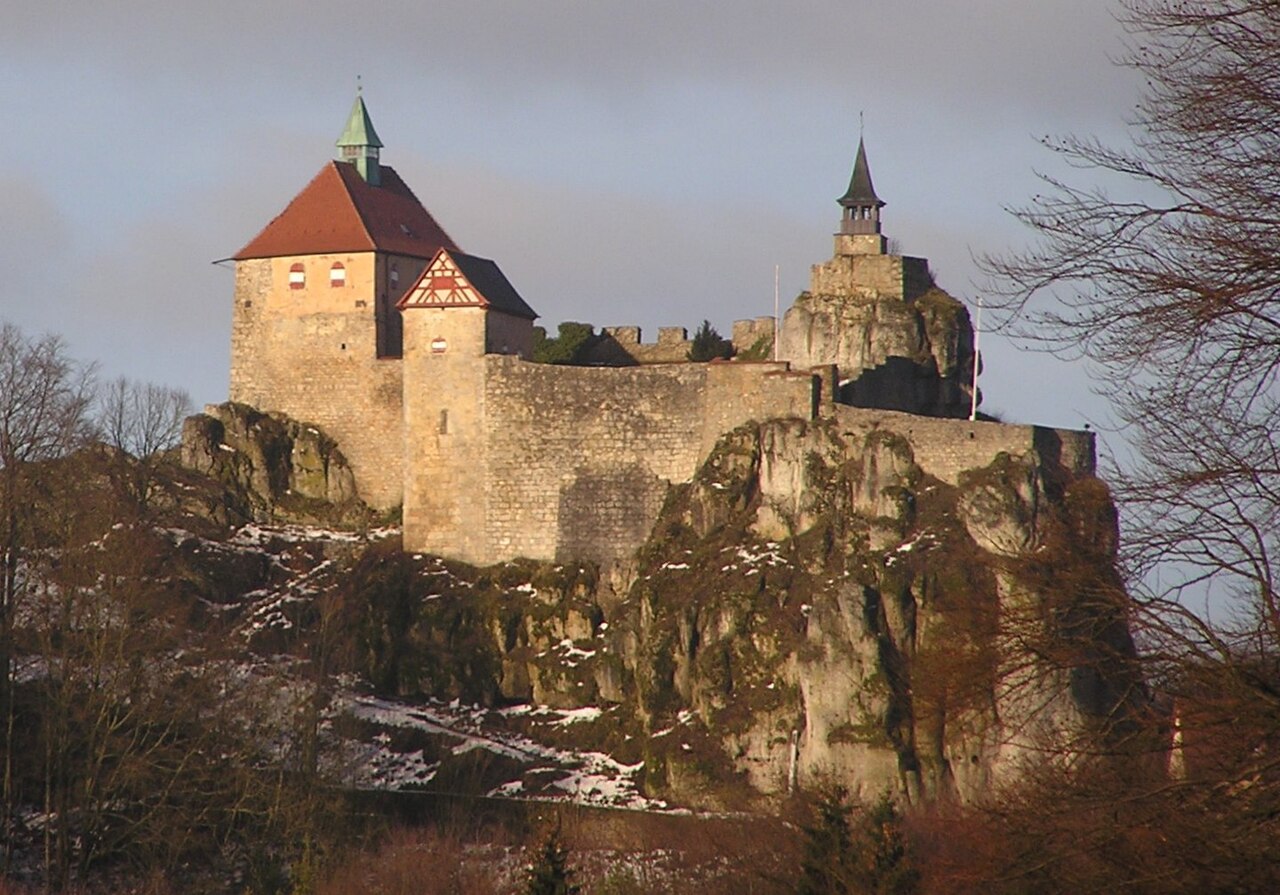
Rothenberg Fortress
Rothenberg Fortress stands prominently on its eponymous hill at 588 meters above sea level near Schnaittach in the Franconian Jura, Germany. This imposing hill castle combines medieval origins with an impressive 18th-century bastion fortification, reflecting centuries of military architecture and regional power struggles. Built primarily of brickwork, the fortress rises 16 meters high on all sides, featuring vaulted interiors reaching 10 meters, and showcases a polygonal star-shaped design typical of late medieval to early modern fortresses inspired by French military engineering.
Historical development and strategic importance
The site of Rothenberg Fortress has a long history of settlement, dating back to around 600 BCE when Celtic Hallstatt tribes established an oppidum, a fortified settlement. The earliest medieval fortification, known as Alter Rothenberg, was first recorded in 1254 as the residence of the lords of Rothenberg. This noble family died out by the late 13th century, after which the castle was likely destroyed during local conflicts.
Between 1300 and 1330, a new castle was constructed by Dietrich von Wildenstein on a different hill, marking the beginning of the fortress as it is known today. In 1360, the castle was acquired by Emperor Charles IV, who expanded it to serve as a border fortress protecting his Bohemian allodial estate, Neuböhmen. This imperial possession grew in significance, with a settlement developing outside the fortress walls that included a church, parish, cemetery, and fortified town walls with 26 towers.
Throughout the 15th and 16th centuries, Rothenberg Fortress was a focal point of regional power struggles. It was besieged and captured in 1401 by King Rupert of the Palatinate and Nuremberg and suffered destruction during the First Margrave War (1449–1450). The town was not rebuilt after this conflict, and its inhabitants relocated to nearby Schnaittach.
In 1478, Count Palatine Otto II transformed the fortress into a Ganerbenburg, a jointly owned castle with initially 44 co-heirs, later increasing to 133 noble families. This unique ownership structure led to the fortress being nicknamed the "wasp's nest" due to the complex alliances and conflicts among the co-heirs. The fortress adopted Lutheranism in 1529 but was forcibly re-Catholicized during the Thirty Years' War under Bavarian Elector Maximilian. Eventually, the co-heirs sold the fortress to Bavaria for 200,000 gulden.
18th-century reconstruction and architectural features
After Bavaria acquired the fortress in 1698, it underwent significant renovations and reinforcements. Between 1720 and 1743, Elector Charles Albert of Bavaria, later Emperor Charles VII, commissioned the construction of the current Rococo-style fortress on the ruins of earlier fortifications. This reconstruction followed French bastion fort design principles, resulting in a star-shaped polygonal layout with bastioned towers at each corner to eliminate blind spots and improve defensive capabilities.
The fortress walls, built entirely of brick, stand 16 meters tall with vaulted interiors 10 meters high. The rampart crown is deliberately kept low to minimize exposure to enemy fire. The northern defenses include a gently sloping glacis, a covered way, a moat, and a main rampart barely higher than the glacis, making the fortress difficult to shell effectively. Natural slopes protect the south, east, and west sides, although these did not fully shield the fortress from the era's powerful siege artillery.
Inside the fortress, two two-story barrack buildings housed the garrison, alongside an armory, engineer's house, gatehouse, commandant's quarters, and a church. The garrison, which sometimes numbered up to 400 soldiers, lived here with their families. Bastions were named after Charles Albert, his wife Maria Amalia, the nearby Glatzenstein hill, and the towns of Kersbach, Nuremberg, and Schnaittach.
Water supply and infrastructure
Water supply was a critical challenge for Rothenberg Fortress. Despite nearby natural springs, the fortress relied on a deep well tapping groundwater since its earliest construction. From 1760, a sophisticated system called the Schneckenbrunnen (Snail Well) was built, featuring a 40-meter-long collection tunnel, a draw well shaft, and a helical staircase for monitoring water levels. This well was protected by a counterguard named after Max Joseph, constructed of rubble stone outside the main walls. Although a planned underground passage connecting the well to the fortress was never completed, the system ensured a reliable water supply during sieges.
After abandonment, the well system was filled in but restored between 1987 and 1989. It now supplies about 4,000 liters of water weekly. Excavations have uncovered artifacts such as a gold ducat coin, a stiletto, harmonicas, stone marbles, charred bricks, knives, ceramic fragments, forged nails, and a barrel hoop, providing insights into the daily life and military history of the fortress.
Military history and decline
Rothenberg Fortress was built primarily to counter the influence of the imperial city of Nuremberg, located only 25 kilometers away. It served as a strategic border fortress guarding the Bavarian border and the Electoral Bavarian enclave near Schnaittach. During the War of Spanish Succession in 1703, the fortress was besieged and surrendered due to supply shortages.
It successfully resisted Austrian attempts to capture it during the War of Austrian Succession (1740–1744) and remained neutral during the Franconian Circle's involvement. The fortress also supplied arms to defenders during this period. From 1793 to 1806, during the Coalition Wars, it was used by passing troops from France, Austria, and Bavaria but saw no active combat.
Following the dissolution of the Holy Roman Empire and the incorporation of Franconia into the Kingdom of Bavaria in 1806, Rothenberg lost its strategic importance as a border fortress. It was repurposed as a prison and veterans' home with a reduced garrison. However, maintenance declined due to water damage and structural issues.
In 1838, the Bavarian Minister of War officially decommissioned the fortress, selling off its entire inventory, including doors, beams, and other removable materials. The fortress was abandoned and fell into ruins, with stones quarried for the construction of Nuremberg Central Station. In 1876, explosive demolition testing was conducted on the ravelin, further damaging the site.
Preservation and current status
Despite its decline, Rothenberg Fortress remains a significant historical and architectural monument. Preservation efforts began in 1898 by a local heritage association, and a major restoration was completed in 2008. The site is now accessible to the public through guided tours, although the underground casemates are closed from November to April to protect bat populations.
Visitors can explore the fortress ruins, including the well-preserved bastions, barracks, armory, and church foundations. South of the fortress lies a cemetery containing 1,083 burials, used from 1740 to 1843 and restored in 1927, with surviving gravestones relocated to the current site.
Today, Rothenberg Fortress is valued not only for its military and architectural heritage but also as a cultural landmark illustrating the complex history of Franconia and Bavaria. Its combination of medieval origins, Renaissance transformations, and Rococo bastion fortifications makes it a unique example of evolving castle architecture and regional defense strategies over several centuries.
Frequently asked questions (FAQ)
- How do I get to Rothenberg Fortress?
- Rothenberg Fortress is located in Schnaittach, Germany, and is accessible by car or public transportation. If driving, take the A9 motorway and follow the signs to Schnaittach. For public transport, check local train schedules for connections to Schnaittach station, followed by a short walk to the fortress.
- What is the historical significance of Rothenberg Fortress?
- Rothenberg Fortress dates back to the 13th century and was built to protect the trade routes in the region. It played a crucial role in the defense strategies of the Holy Roman Empire. The fortress has witnessed numerous historical events and is a testament to medieval military architecture.
- When was Rothenberg Fortress constructed?
- Construction of Rothenberg Fortress began in the early 1200s, with significant expansions occurring over the following centuries. Its strategic position was chosen for its vantage point over the surrounding landscape, allowing for effective defense against invaders. The fortress remains a well-preserved example of medieval fortifications.
- Can I tour Rothenberg Fortress?
- Yes, visitors can take guided tours of Rothenberg Fortress, which provide insights into its history and architecture. Tours are available in multiple languages, enhancing the experience for international guests. It's recommended to check the official website for tour availability and times.
- Why is Rothenberg Fortress an important architectural site?
- Rothenberg Fortress showcases a blend of Romanesque and Gothic architectural styles, making it a significant example of medieval military design. Its well-preserved towers, walls, and gates offer a glimpse into the engineering techniques of the time. The fortress has also been recognized for its historical value and is a popular site for architecture enthusiasts.
- Is it possible to visit Rothenberg Fortress year-round?
- Yes, Rothenberg Fortress is open to visitors year-round, although hours may vary seasonally. It's advisable to check the official site for the most current opening hours and any seasonal events that might enhance your visit. Some areas may be restricted during winter months due to weather conditions.
- What are the ticket prices for Rothenberg Fortress?
- Ticket prices for Rothenberg Fortress are typically modest, with discounts available for children, students, and seniors. Admission fees contribute to the maintenance and preservation of the site. For the most accurate pricing, it’s best to refer to the official fortress website before your visit.
- What is the best time to visit Rothenberg Fortress?
- The best time to visit Rothenberg Fortress is during the spring and early autumn when the weather is mild and pleasant. These seasons also feature fewer tourists, allowing for a more intimate experience. Additionally, consider visiting during local festivals for a unique cultural experience.
- Are there any nearby attractions to Rothenberg Fortress?
- Yes, the area surrounding Rothenberg Fortress offers several attractions, including the charming town of Schnaittach, known for its half-timbered houses and local shops. Nearby hiking trails provide beautiful views of the Bavarian countryside. Be sure to explore the local restaurants that offer traditional German cuisine.
Information
Website
Visit websiteSources & official resources
Verify the information above using these authoritative references.
Loading map...
Visitor reviews
No reviews yet. Been here? Write the first review and help other travelers!
Write the first reviewVisited this castle? Share your experience
Your review helps other travelers and adds first-hand knowledge to our encyclopedia.