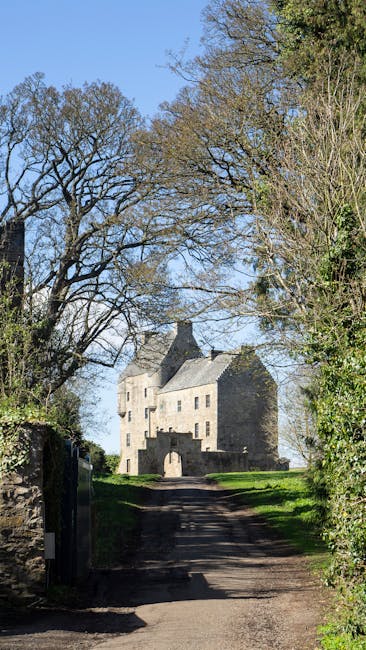
Rosyth Castle
Rosyth Castle stands as a notable example of a late medieval tower house in Scotland, located on the outskirts of Rosyth Naval Dockyard in Fife. Constructed around 1450 by Sir David Stewart, who was granted the Barony of Rosyth in 1428, the castle originally occupied a small island in the Firth of Forth. This tidal island setting made the castle accessible only at low tide, providing a natural defensive advantage against potential attackers. The castle's strategic location on the northern shore of the firth underscored its military and residential importance during the turbulent late medieval period.
Construction and architectural features
The core of Rosyth Castle is its stone tower house, rising approximately 17.4 meters (58 feet) tall. This tower was built with thick stone masonry walls designed to offer both secure living quarters and formidable defense. The tower's architecture reflects typical Scottish tower house characteristics of the 15th century, including narrow windows for defense and battlemented parapets. Around the tower, a courtyard complex was developed, enclosed by defensive walls and supplemented by ancillary buildings serving residential and service functions.
Throughout the 16th and early 17th centuries, the castle underwent significant enlargements and extensions. These expansions included the addition of courtyard buildings and fortifications that enhanced the castle's defensive capabilities and residential comfort. The surviving northern courtyard wall is a key remnant of this extended complex, illustrating the castle's evolution from a solitary tower to a fortified residence with enclosed grounds.
Historical significance and military events
Rosyth Castle played a role in several notable military events during Scotland's history. In 1572, the castle was attacked by forces from Blackness Castle on the southern shore of the Firth of Forth, reflecting the ongoing regional conflicts of the period. Later, in 1651, the castle was occupied by Oliver Cromwell's army following the Battle of Inverkeithing, a key engagement in the Wars of the Three Kingdoms. These events underscore the castle's strategic importance controlling access across the firth and its involvement in wider political and military struggles.
Ownership and decline
Rosyth Castle remained in the hands of the Stewart family until the late 17th century, when it was sold to David Drummond of Invermay. Subsequently, ownership passed to the Earl of Hopetoun. From the 18th century onward, the castle was gradually abandoned. The courtyard buildings were mostly dismantled, and much of the stonework was repurposed in local construction, a common fate for many Scottish castles that lost their residential use. This dismantling left only the main tower and a section of the northern courtyard wall standing above ground level.
20th-century changes and current condition
In 1903, the British Admiralty acquired the castle and its surrounding land for the development of Rosyth Naval Dockyard. Extensive land reclamation altered the castle's original island setting by connecting it to the mainland and embedding it within the dockyard's industrial landscape. Although restoration plans were proposed during the 20th century, none were fully executed. Instead, the ruins were stabilized to ensure safety while preserving their historic fabric. Today, the castle remains a ruined tower house within a restricted dockyard environment and has passed into private ownership following the sale of parts of the dockyard.
Associated structures: the dovecot
Approximately half a mile north of Rosyth Castle lies a well-preserved 16th-century dovecot, an ancillary structure historically used for housing pigeons or doves. This dovecot features crow-stepped gables, a distinctive Scottish architectural element characterized by stepped edges along the roofline. At two corners, carved heads provide decorative detail, enhancing the building's historic character. Inside, the dovecot boasts a barrel-vaulted ceiling, a curved arch design that adds both strength and aesthetic appeal. Both the castle and dovecot were once designated as Category A listed buildings, reflecting their cultural importance, though this status was removed in 2016. They remain protected as Scheduled Monuments, recognizing their archaeological and historical significance.
Cultural and heritage significance
Rosyth Castle is an important example of a Scottish late medieval tower house that illustrates the architectural evolution and military history of the region. Its location on a tidal island in the Firth of Forth highlights the strategic considerations of castle builders in the 15th century. Despite its ruined state, the castle provides valuable insights into the defensive design and residential arrangements of Scottish nobility during the late medieval and early modern periods. The survival of the dovecot adds to the understanding of estate management and ancillary structures associated with such castles.
Though surrounded by modern industrial development, the castle and dovecot remain significant heritage assets. Their protection as Scheduled Monuments ensures ongoing recognition of their historical value and encourages preservation efforts. Visitors interested in Scotland's medieval architecture and military history find Rosyth Castle a site of considerable interest, offering a tangible connection to the region's past.
Frequently asked questions (FAQ)
- How do I visit Rosyth Castle?
- Rosyth Castle is located within the Rosyth Naval Dockyard, which is a restricted area. Public access is limited, so visitors should check local guidelines and permissions before planning a visit.
- What is the historical significance of Rosyth Castle?
- Rosyth Castle was built around 1450 as a fortified residence and played roles in military conflicts including an attack in 1572 and occupation by Cromwell's army in 1651.
- When was Rosyth Castle built and by whom?
- The castle was constructed circa 1450 by Sir David Stewart, who was granted the Barony of Rosyth in 1428.
- Can I see the dovecot near Rosyth Castle?
- Yes, the 16th-century dovecot located about half a mile north of the castle is well preserved and features distinctive crow-stepped gables and a barrel-vaulted ceiling.
- Why is Rosyth Castle no longer on an island?
- Land reclamation during the early 20th century for the naval dockyard connected the castle's original tidal island to the mainland, removing its waterfront position.
Information
Website
Visit websiteAddress
Barham Road, United Kingdom of Great Britain and Northern Ireland
Sources & official resources
Verify the information above using these authoritative references.
Loading map...
Visitor reviews
No reviews yet. Been here? Write the first review and help other travelers!
Write the first reviewVisited this castle? Share your experience
Your review helps other travelers and adds first-hand knowledge to our encyclopedia.