Roscommon Castle
Roscommon Castle stands as a prominent example of Anglo-Norman military architecture in Ireland, located on a strategic hillside near the town of Roscommon. Constructed beginning in 1269 by Robert de Ufford, an Anglo-Norman nobleman, the castle was built on land formerly owned by an Augustinian monastery founded in the 5th century by Saint Coman mac Faelchon. This fortress played a key role in the turbulent history of medieval Ireland, witnessing multiple sieges, shifts in control, and architectural adaptations over several centuries.
Historical context and construction
The castle was established during the High Medieval period, a time when Anglo-Norman lords were consolidating their power in Ireland following the 12th century invasion. The choice of a hill castle location provided natural defensive advantages, overseeing the surrounding landscape and controlling important routes in the province of Connacht. Its initial construction reflected typical Anglo-Norman military design, focusing on strong defensive features to assert dominance in a contested region.
Shortly after completion, Roscommon Castle became a focal point of conflict. In 1272, it was captured by Aodh Ó Conchobhair, the regional king of Connacht, representing native Irish resistance to Anglo-Norman rule. English forces regained the castle in 1280, undertaking repairs and expansions to reinforce its defenses. By the mid-14th century, the castle came under the control of the Irish O’Connor family, who held it for over two centuries, successfully defending it against English attempts to reclaim the site.
Architectural features and modifications
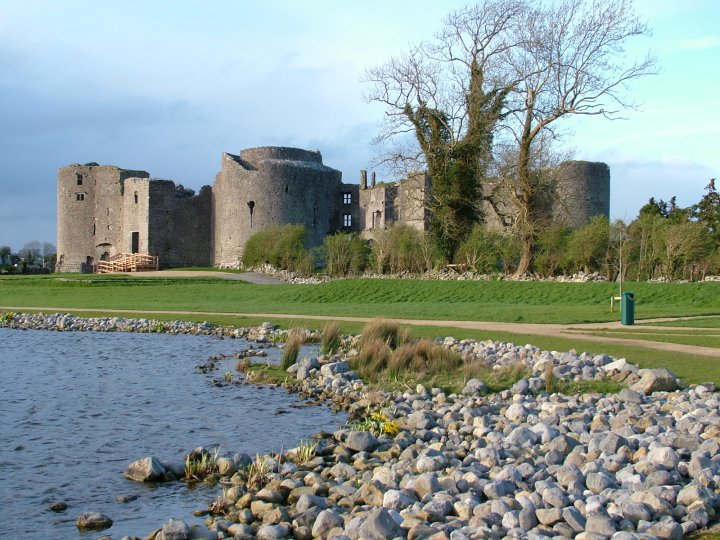
The castle occupies a rectangular site defined by four imposing D-shaped towers, each rising three stories high. Two of these towers serve as twin gatehouses, forming the main entrance. Notably, one entrance tower retains its vaulted stone roof, an architectural feature that highlights the castle's robust construction and defensive capabilities. The vaulted roofs consist of arched stone ceilings designed to support significant weight, enhancing the structure's durability.
Originally, the castle was encircled by a tall curtain wall, connecting the towers and providing a formidable barrier against attackers. Surrounding the castle at some distance was a symmetrical ditch, a trench that functioned as an additional defensive obstacle, impeding enemy advances toward the walls.
In 1578, under the ownership of Sir Nicholas Malbie, the castle underwent significant remodeling. This included enlarging window openings in both the towers and curtain walls, replacing earlier narrow arrow slits with large paired windows. These changes reflected evolving military technology and a shift toward increased comfort and light within the castle, although they somewhat reduced its defensive strength.
Later history and decline
The castle's strategic importance continued into the 16th and 17th centuries. In 1569, it was captured by Henry Sidney, the Lord Deputy appointed by the English crown, marking intensified efforts to consolidate English control over Ireland. Following this, the castle was granted to Sir Nicholas Malbie, who served as governor of Connacht under Queen Elizabeth I.
The 17th century brought further turmoil, with the castle changing hands multiple times during the Irish Rebellion of 1641 and subsequent conflicts. It sustained damage from artillery during the siege led by Oliver Cromwell in 1652. The final blow came in 1690 when a destructive fire left the castle in ruins, leading to its abandonment.
Cultural significance and preservation
Roscommon Castle is frequently mentioned in medieval Irish annals, including the Annals of Inisfallen and the Annals of the Four Masters, underscoring its importance in Irish history. Today, the castle remains a ruined but visually striking monument, with many architectural features still visible. The surviving towers, sections of the curtain wall, and the vaulted roof of one entrance tower provide valuable insights into medieval fortification techniques and the complex history of Anglo-Norman Ireland.
The castle's layout and remaining structures offer visitors a tangible connection to the past, illustrating the evolution of defensive architecture from the 13th century through the Renaissance period. Its location on a hillside enhances its commanding presence over the surrounding landscape, making it a significant heritage site in Northern Ireland.
Architectural legacy
Roscommon Castle exemplifies the Anglo-Norman hill castle typology, with its characteristic D-shaped towers designed to deflect projectiles and provide flanking fire along the curtain walls. The incorporation of vaulted stone roofs in the gatehouses reflects advanced medieval engineering aimed at enhancing the fortress's resilience.
The 16th-century modifications, including the introduction of larger windows, mark a transition in castle architecture from purely military functions to more residential and administrative roles, reflecting broader changes in the political and social landscape of Ireland under English rule.
Visiting roscommon castle
Today, Roscommon Castle is accessible to the public as a historical ruin. Visitors can explore the remains of the towers and curtain walls, gaining insight into medieval defensive strategies and the castle's layered history. The site offers picturesque views of the surrounding countryside and serves as a cultural landmark celebrating Ireland's rich medieval heritage.
Interpretive signage and guided tours may be available seasonally, providing additional context about the castle's architectural features and historical significance. Its location near the town of Roscommon makes it a convenient destination for those interested in Irish history and medieval architecture.
Frequently asked questions (FAQ)
- How do I get to Roscommon Castle?
- Roscommon Castle is located in the heart of Roscommon town, easily accessible by car or public transport. If you are traveling by car, ample parking is available nearby. For those using public transport, local buses and trains connect Roscommon to major cities in Ireland.
- What is the historical significance of Roscommon Castle?
- Roscommon Castle, built in the 13th century, is a significant medieval fortress that played a crucial role in the history of Ireland. It served as a stronghold for the ruling O'Conor dynasty and was strategically important during various conflicts. Today, it stands as a testament to the architectural and historical heritage of the region.
- When was Roscommon Castle built?
- Construction of Roscommon Castle began in the late 12th century and was completed in the early 13th century. The castle was built by the Anglo-Normans and has undergone various modifications over the centuries. Its ruins today reflect the grandeur of medieval strongholds in Ireland.
- Can I visit Roscommon Castle year-round?
- Yes, Roscommon Castle is open for visitors throughout the year, although specific opening hours may vary by season. It's advisable to check the official website for the most current visiting hours. The castle's grounds are accessible for a leisurely stroll at any time.
- Why is Roscommon Castle a popular tourist attraction?
- Roscommon Castle is popular due to its rich history, stunning architecture, and beautiful surrounding gardens. Visitors can explore the ruins, learn about medieval life, and enjoy scenic views of the countryside. Additionally, the castle's proximity to the town center makes it a convenient stop for tourists.
- Is it possible to take guided tours of Roscommon Castle?
- Yes, guided tours of Roscommon Castle are available, providing an in-depth look at its history and architecture. Expert guides share fascinating stories and insights that enhance the visitor experience. It's recommended to book tours in advance, especially during peak tourist seasons.
- What are the ticket prices for visiting Roscommon Castle?
- Entrance to Roscommon Castle is typically free for visitors, making it an affordable destination for families and history enthusiasts. However, if you opt for a guided tour, there may be a nominal fee. Always check for any special events that may have different pricing.
- What is the best time to visit Roscommon Castle?
- The best time to visit Roscommon Castle is during the spring and summer months when the weather is generally mild and conducive for outdoor exploration. Additionally, the gardens surrounding the castle are in full bloom, enhancing the visit. Autumn also offers a beautiful backdrop with changing foliage.
- Are there any nearby attractions to visit along with Roscommon Castle?
- Yes, there are several attractions near Roscommon Castle, including the Roscommon Arts Centre and the historic St. Coman's Church. The town also offers charming shops and cafes, perfect for a day out. Nearby, you can explore Lough Key Forest Park for outdoor activities and scenic walks.
Information
Website
Visit websiteSources & official resources
Verify the information above using these authoritative references.
Loading map...
Visitor reviews
No reviews yet. Been here? Write the first review and help other travelers!
Write the first reviewVisited this castle? Share your experience
Your review helps other travelers and adds first-hand knowledge to our encyclopedia.