
Roquetaillade Castle
Roquetaillade Castle stands as a remarkable example of medieval military architecture fused with 19th-century restoration artistry, located in Mazères, near Bordeaux in the Nouvelle-Aquitaine region of southwestern France. Its origins trace back to prehistoric times, evidenced by troglodyte caves and flint tools found on the site, indicating human occupation long before the medieval period. The castle’s name, meaning "carved on the rock," reflects its strategic position atop a rocky promontory overlooking the surrounding landscape.
The castle complex consists of two main parts: the Old Castle, dating from the 10th to 12th centuries, and the New Castle, built in 1306 by Gaillard de La Mothe, nephew of Pope Clement V. This lineage has maintained continuous ownership of the site for over seven centuries, passing through five family names, preserving its historical and cultural legacy.
Early history and medieval origins
The site of Roquetaillade was initially fortified during the early medieval period. According to tradition, Charlemagne established a wooden fortification here around 778 during his campaign towards the Pyrenees, marking the beginning of a defensive stronghold. This early wooden motte-and-bailey fortification was gradually replaced by stone structures between the 10th and 12th centuries, giving rise to the Old Castle.
The Old Castle featured imposing stone walls, towers, barbicans, and ramparts that protected a fortified settlement known as a castelnau. This village, first documented in 1274, developed around the castle, complete with walls, a church, and a community of bourgeois inhabitants. The gate tower, enlarged circa 1305, served as the main entrance to the castle from the village.
The fortified village and its decline
By the 15th century, the village of Roquetaillade was prosperous, rivaling nearby towns. However, the disruptions caused by the Hundred Years’ War and subsequent social changes led to its decline and eventual abandonment by the late 16th century. The Old Castle’s defensive structures remain largely intact, though some areas are now in ruins.
Construction of the new castle in 1306
In 1306, with the authorization of King Edward I of England, who controlled the region at the time, Gaillard de La Mothe constructed the New Castle within the same fortified enclosure. This new fortress was designed as a square-plan palace-fortress with six towers and a central donjon (keep), combining advanced military architecture with residential comfort.
The New Castle was equipped with innovations such as a well within the courtyard, ensuring a secure water supply during sieges, and thick stone walls for enhanced defense. This construction marked one of the earliest examples of a palace-fortress in France, reflecting the evolution of castle design from purely military to incorporating noble residence features.
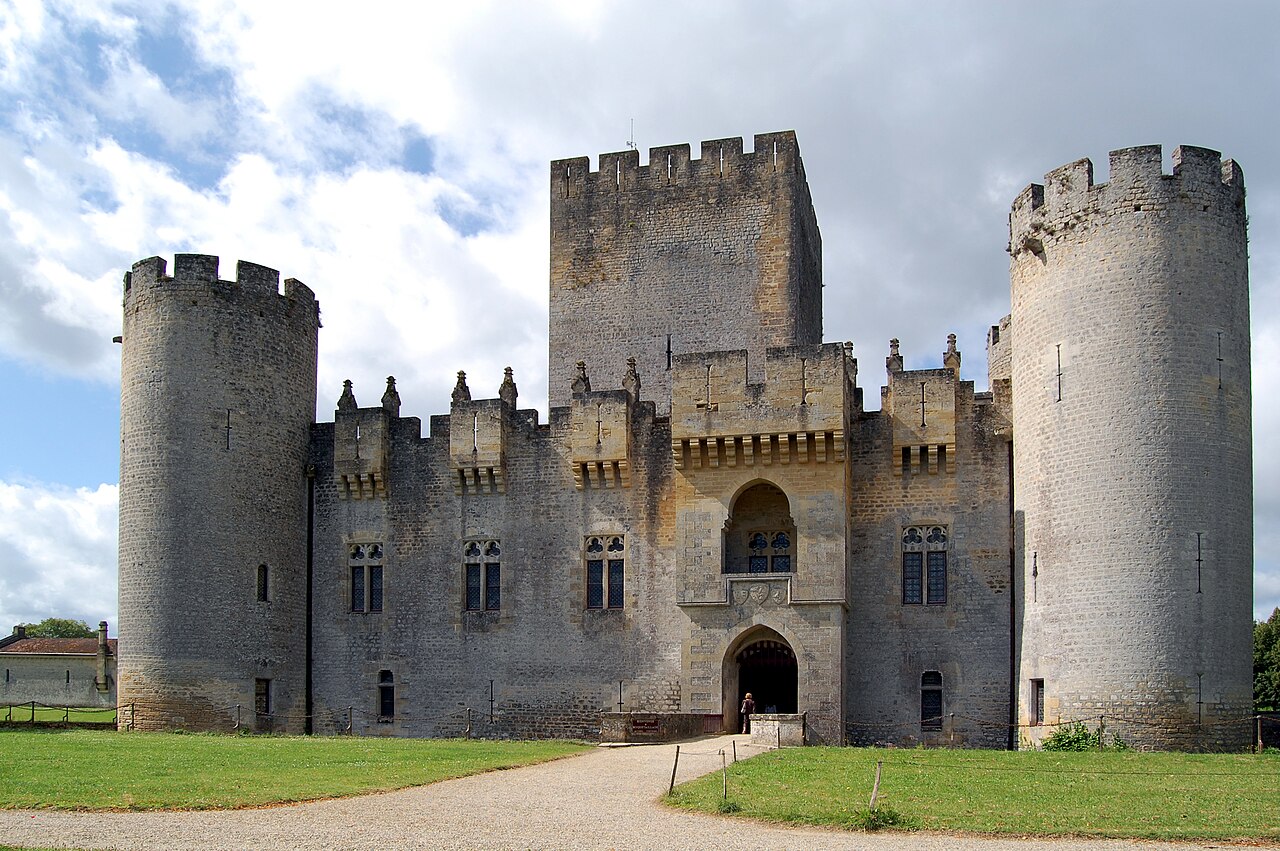
Photo by Pline • CC BY-SA 3.0
Renaissance modifications and later history
In the late 16th century, the château underwent Renaissance-style modifications under the direction of architect Pierre Souffron. These changes included enlarging windows to increase natural light and adding ornate fireplaces, blending comfort with the castle’s defensive character.
The château suffered minor damage during the French Revolution and a lightning strike at the end of the 18th century damaged the donjon. Despite these challenges, the castle remained inhabited and retained its historical importance.
19th-century restoration by Viollet-le-Duc
By the mid-19th century, the château had fallen into disrepair. The Mauvesin family, descendants of the original owners, commissioned renowned architect Eugène Viollet-le-Duc and his pupil Edmond Duthoit to restore the castle between 1864 and 1879. Their work was comprehensive, involving structural repairs, restoration of the donjon and curtain walls, and the addition of distinctive conical "pepperpot" roofs on the towers.
Viollet-le-Duc’s restoration extended to the interiors, where he designed extraordinary polychrome arabesques, fantastic bestiary motifs, and custom furniture inspired by medieval sources. These elements contributed to the château’s unique character as a masterpiece of medieval revival architecture.
Architectural features and interior decoration
The castle’s interior showcases 19th-century neo-Gothic decoration with painted ceilings, richly carved woodwork, and period furnishings. The Saint-Michel chapel, dating from the late 13th century, features a coffered ceiling with Moorish-inspired designs added during the restoration, highlighting the blend of medieval and revival styles.
Castle grounds and surrounding heritage
The château park contains remnants of the medieval curtain wall with its barbican, the Pesquey stream and its natural banks, a 19th-century chalet, and the Crampet pigeon loft. The park is part of the Natura 2000 ecological network, emphasizing its environmental as well as cultural significance.
Archaeological finds, including prehistoric flint tools, are displayed in the château’s reception area, connecting visitors to the site’s deep historical roots beyond the medieval period.
Modern use and public access
Roquetaillade Castle remains inhabited by the family of Vicomte Sébastien de Baritault du Carpia, continuing a lineage of ownership spanning over 700 years. The castle has been open to the public since 1956 and is the most visited castle in the Bordeaux region. It offers guided tours in English with the owners, providing an intimate and informative visitor experience.
In addition to its historical and architectural appeal, the château is known for its production of white Graves wines under the label "Chateaufort de Roquetaillade" and for breeding Bazadais cattle, linking the estate to regional agricultural traditions.
Film and cultural significance
The castle has served as a filming location for several movies, including "Fantômas contre Scotland Yard" and "Le Pacte des loups" (Brotherhood of the Wolf), enhancing its cultural profile and attracting cinema enthusiasts.
Recognized as a French monument historique since 1976, Roquetaillade Castle stands as a testament to the layered history of medieval fortifications, Renaissance adaptations, and 19th-century revival architecture, all preserved within a living heritage site.
Frequently asked questions (FAQ)
- What is the historical significance of Roquetaillade Castle?
- Roquetaillade Castle, located in Mazères, France, dates back to the 12th century and is a remarkable example of medieval architecture. It has played a crucial role in regional history, serving as a fortress during various conflicts and showcasing the evolution of defensive structures over the centuries.
- When was Roquetaillade Castle built?
- Roquetaillade Castle was initially constructed in the 12th century, with significant renovations and expansions occurring in the 14th and 15th centuries. Its enduring presence highlights its importance in the historical landscape of the region and reflects the architectural styles of those times.
- Can I visit Roquetaillade Castle?
- Yes, Roquetaillade Castle is open to visitors, offering guided tours that delve into its rich history and architectural features. It's advisable to check the official website for specific visiting hours and any potential restrictions.
- What are the opening hours for Roquetaillade Castle?
- Roquetaillade Castle typically opens from 10 AM to 6 PM during the tourist season, which runs from spring to early autumn. It's recommended to verify the opening hours before your visit, as they may vary seasonally or due to special events.
- Is it possible to access Roquetaillade Castle for visitors with disabilities?
- Roquetaillade Castle strives to be accessible to all visitors, although some areas may have limited access due to the castle's historical structure. It is advisable to contact the castle in advance to inquire about specific accessibility options and facilities.
- What is the best time to visit Roquetaillade Castle?
- The best time to visit Roquetaillade Castle is during the spring and fall when the weather is mild, and tourist crowds are smaller. These seasons provide a comfortable experience to explore the castle and enjoy the surrounding landscapes.
- Are there any nearby attractions to Roquetaillade Castle?
- Yes, visitors can explore several nearby attractions, including the charming village of Mazères, which offers local shops and restaurants. Additionally, the scenic countryside of Occitanie provides opportunities for hiking and enjoying nature.
- What are the ticket prices for Roquetaillade Castle?
- Ticket prices for Roquetaillade Castle typically range from €8 for adults, with reduced prices for children and seniors. Group rates and family tickets may also be available, so it’s best to check the official website for the latest pricing information.
Photo gallery

Information
Website
Visit websiteSources & official resources
Verify the information above using these authoritative references.
Loading map...
Visitor reviews
No reviews yet. Been here? Write the first review and help other travelers!
Write the first reviewVisited this castle? Share your experience
Your review helps other travelers and adds first-hand knowledge to our encyclopedia.